NASA’s Swift rescue mission is the kind of space story that sounds like science fiction until the schedule, hardware and risk make it very real.
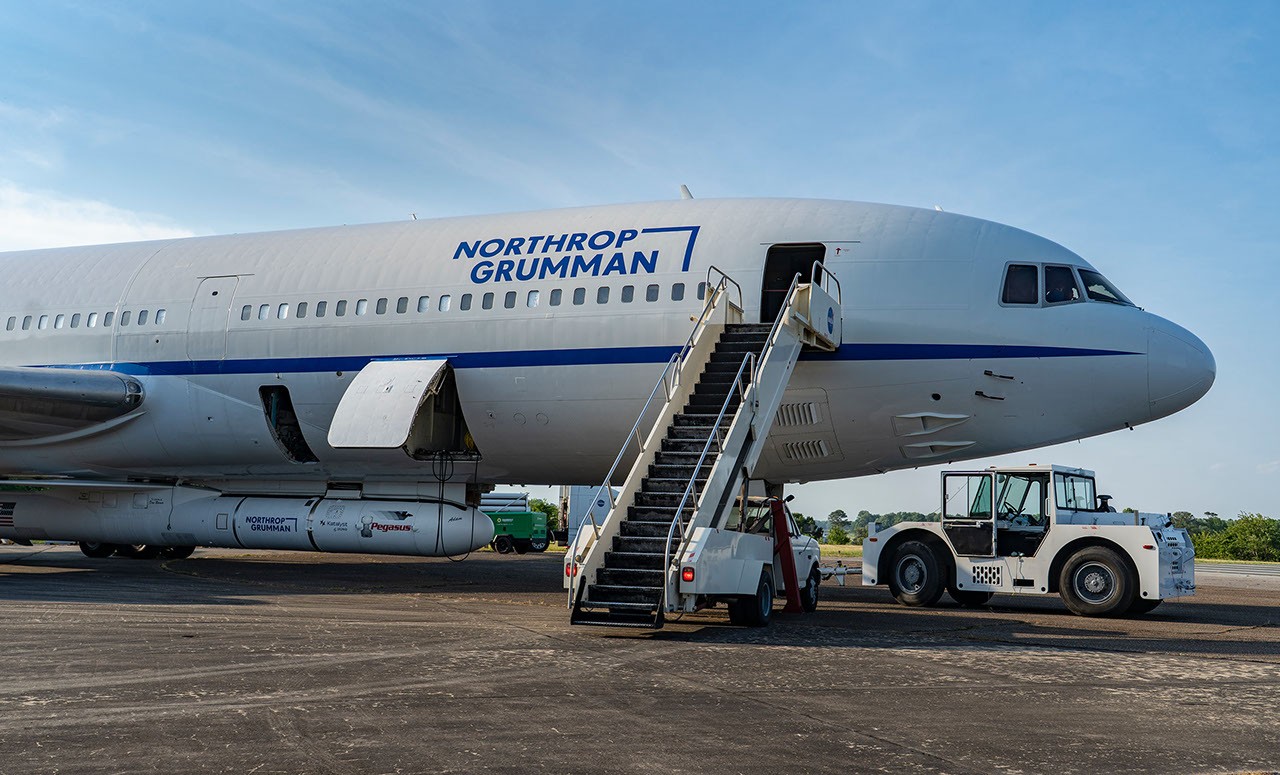
On July 3, 2026, Northrop Grumman’s Stargazer aircraft released a Pegasus XL rocket over Kwajalein Atoll in the Marshall Islands. The rocket carried LINK, a robotic servicing spacecraft built by Katalyst Space, into low Earth orbit. NASA later said teams had successfully established communications with LINK, giving the mission its first in-orbit checkpoint.
The target is NASA’s Neil Gehrels Swift Observatory, a 21-year-old astrophysics satellite that studies gamma-ray bursts and other high-energy cosmic events. Swift has no propulsion system for maintaining its own orbit. Recent solar activity increased atmospheric drag, making the spacecraft sink faster than expected.
GearPulse’s view: this matters because satellite rescue is moving from a PowerPoint promise to a live, high-stakes operation. If LINK works, NASA gets more science from Swift and the industry gets a clearer case for servicing valuable spacecraft instead of treating them as disposable.
The rescue is urgent, but not simple
NASA’s mission page lays out the basics: LINK must approach Swift, survey the observatory, capture it, and raise its orbit over several months. That is not the same as docking with a cooperative spacecraft that was designed for servicing. Swift was launched in 2004, long before this kind of commercial rescue attempt became a mainstream business case.
The operational sequence matters because each step carries a different kind of risk.
| Mission phase | What has to happen | Why it matters |
|---|---|---|
| Launch and deployment | Pegasus XL delivers LINK to low Earth orbit | Puts the servicing craft on the right path before Swift drops too low. |
| First contact | Teams confirm communications, power and spacecraft health | NASA says this checkpoint is complete. |
| Checkout | Katalyst tests propulsion, sensors and navigation | These systems decide whether LINK can safely approach Swift. |
| Survey | LINK inspects the 21-year-old observatory | The spacecraft needs a workable capture plan around hardware not built for this. |
| Capture and boost | LINK grabs Swift and raises its altitude | This is the proof point for practical orbital servicing. |
NASA awarded Katalyst the Swift contract in September 2025, leaving the company less than a year to design, build, test and launch the servicing craft. That speed is part of the story. A normal replacement mission would be slower and far more expensive. A rescue mission only helps if it can move on the same timescale as the problem.
Swift is worth saving
Swift is not a glamorous new flagship. That is exactly why the mission is interesting.
The satellite has been working since 2004 and can observe the universe in visible, ultraviolet, X-ray and gamma-ray light. NASA calls it an astrophysics multitool, which is a useful phrase because Swift’s value is not just one instrument or one famous image. It is speed and flexibility: catching violent cosmic events fast enough that other telescopes can follow up.
If Swift re-entered the atmosphere, NASA would lose a working science asset. The replacement question is not just “could another telescope do some of this work?” It is “how much would it cost, how long would it take, and what observations would be missed while waiting?”
That is why the economics are easy to understand even if the engineering is hard. Saving a useful spacecraft can be cheaper than recreating its capabilities from scratch.
The bigger product is orbital servicing
The phrase “space infrastructure” gets thrown around too easily, but this is a clean example of what it should mean. A mature space economy needs repair, refueling, reboosting and life-extension services, not only launches and new satellites.
Swift gives Katalyst and NASA a real test case. It is an active spacecraft with real scientific value, an urgent orbital-decay problem, and no built-in servicing fixture that makes the capture trivial. That combination is uncomfortable, but it is also more useful than a low-risk demonstration.
The caveat is that success is not guaranteed. LINK still has to complete checkout, navigation, approach, survey and capture. A safe approach matters more than dramatic speed, because Swift is the asset NASA is trying to protect. A failed or rushed capture attempt could turn a rescue into a new hazard.
The practical lesson for readers is that the next era of space technology may look less like “launch a new thing” and more like “keep the expensive thing working.” That is less romantic than a fresh spacecraft, but it is how infrastructure becomes durable.
Bottom line
NASA’s Swift boost mission is relevant because it asks a direct question: can a commercial spacecraft rescue a valuable government satellite that was not designed around modern servicing?
The first answer is encouraging. LINK launched on July 3, reached orbit, and made contact. The hard part is still ahead.
GearPulse’s read: if Katalyst can capture and raise Swift safely, this mission will matter beyond one telescope. It will make satellite servicing feel less like an experimental niche and more like a practical maintenance layer for space hardware we cannot afford to throw away.