
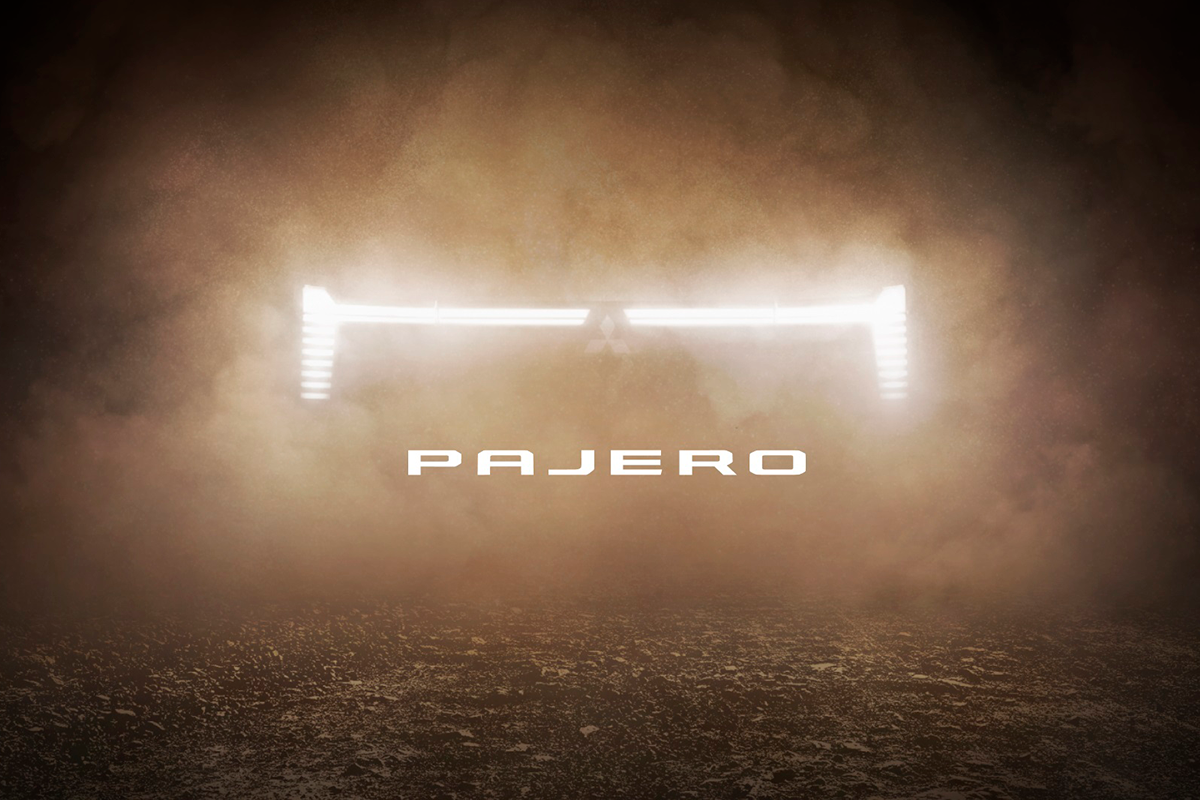
Mitsubishi bringing back the Pajero would have been interesting even if the company had only shown a shadowy SUV teaser. The more useful signal is smaller: the new Pajero is getting an off-road information display that looks designed for actual trail use, not just nostalgia.
That matters because revived badges are easy. Reviving the point of a badge is harder.
Mitsubishi’s official release says the all-new Pajero cross-country SUV will debut in autumn 2026. Motor1’s follow-up on the latest teaser adds the practical detail: the reborn Pajero is expected to use a digital take on Mitsubishi’s old Multi Meter, showing information such as pitch, roll, altitude, compass heading, and torque distribution.
That is not a complete spec sheet. It is still a teaser. But it is the right kind of teaser.
What Mitsubishi has confirmed
Mitsubishi has confirmed the name, the autumn 2026 debut window, and the positioning: this is an all-new Pajero cross-country SUV. The official image pack also makes clear that the company is leaning into the old Pajero’s identity rather than pretending the badge has no history.
The missing details are just as important. Mitsubishi has not published final engine specs, dimensions, markets, trim names, prices, or launch timing beyond the debut window. Reports have tied the new Pajero to a more serious off-road architecture, but buyers should treat anything beyond the official announcement as provisional until Mitsubishi publishes the full reveal.
| Item | What is known now | What is still unresolved |
|---|---|---|
| Name | All-new Pajero | Whether every market uses Pajero or Montero branding |
| Reveal timing | Autumn 2026 | On-sale dates by market |
| Positioning | Cross-country SUV | Final trims and equipment |
| Off-road display | Digital Multi Meter-style feature reported from teaser material | Exact screen location and interface |
| US arrival | Not officially confirmed in Mitsubishi’s global release | Dealer-report timing and naming remain unverified |
That caution is necessary because the Pajero name carries a lot of emotional weight. A vague lifestyle crossover with the badge would be easy to market and disappointing to enthusiasts. The early signals suggest Mitsubishi knows that.
Why the screen matters
An off-road screen sounds like a small feature until you compare it with the usual modern SUV interface. Many vehicles bury useful trail information inside menus, widgets, or drive-mode pages that are more decorative than practical.
A dedicated Multi Meter-style setup has a different job. It should tell the driver what the vehicle is doing when the road is no longer flat, paved, or predictable.
| Data point | Why an off-road driver cares |
|---|---|
| Pitch angle | Helps judge steep climbs and descents. |
| Roll angle | Gives clearer feedback on side slopes. |
| Altitude | Useful context in mountain driving. |
| Compass heading | Helps when trails and maps are not enough. |
| Torque distribution | Shows how the 4WD system is reacting. |
None of that makes the Pajero automatically good. A screen cannot compensate for poor suspension tuning, weak underbody protection, bad tire choices, or a drivetrain that overheats under load. But it does show Mitsubishi is talking to the old Pajero audience in the language that audience understands.
The bigger product question
The Pajero has to land in a strange market. Traditional off-roaders are having a moment, but buyers also expect modern safety tech, better infotainment, reasonable refinement, and some level of electrification story. The Toyota Land Cruiser, Ford Bronco, Jeep Wrangler, Ineos Grenadier, and a wave of body-on-frame SUVs have trained people to ask harder questions.
Mitsubishi does not need the Pajero to beat every one of those vehicles on every metric. It needs the Pajero to feel credible.
That means real 4WD capability, sensible approach and departure angles, useful ground clearance, a cabin that can handle mud and family use, and powertrain choices that fit the markets Mitsubishi wants to reach. If the company also brings back the right visual cues, that is a bonus. The fundamentals matter more.
Do not overread the Montero rumors yet
Some coverage connects the Pajero’s return with a future Montero for North America. That would make sense historically, because the Pajero name has not always been used everywhere. But Mitsubishi’s official global release does not give a clean US launch plan, price, or dealer timing.
So the safe read is simple: the Pajero is officially coming back, the debut is set for autumn 2026, and North American details are still a separate question.
That uncertainty does not weaken the story. It is the story. Mitsubishi has an opportunity to turn a respected badge into a real modern off-roader, but it has not yet shown enough to prove the whole product.
Bottom line
The new Pajero’s off-road screen is a promising sign because it points to intent. Mitsubishi is not just teasing a familiar name; it is teasing the kind of functional detail that made the old Pajero make sense.
The caveat is that a good display is not a good SUV. The autumn 2026 reveal still needs to answer the hard questions: platform, powertrain, markets, pricing, durability, and whether this is truly built for rough ground.
For now, Mitsubishi has done the important first thing. It has made the Pajero comeback look less like badge recycling and more like a serious attempt to remember what the badge was for.