
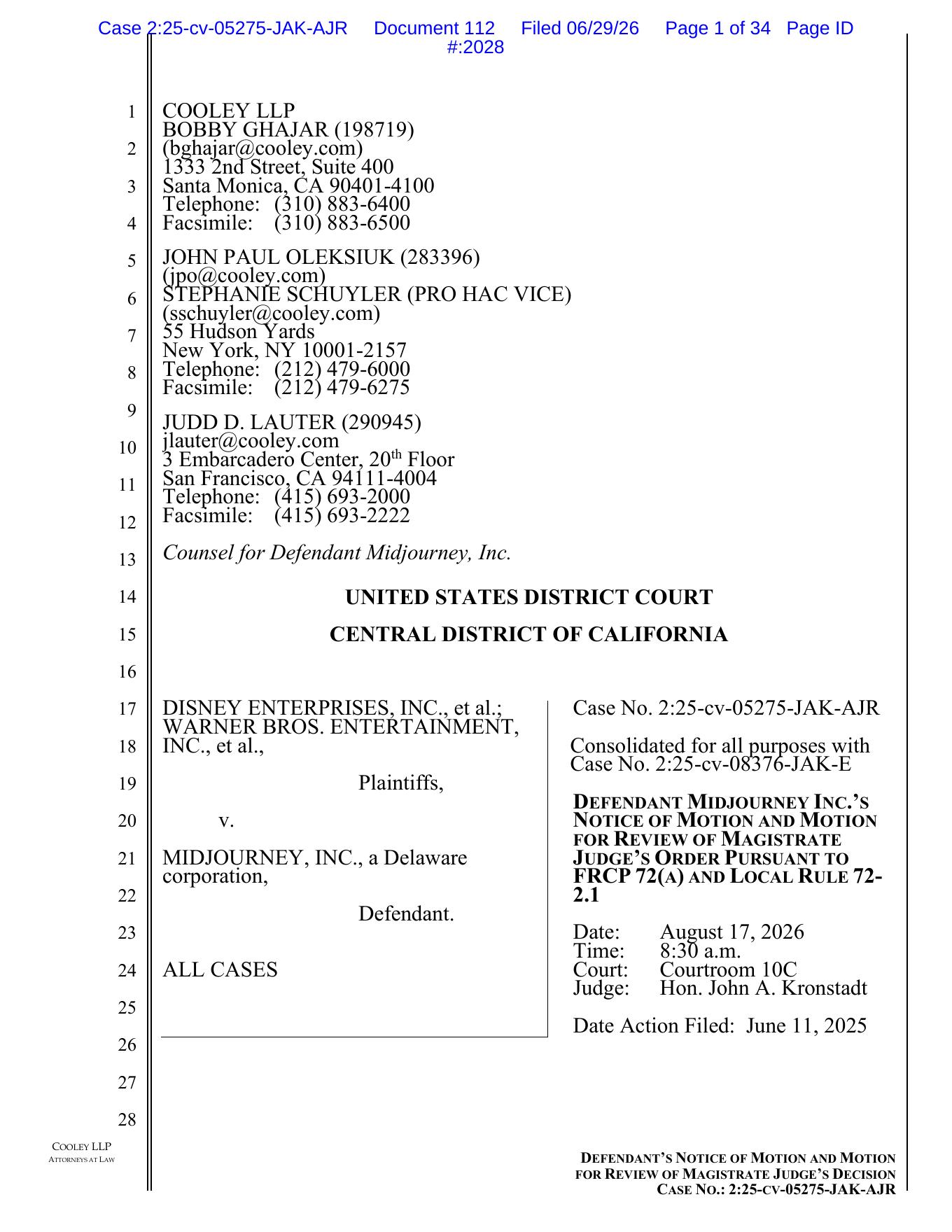
Midjourney’s latest move in the Hollywood copyright fight is not subtle: if the studios are suing over generative AI, Midjourney wants the court to make them show more about how they use generative AI themselves.
TechCrunch reports that Midjourney is seeking to overturn limits on discovery in the case involving Disney, Universal and Warner Bros. The public filing linked through CourtListener asks the district judge to review a magistrate judge’s order that, according to Midjourney, lets the studios produce only a narrower slice of their own AI-use documents.
GearPulse’s view: this is relevant because the AI copyright debate is becoming less abstract. The courtroom question is not just whether Midjourney outputs infringing images. It is also what evidence counts when studios claim market harm while also experimenting with generative tools inside their own businesses.
What Midjourney is asking for
The current dispute is about discovery, not the final answer to copyright liability. That distinction matters.
The studios allege that Midjourney’s image-generation service infringes major entertainment IP. The original Disney/NBCUniversal complaint, filed in 2025, targeted alleged reproductions and derivatives involving characters and franchises owned by the plaintiffs. Warner Bros. later joined the broader fight with its own claims.
Midjourney’s latest filing argues that the studios’ own generative-AI use is relevant to defenses, market-harm analysis and industry custom. TechCrunch summarizes the dispute this way: the previous order required information about generative-AI usage only when it led to consumer-facing videos and images, while Midjourney wants broader internal documents, prompts and outputs.
That is a very lawyerly fight. It is also the kind of fight that can shape the practical record around AI.
| Issue | Why it matters |
|---|---|
| Consumer-facing AI output | Shows whether studios released AI-assisted work to audiences. |
| Internal AI ideation | Could show whether AI is treated as ordinary production tooling. |
| Training or development documents | Could bear on arguments about industry practice and market effects. |
| Midjourney prompts by studio users | Could reveal whether plaintiffs or vendors used the same tool at issue. |
| Discovery limits | Decide what evidence reaches the record before bigger rulings. |
None of this means Midjourney wins the case. Discovery relevance is not the same as permission to infringe. But what the court allows into the record can change the story both sides get to tell.
The “everyone uses AI” defense has limits
Midjourney’s argument is politically potent because Hollywood has spent the last few years sending mixed signals about AI. Studios want strong copyright protection against unauthorized character generation. At the same time, parts of the entertainment pipeline are testing AI for ideation, previsualization, localization, marketing, cleanup and internal workflow.
That tension is real. It does not automatically make the studios hypocrites.
Using an AI tool internally is not the same as training a commercial model on copyrighted work. Using AI for storyboards is not the same as selling images of someone else’s protected characters. And a studio vendor experimenting with Midjourney does not settle whether Midjourney’s product crosses a legal line.
Still, the evidence matters. If a studio says generative AI damages a market, the court may want to know how that studio defines acceptable and unacceptable AI use in practice. If internal teams use prompts, outputs or training workflows that resemble what they criticize, the distinction has to be explained with more than press-release language.
Why this matters outside Hollywood
The Hollywood case is about famous characters, but the discovery fight has a wider audience: every company trying to write AI policy while also using AI.
There is a pattern here that will repeat in music, games, publishing, advertising and software:
| Company position | Hard question |
|---|---|
| ”Do not train on our work without permission.” | What internal AI training or fine-tuning does the company permit? |
| ”AI outputs can harm our market.” | Is the company using AI outputs to reduce production cost? |
| ”Our characters and style are protected.” | How does the company police AI use by vendors and contractors? |
| ”We support responsible AI.” | What records prove the policy is actually followed? |
The better version of this debate is not “AI is theft” versus “everything is fair use.” The better version is specific: what data, what tool, what output, what market, what permission and what harm?
That is why discovery fights are important. They force broad claims into documents, prompts, workflows and dates.
The caveat: courtroom strategy is not moral clarity
Midjourney benefits from making the studios look inconsistent. The studios benefit from keeping the case focused on alleged infringement by Midjourney. Both incentives are obvious.
Readers should be careful not to confuse a clever discovery argument with a full legal defense. Even if the studios use generative AI internally, a court could still find that Midjourney’s conduct is infringing. Conversely, even if Midjourney’s broader discovery request is limited, that would not prove the studios’ copyright theory is right.
What the filing does show is that generative-AI lawsuits are no longer only about training-data headlines. They are becoming audits of real creative workflows.
Bottom line
Midjourney’s discovery fight is relevant because it pushes the Hollywood AI copyright case toward evidence about actual industry behavior. The question is not just whether studios dislike AI. It is how they use it, when they use it, what they tell vendors, and whether those facts matter to market-harm and fair-use arguments.
GearPulse’s read: this is where the next phase of AI law gets more uncomfortable and more useful. The public debate has been heavy on slogans. The courts are going to ask for documents.
For creators and tech users, that is the important shift. AI policy will not be judged only by what companies say they believe. It will be judged by what their teams, tools and records show they actually do.