
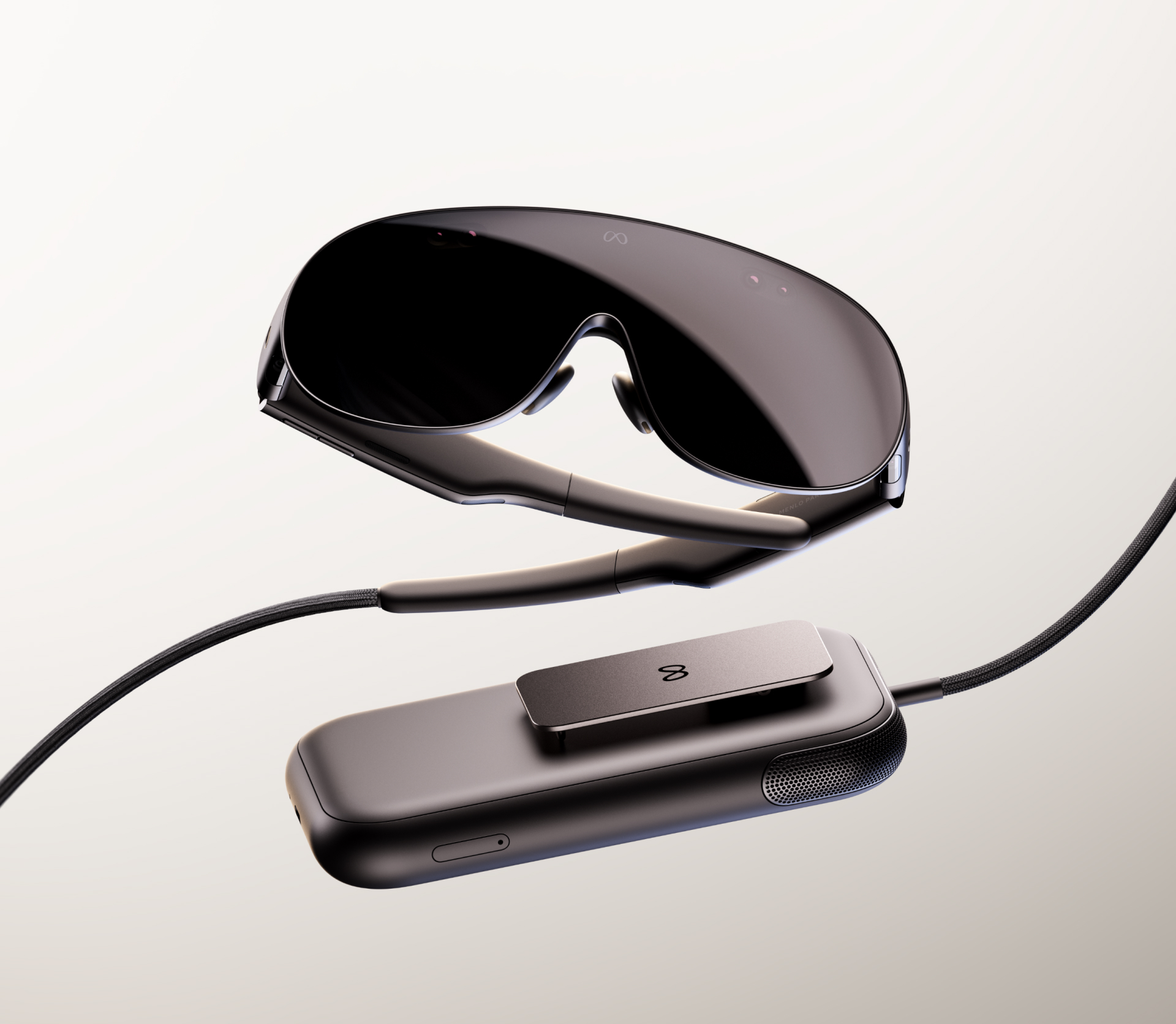
Meta’s new VR Glasses make an unusually clear hardware trade: take the hot, heavy parts off the face and put them in a wired puck that clips to a pocket or bag.
That trade produces the headline figure—about 100 grams on the face, according to Meta, versus a much heavier self-contained headset. It may be the most sensible direction VR hardware has taken in years. But it also replaces a familiar problem, headset bulk, with a more personal one: whether people will accept a cable and a separate battery every time they want a private cinema or floating workspace.
Meta says the glasses will ship in Spring 2027 for $1,299.99 in the US. They are not a lighter pair of Ray-Bans and should not be confused with a simple display accessory. This is a full VR computer split across the glasses and a tethered compute module. Axios and Road to VR’s early demos both confirm the central design choice: the small frame is enabled by a wired puck containing the processor, battery and storage.
The specification that matters is where the weight went
Meta calls the device a two-part system. The frame carries displays, sensors and audio; the optical tether leads to the pocketable module, which carries compute, battery and storage. Meta says the glasses use micro-OLED displays, its 5K Infinite Display branding and 37 pixels per degree, while its developer documentation lists a nominal straight-ahead field of view of 70 degrees horizontal by 66 degrees vertical.
| Claimed detail | What it could improve | The boundary to remember |
|---|---|---|
| About 100 g on the face | Less pressure on cheeks and forehead during a film or work session | The total system is not 100 g once the puck and cable are included |
| Wired compute puck | Lets Meta move heat, battery and storage away from the frame | A tether can snag, pull and become another object to carry |
| 5K micro-OLED, 37 pixels per degree | Better text legibility and movie detail than older standalone VR | Comfort, lens fit and visible field of view still decide the lived experience |
| Up to three hours of high-resolution playback | Long enough for many films and travel sessions | This is Meta’s claim, not an independently measured mixed-use runtime |
| Eye, hand and voice input | Removes the need to hold controllers for basic navigation | Gesture recognition and passthrough need to prove dependable outside a demo |
The cable is not a cosmetic footnote. It is the engineering answer to a hard constraint: a headset needs serious compute and a battery, but faces are poor places to carry either for long. For a seated movie, desk work or a flight, routing that weight to a pocket may be a fine bargain. For exercise, room-scale games, crowded spaces or any situation where a cable catches on furniture, it can be a much less elegant one.
A private screen is the credible first use
Meta’s launch story covers cinema, sport, work, games and hologram calls. Some of that is necessarily forward-looking: the device is months from sale, its media catalogue is still forming and Meta’s promised more-than-100 immersive annual sports events are a launch-era target rather than a service anyone can judge today.
The most believable daily use is narrower. A high-quality, private screen that can follow a traveler, a shared household member or someone who lacks desk space has an immediate appeal. Meta also says users will be able to turn a flat surface into a keyboard and touchpad, with full-color passthrough keeping the real desk and phone visible. That is an interesting workspace idea, but it raises a standard higher than a movie player: text must be comfortable, hand input must be accurate, and the tether must stay unobtrusive through a real work block.
This is why Meta’s developer field-of-view number is worth reading alongside the marketing imagery. A nominal 70-by-66-degree view can be useful for designing an application, but it is an upper-bound measurement; fit, eye position and gaze can shrink what a person comfortably sees. Pixel density alone does not settle whether a virtual monitor feels effortless.
The buyer question is not whether this is “real VR”
It plainly is: Meta is promising PC-class processing through Qualcomm’s Snapdragon Reality Elite, controller-free input, 75-plus hand-gesture games at launch and optional Xbox Cloud Gaming. The better question is whether the form factor makes VR more available at the exact moments a conventional headset is too much trouble to fetch and wear.
That is a useful contrast with our earlier look at Meta AI glasses and their feature limits. Those glasses try to keep computing almost invisible, but accept major limits in display and immersion. VR Glasses go the other way: they promise a serious visual computer, then make the power system deliberately visible as a pocket puck. Neither compromise disappears; each puts it in a different place.
There are three practical reasons to wait for independent testing before treating the announcement as a buying recommendation:
- Battery behavior: Three hours of continuous high-resolution media playback is not the same as a day of work, mixed reality or gaming.
- Tether behavior: We need to know how the cable feels when standing, reaching, traveling and charging—not just sitting for a guided demo.
- Software behavior: The device’s value will hinge on regional app availability, media partnerships, account requirements and whether its promised keyboard, hand and eye controls remain calm under everyday use.
Bottom line
Meta VR Glasses have found a compelling way to make a VR device lighter where human comfort matters most: on the face. The resulting system is less a magical pair of glasses than a carefully distributed computer, and that is exactly why it could work.
At $1,299.99 and with a Spring 2027 release, it is not a purchase decision today. It is a promising design thesis. If Meta can make the puck and tether disappear into normal routines—and deliver credible battery, display comfort and software support—the company may finally have a VR form factor people want to use beyond a short session. Until then, the cable is not a flaw to ignore; it is the feature that must earn the whole product.