
Cloud AI is convenient until the bill, the data boundary or the model change becomes the story.
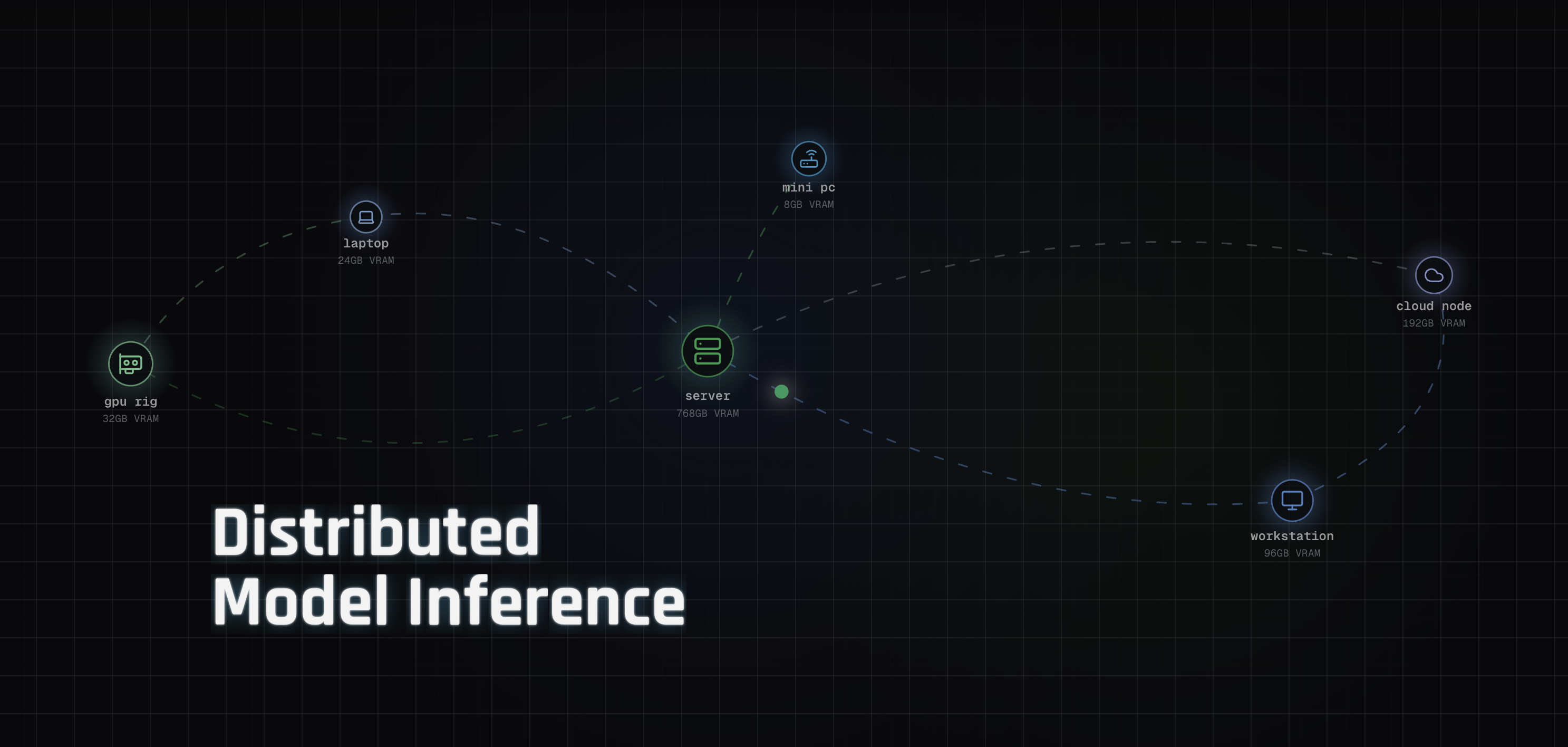
Mesh LLM is trying to answer a narrower question: what if the GPUs already scattered across a homelab, office, workstation fleet or small server room could act like one inference pool? The project, described in a new Iroh post, uses Iroh’s peer-to-peer networking layer to connect machines and expose the result as an OpenAI-compatible endpoint.
GearPulse’s view: this is relevant because local AI is no longer only about ideology. It is becoming an infrastructure choice. Some teams want lower recurring costs, predictable model versions, private data paths or better use of idle hardware. Mesh LLM is interesting because it treats that as a routing and operations problem, not just a model-download problem.
What Mesh LLM does
The pitch is simple: start one node, add more later, and let the mesh decide whether a request runs locally, routes to a peer or splits a large model across several machines.
Iroh says Mesh LLM presents itself as a local OpenAI-compatible API. Its blog points users at localhost:9337/v1; the Mesh LLM website uses the same idea with OPENAI_BASE_URL for existing tools. The GitHub repository describes quick-start flows for installing the executable, running setup, joining a public mesh and serving models.
| Capability | Public source claim | Why it matters |
|---|---|---|
| Local endpoint | OpenAI-compatible API on localhost | Existing clients can be pointed at the mesh with less rewriting. |
| Routing mode | Requests can be served by a peer that already has the model loaded | Useful when one machine is better suited to a model than another. |
| Split mode | Large models can be partitioned into layer stages | Lets several smaller machines attempt jobs one machine cannot hold. |
| Network layer | Iroh provides authenticated QUIC connections with NAT traversal and relay fallback | The hard part is often reaching machines reliably, not only loading weights. |
| Model catalog | Mesh LLM lists many quantized model references and hardware classes | Makes the project easier to test than a bare research prototype. |
The Iroh post also describes protocol details: a main mesh-llm/1 connection for gossip, routing, HTTP tunnels, plugin channels and peer events; a control ALPN; and a skippy-stage/2 transport for split model activations. That is the signal that this is not just a demo page wrapped around a single local model.
Where this helps
Mesh LLM is not a magic replacement for frontier hosted models. Cloud APIs are still easier, faster to start, and often stronger for general use. The value is different: control.
If a small team has a Mac Studio, a gaming PC, a Linux box with an older GPU and a server with more memory, each machine is useful in isolation but awkward as a shared AI backend. Mesh LLM’s promise is that the team can pool those resources without forcing every app to understand every machine.
| Scenario | Why a mesh helps | Remaining caveat |
|---|---|---|
| Homelab experimentation | Uses machines already on the network | Performance will depend on network quality and model fit. |
| Small business AI tools | Keeps some inference under local control | Admins still need update, access and observability discipline. |
| Developer agents | OpenAI-compatible endpoint lowers integration cost | Tool output quality depends on the selected local model. |
| Large local models | Layer splitting can use several modest GPUs | Activation traffic and latency can become the bottleneck. |
| Privacy-sensitive workflows | Data can avoid a third-party hosted model path | Private deployment still needs security review and policy. |
This is the right level of ambition for local AI in 2026. The credible claim is not that everyone should stop using cloud models. The credible claim is that more teams should be able to choose when cloud AI is worth it.
The practical caveats
Distributed inference has sharp edges. Splitting a model across machines is not the same as adding more cores to a desktop app. You have to move activations between stages, handle peer failures, keep model versions aligned, warm the right nodes and decide which requests deserve which hardware.
Mesh LLM’s use of Iroh helps with connectivity, identity and direct authenticated transport. It does not remove the need for operational judgment. A public mesh may be useful for experimentation, but businesses will care more about private meshes, access control, auditability, model provenance and failure modes.
There is also a buyer-style caveat even though this is open-source infrastructure: “free” local inference is not free if it requires expensive GPUs, power, cooling and maintenance. The strongest case is for teams that already own hardware or need a specific data-control posture.
The bottom line
Mesh LLM is compelling because it makes local AI feel less like a single-machine hobby and more like infrastructure.
The audience lesson is practical. If AI agents and coding tools are becoming part of daily work, then inference location becomes a strategic choice. Sometimes the right answer is a hosted frontier model. Sometimes it is a smaller local model. Sometimes it may be a mesh of machines already sitting nearby.
Mesh LLM will need real-world benchmarks, security hardening and operational proof before it becomes boring infrastructure. But the direction is useful: give developers a local endpoint, hide the routing complexity, and let existing hardware do more work before the next cloud bill arrives.