
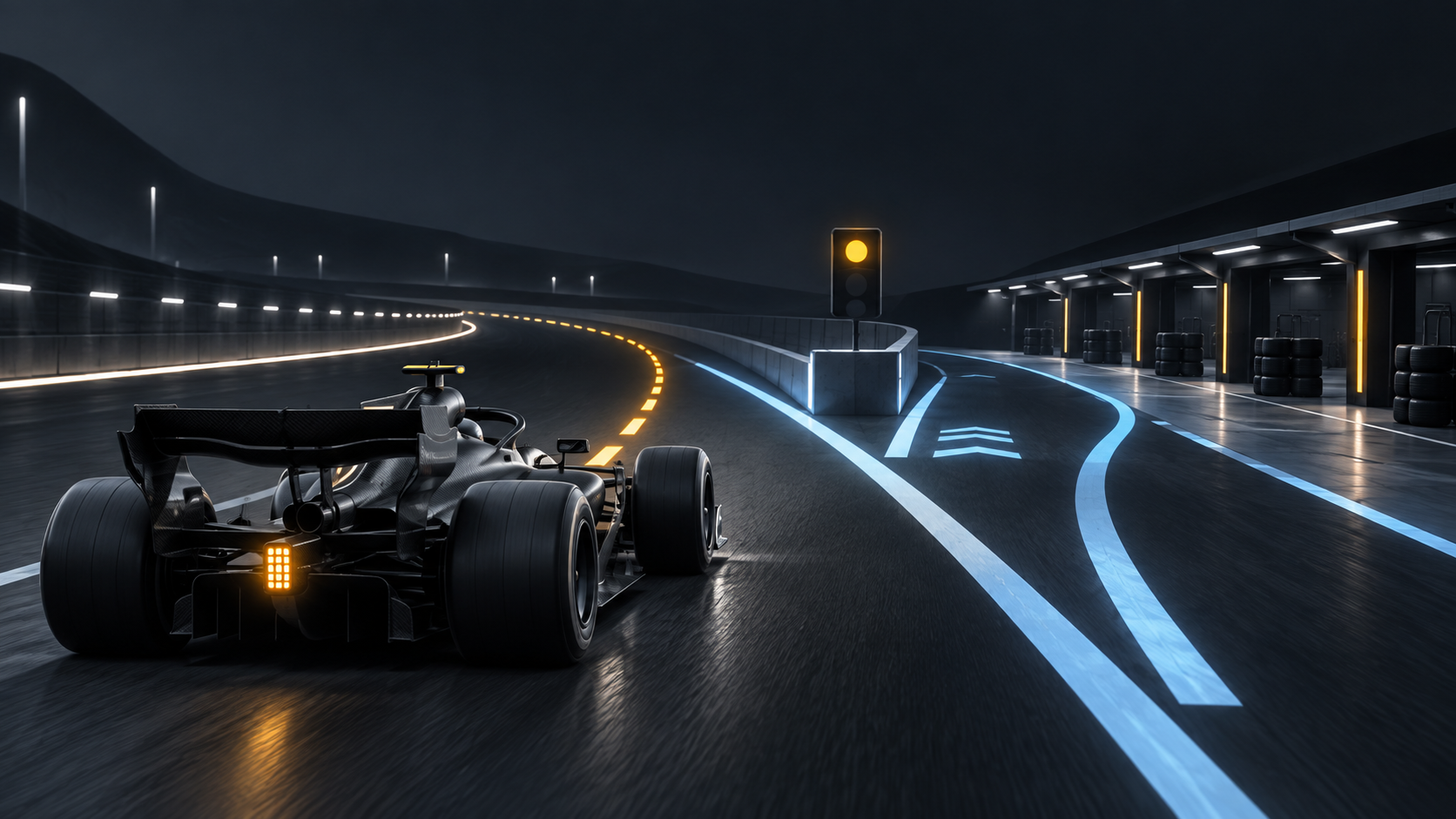
Kimi Antonelli’s Madrid victory looked, from a distance, like the sort of Formula 1 moment people call instinct. A car stops, yellow flags appear, the Virtual Safety Car arrives at precisely the useful time, and the eventual winner happens to be at the pit entry.
Mercedes’ new account makes that reading too romantic. The winning move was not clairvoyance; it was readiness.
In the latest Nu Silver Arrows Radio Show, trackside engineering director Andrew Shovlin explained that Mercedes uses changing code words to tell drivers when a Safety Car or VSC scenario might be worth considering, while keeping the detail from rivals listening to the radio. That is not an exotic loophole. It is the useful, unglamorous part of elite race operations: decide the priorities before a race becomes loud enough to make good decisions difficult.
At Madring, that preparation met a very narrow opening. Motorsport.com reports that the first yellow flag for Lance Stroll’s stopped Aston Martin came 35 seconds before the VSC was called. Antonelli eased significantly through the affected sector after Peter Bonnington’s warning, buying enough time to reach the pit lane once the neutralisation arrived. Mercedes then double-stacked Antonelli and George Russell. Just 15 seconds separated the VSC call from Antonelli reaching his box.
That is a tiny interval in which a win can change hands.
A code word does not replace a strategy
The phrase “secret code” is fun, but it can mislead. No one at Brackley has revealed a magic instruction that manufactures a cheap pit stop. A VSC creates the same lower-time-loss opportunity for every team whose car is in range. The difference comes from whether the driver, pit wall and crew have already agreed what counts as “in range,” and whether they can act without a fresh committee meeting at 300 km/h.
Shovlin said Mercedes maps possible neutralisation responses in its Sunday-morning preparation. That matters because a VSC decision has several moving parts at once:
| The question | What has to be ready |
|---|---|
| Is the driver close enough to pit? | A pre-calculated window, communicated simply enough to use under pressure. |
| Is stopping actually better? | Tyre condition, race position, traffic and the remaining stint all have to point the same way. |
| Can the team service two cars? | The crew needs both tyre sets and a clear double-stack order before the cars arrive. |
| What if the VSC never comes? | The driver cannot throw away a sector on a hunch; the response must remain legal and proportionate to the flags shown. |
That last point keeps the Madrid move in perspective. Antonelli did not know the VSC was guaranteed. He reacted to a yellow-flag situation and an engineer’s warning that the safety-car window was possible. The FIA’s race report records the consequence—Antonelli won ahead of Max Verstappen, with Lando Norris third—but it does not turn a conditional call into foreknowledge.
The distinction matters because it is exactly where teams earn their reputation. Formula 1 is full of cars that have the raw pace to lead. Far fewer create an environment in which a driver can recognise an opportunity, preserve the option and trust the pit wall to complete it.
The extra second was the real asset
Our analysis of Ferrari’s late-stop gamble in Madrid examined what happens when a team keeps an unconventional route alive while waiting for the race to shift. Mercedes played a different version of the same strategic game: it made itself available to an opportunity before that opportunity became definitive.
Antonelli’s extra lift through the yellow-flag area was not spectacular to watch, and it did not make the VSC happen. It did something more useful: it prevented the pit entry from disappearing before race control made its decision. Once that option survived, Mercedes’ preparation turned it into track position.
The double-stack sharpens the point. Calling one car in under a VSC is difficult enough; calling both means the second driver must not lose so much time in the queue that the nominal saving vanishes. Shovlin’s account, backed by Motorsport.com’s reconstruction, says the tyres were arriving as Antonelli stopped. That is a picture of a crew reacting fast, but it is also evidence of a process designed for exactly that sort of reaction.
Norris’s side of the story is the useful caveat. Formula 1’s subsequent analysis focused on how the VSC timing cost McLaren a likely route to victory. Timing always has an element of luck: Stroll stopping when he did was not created by Mercedes, and no pre-race plan can put every competitor on the favourable side of a neutralisation.
Preparation cannot control the trigger. It can control whether a team wastes the moment after it appears.
Why this matters beyond one Madrid afternoon
Mercedes now leads both championships, and Antonelli’s 292 points after Spain put him 81 ahead of Russell, according to the official standings reflected in the FIA result. That gap makes it tempting to describe every successful Mercedes decision as inevitable. Madrid was a better reminder that dominance still has a human operating system underneath it.
The team is not winning merely because it has a quick W17. It is winning because it has reduced the number of seconds in which driver, engineer and crew need to improvise independently. Its weekly changing codes are a small detail, but they reveal the larger habit: make the complicated decision early, then communicate it in a form that can survive a yellow flag, a pit-entry line and a crowded radio channel.
There is no reason to assume the same routine will always beat rivals. A VSC can fall at the wrong end of the lap, traffic can ruin a fresh-tyre stop, and a double-stack can become a costly queue. Mercedes also cannot plan its way around a car that is fundamentally slower.
But in a season already decided by small margins, Madrid showed the competitive value of converting preparation into action. The yellow flag gave Antonelli a chance. Mercedes made sure the chance had somewhere to go.
GearPulse’s bottom line: the winning call was not a clever phrase on the radio. It was a rehearsed chain of decisions that left Antonelli with one extra second, then used it perfectly.