
Mercedes has reached the summer break with the championship lead, the fastest early-season baseline and the driver on top of the standings.
That is the comfortable version.
The less comfortable version is that the 2026 title fight has stopped looking like a Mercedes control exercise. Motorsport.com and Autosport both reported today that Toto Wolff says the team will bring more upgrades in the second half of the season, but is “closely monitoring” when to introduce them. RacingNews365 and Motorsport Week carried the same core message from Wolff: Mercedes has deliberately weighted more of its development response toward the back half of the year, rather than spending heavily at every race.
GearPulse’s view: this is the most interesting F1 story of August 5 because Mercedes’ restraint has become a competitive story in itself. The team may be right to save cost-cap room and choose the circuits where new parts matter most. It may also be giving McLaren and Ferrari exactly the runway they need to turn one-off wins into a real title squeeze.
Why this rose today
The source trail is useful because it connects a fresh quote-driven story to official context.
Motorsport.com and Autosport updated the Wolff upgrade-timing story today. RacingNews365 and Motorsport Week had already picked up the same post-Hungary theme. Formula 1’s official midseason review says the development war has become one of the defining lessons of the first half, with Mercedes no longer alone at the front and five different drivers from three teams winning the last five events before the break. Mercedes’ own shutdown explainer adds the timing constraint: its 2026 factory shutdown runs from August 1 to August 15, during which performance-related development work is largely stopped.
That combination is stronger than another generic summer-break ranking. The news angle is not just “Mercedes has upgrades.” It is that Mercedes has chosen patience at the exact moment its rivals have started converting parts into wins.
It also avoids duplicating GearPulse’s recent Mercedes coverage. The July 21 and July 23 articles focused on Russell’s energy-deployment diagnostics and software fix. The August 2 article explained the FIA-mandated shutdown as a whole-grid development freeze. This piece is about Mercedes’ specific strategic bet: whether waiting to deploy upgrades is smart title management or a risk that narrows Antonelli’s margin.
Mercedes still has the points cushion
Start with the obvious: Mercedes is not chasing from weakness.
Formula 1’s standings after Hungary list Kimi Antonelli on 219 points, 50 clear of Lewis Hamilton and 59 ahead of George Russell. Lando Norris is fifth on 128, with Max Verstappen sixth on 109. RacingNews365 also notes Mercedes leading the constructors’ championship by 72 points over Ferrari.
That changes how Mercedes should think about upgrades. A team with a large points lead does not need to panic-buy lap time every weekend. It needs to avoid wasting budget on parts that produce marginal gain at the wrong circuit, or that complicate correlation while the factory is trying to understand a new regulation cycle.
Wolff’s argument, as reported across the current coverage, is essentially about timing. If Mercedes can introduce a package when it has the biggest performance effect, it gets a leap rather than a drip-feed. If it spends too early, rivals may simply answer in the next cycle.
That is coherent. It is also easy to defend while the points table still looks generous.
The risk is that McLaren changed the reference
Hungary is the race that made this story sharper.
Formula 1’s midseason review frames the first half as a development war, and Motorsport.com’s Andrea Stella analysis makes the McLaren point directly: the team’s Hungary step was tied to the upgrade package it brought to the MCL40. Norris won by a clear margin, and Piastri looked quick enough before his retirement to suggest the car, not just the driver, had moved.
That matters because Mercedes’ upgrade patience relies on the old reference still being close enough to manage. If McLaren’s Hungary package travels to Zandvoort, Monza and Madrid, then Mercedes is not just timing its own gain. It is trying to predict a moving target.
The editorial probability read is simple: Mercedes is still the most likely team to finish the job, but the chance that the second half becomes a genuine three-team development fight has risen. Before Hungary, I would have put Mercedes’ control of the constructors’ title in the 75-85% range. After McLaren’s win and the latest Wolff upgrade comments, the more realistic GearPulse range is 65-75%. Still favored, no longer insulated.
That is not betting advice. It is a read on how much risk Mercedes has accepted by keeping some firepower back.
Ferrari is the cost-cap comparison Wolff cannot ignore
Ferrari is the other side of the argument.
Wolff has already questioned how Ferrari could sustain such an aggressive upgrade stream under the cost cap. The current reporting repeats that tension: Ferrari pushed earlier and more visibly, while Mercedes has tried to be more selective. Formula 1’s official midseason review also points to Hamilton’s rejuvenated Ferrari form, including his Barcelona win, as part of why the second half remains interesting.
The Ferrari case is messy because the team still converts speed into points unevenly. GearPulse has covered that repeatedly this summer: Ferrari has shown real pace at Silverstone, Spa and Hungary, but penalties, execution and weekend completeness have kept blunting the result.
Still, there is a difference between an imperfect threat and no threat. Hamilton is second in the standings. Leclerc is fourth. Ferrari has already won with Hamilton and Leclerc this season. If Mercedes waits too long, Ferrari does not need to become flawless overnight. It only needs to keep banking upgrades and hope Mercedes hits a reliability or penalty weekend.
Engine usage is the hidden second-half tax
The Motorsport.com report adds the caveat that makes the Mercedes strategy less clean: expected power-unit penalties.
Antonelli and Russell are already deep into their engine allocations, and the next new unit beyond the allowance would trigger a grid drop. That turns upgrade timing into a wider race-management question. A new aero package is most valuable when the car can start near the front. A grid penalty weekend changes the maths.
Mercedes therefore has two calendars to solve, not one. There is the development calendar: where does a package produce the most lap time? And there is the penalty calendar: where can a driver survive a drop without sacrificing too much?
The answer may not be the same weekend.
That is why Zandvoort is interesting even before the paddock arrives. It is a Sprint weekend on a compact, flowing circuit where qualifying and track position matter. Monza then brings a very different drag and energy profile. Madrid follows as a new variable. Mercedes cannot just bring a part because it is ready. It has to decide where that part gives Antonelli and Russell the cleanest strategic return.
The shutdown makes patience look deliberate
Mercedes’ own shutdown explainer is important because it turns the current pause into a hard boundary. The team says its 2026 shutdown runs from August 1 to August 15, and describes the FIA-mandated break as a period when teams must halt most activities related to improving car performance, including wind tunnel work, CFD, design, manufacturing and performance engineering.
That makes the next phase more compressed.
Once the factory returns, Mercedes has to restart development, review first-half evidence, prepare new components and plan freight while the calendar heads toward Zandvoort. Everyone else faces the same restriction, but not everyone enters the break with the same unanswered question. McLaren wants to understand whether Hungary travels. Ferrari wants to keep adding performance without losing execution. Red Bull wants to stop turning Verstappen’s ceiling into damage limitation.
Mercedes’ question is different: how late can the leader wait before patience becomes exposure?
Comparison board
| Team | First-half development signal | Second-half risk |
|---|---|---|
| Mercedes | Strongest baseline, measured upgrade deployment, points lead still intact. | Waiting too long could let rivals define the next reference. |
| McLaren | Hungary upgrade converted into pole and victory with Norris. | Needs proof the step works beyond high-downforce Budapest. |
| Ferrari | Aggressive upgrade flow and wins for Hamilton and Leclerc. | Execution and cost-cap efficiency remain the caveats. |
| Red Bull | Verstappen still converts messy weekends into points. | Car development has not looked stable enough to lead the chase. |
| Aston Martin | Hungary update and Honda integration give useful second-half clues. | Too far back for this to be a title story in 2026. |
| Williams | Baku package is planned, according to current coverage. | Starting point is too low for one upgrade to fix the season. |
Fun facts
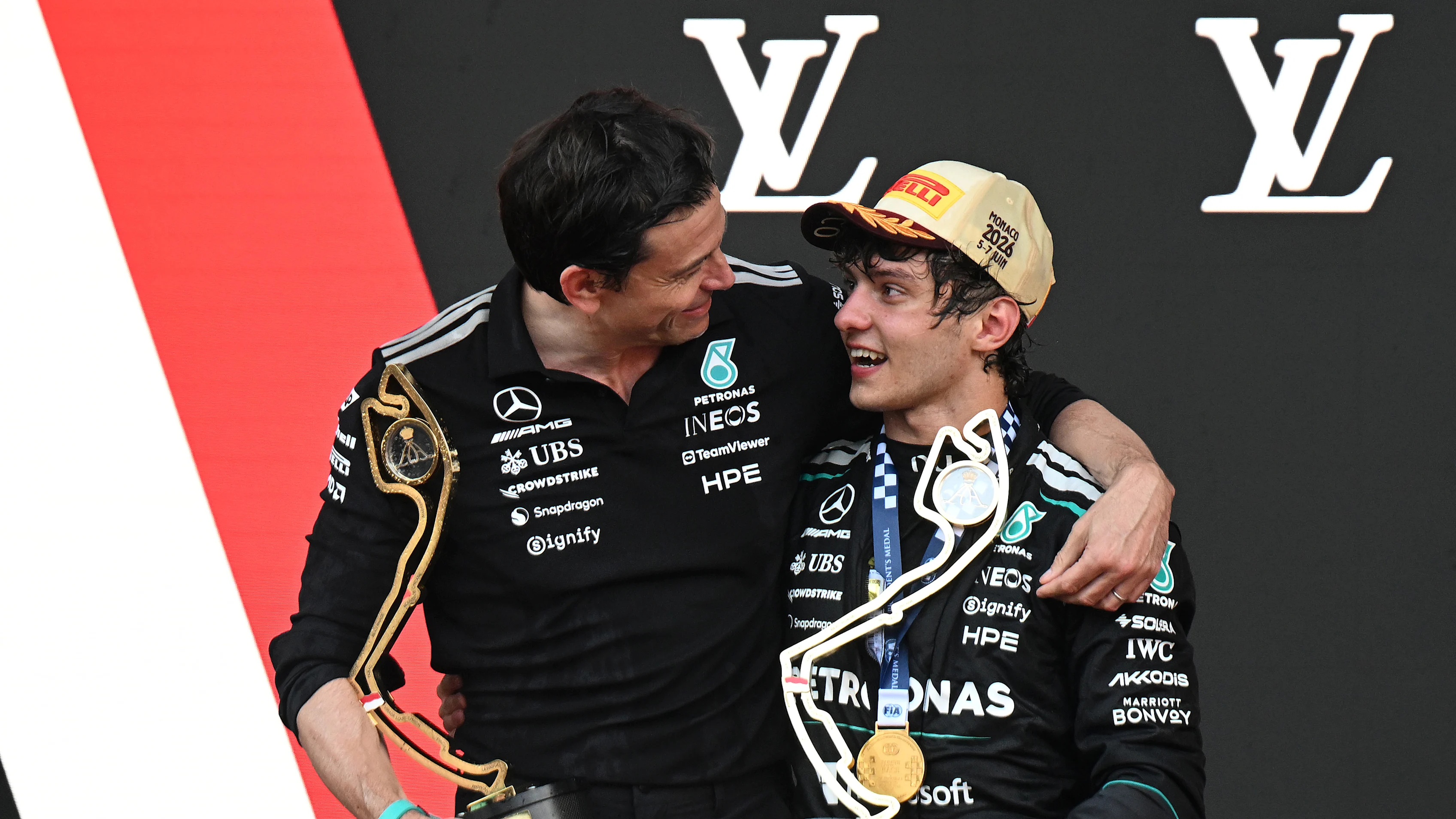
The image on this article comes from Monaco, where Antonelli’s early-season surge reached one of its loudest moments. That race matters in hindsight because it made Mercedes’ cushion look enormous. The last five races before the shutdown then changed the mood: the lead remained, but the monopoly did not.
Another useful detail: Mercedes’ official shutdown runs exactly through the middle of the break, August 1-15. That means the most important upgrade decisions for the Dutch Grand Prix will be shaped by work done before the doors closed and by how quickly the team can restart once the shutdown ends.
Skipped candidates
The Race’s new piece on why F1 cannot simply remove disliked energy algorithms was worth monitoring. GearPulse recently covered the Spa energy-algorithm backlash and Domenicali’s battery-graphics defence, so another version of the same rules-design debate needed a bigger official development to avoid repetition.
Cadillac’s honeymoon-wearing-off analysis on Autosport was interesting, especially after the team’s respectable first half. It lacked a fresher primary trigger than Mercedes’ upgrade plan and was more reflective than news-led.
Williams’ Baku upgrade story had strong midfield context through Alex Albon and Formula 1’s official midseason review, but GearPulse published an Aston Martin leadership article this morning and Williams’ Baku package is still a later proof point rather than today’s strongest competitive question.
McLaren’s Portimao TPC running with Norris, Piastri and Fornaroli had official Formula 1 and McLaren support, plus Motorsport Week and PlanetF1 pickup. It was skipped because GearPulse has recently published several McLaren/Hungary pieces, and Mercedes’ response to that McLaren upgrade is the broader title story today.
Bottom line
Mercedes is still in the best position. Antonelli leads the drivers’ standings, Russell keeps the team score high, and the constructors’ cushion gives Wolff room to be selective.
But selectivity is only a virtue if the timing lands. McLaren has already shown one major step. Ferrari has already shown it can keep adding parts. The shutdown now freezes everyone for two weeks, then the title fight restarts with a leader trying to decide where to spend its next big performance move.
GearPulse’s bottom line: Mercedes’ upgrade patience may still win the 2026 title. It has also become the easiest place for its rivals to apply pressure.