
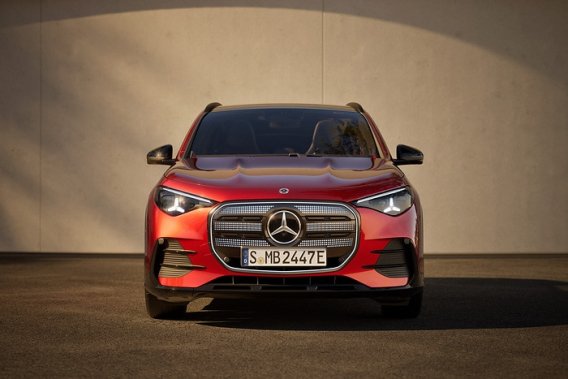
Mercedes-Benz has just reported the kind of electric-vehicle number it needed: 68,400 battery-electric passenger cars delivered in the third quarter, its highest quarterly BEV total to date. That is 61% above the same quarter last year and 29% ahead of the preceding quarter.
The easy headline is that Mercedes has found traction. The more useful one is that the company has found traction while the rest of its car business is still slipping. Total Mercedes-Benz Cars deliveries fell 8% year on year to 407,200, pulled down by a 31% fall in China. A record EV quarter and an overall contraction can both be true, and together they tell a far more revealing story about the current luxury-car market.
The record is real, but it is not a clean victory lap
Mercedes says group-wide BEV deliveries, including vans, reached 78,100 in July through September—up 52% from a year earlier. Cars accounted for 68,400 of those deliveries. The electric GLC was the principal growth driver, with sales more than tripling against the second quarter; the electric CLA grew 24% sequentially as it reached more markets.
| Q3 2026 measure | Result | What it says |
|---|---|---|
| Mercedes-Benz Cars deliveries | 407,200 | Down 8% year on year: electric momentum has not offset every market and model changeover. |
| Car BEV deliveries | 68,400 | A quarterly company record, up 61% year on year. |
| Group BEV deliveries | 78,100 | Cars and vans combined, up 52% year on year. |
| BEV share of Mercedes Cars | 16.8% | Roughly one in six new Mercedes passenger cars was fully electric. |
| China car deliveries | 86,800 | Down 31% year on year, the central drag on the quarter. |
| Europe car deliveries | 168,700 | Up 5% year on year; this is where the new EV push is visibly converting. |
Those figures are not just a scorecard for powertrains. They show a manufacturer moving from an early, fragmented EV range to the models buyers expect it to make: a GLC-sized SUV, a CLA sedan and the new GLB. In a premium brand, familiar nameplates and body styles can matter more than an abstract promise of a clean-sheet electric future.
That is especially clear in the GLC. Mercedes says its electric version more than tripled quarter on quarter, while the broader GLC remains central to its conventional sales in China. The company does not disclose a standalone GLC-EV delivery total, so it would be a mistake to reverse-engineer one from the growth rate. But the direction is unambiguous: the model is doing the work a volume electric Mercedes needs to do.
Europe is supplying the lift; China is supplying the caveat
Mercedes says its battery-electric GLC, CLA, GLB and GLA variants are sold out in Europe for the rest of 2026, with order books extending into 2027. That is encouraging demand evidence, not a guarantee of revenue or a measure of how many vehicles each model will ultimately deliver. Production capacity, component supply, configuration mix and cancellations still sit between an order book and a quarterly result.
Still, the regional split is hard to ignore. Europe rose 5% and North America 4% for Mercedes-Benz Cars, while Asia fell 25%; China accounted for a 31% drop on its own. Reuters’ reporting underscores the point: the company’s core-car decline remains chiefly a China story, even as electric deliveries improve. Electrive’s breakdown adds another useful perspective: Europe’s BEV growth was substantially faster than the global rate, with nearly one in three Mercedes passenger cars sold there fully electric, according to the company.
| What is improving | What remains unresolved |
|---|---|
| New EV nameplates are reaching additional markets. | China remains a large, intensely competitive market where Mercedes Cars sales fell sharply. |
| European demand appears strong enough to fill the 2026 allocation for several EVs. | “Sold out” does not tell us whether demand holds once early adopters are served or supply expands. |
| The BEV mix is rising alongside a more recognisable SUV and compact lineup. | Overall Cars volume is still down, and premium top-end sales dropped 21% year on year. |
For a buyer, this is more than investor-relations texture. A successful rollout generally brings better dealer familiarity, broader service knowledge and a more predictable used-market conversation. But tight allocations can also mean long waits and limited leverage on configuration. If the electric GLC or CLA is on your shortlist, confirm the exact delivery window and specification rather than treating a regional order-book statement as local availability.
The relevant transition is becoming less theatrical
Mercedes is not winning because it has announced the largest battery or the wildest acceleration figure. Its quarter suggests something quieter: electric models begin to matter when they map onto the body styles people already buy, and when dealers can actually put them in customers’ hands.
That does not remove the difficult part. China is no longer a market where a prestigious badge automatically makes the volume problem disappear. Price competition, a rapid domestic EV field and shifting consumer preferences make the old luxury playbook less reliable. Mercedes’ stronger European and North American performance helps, but it does not make a 31% China decline immaterial.
The reporting also gives context to the current EV conversation. The question is not whether every Mercedes buyer suddenly wants a battery vehicle; 16.8% is a meaningful share, but far from the whole business. It is whether the company can use real demand for the GLC, CLA, GLB and GLA to stabilise total volume while adapting in the markets where the old product mix is under pressure.
For more on what an electric Mercedes is being asked to prove at the performance end of the range, read our look at the AMG GT 4-Door EV. The Q3 results are the useful counterweight: a transformation is ultimately decided less by halo-car drama than by ordinary deliveries of mainstream premium models.
Bottom line
Mercedes-Benz has earned its record EV quarter. The electric GLC’s ramp, the expanding CLA rollout and Europe’s strong demand are tangible signs that its newer battery models are landing.
But the result is a signal, not a verdict. With total Cars deliveries down 8% and China down 31%, the company still has a regional and competitive problem that electric growth alone has not solved. The next few quarters will show whether these familiar-nameplate EVs can become a durable volume base—or merely the bright part of a difficult transition.