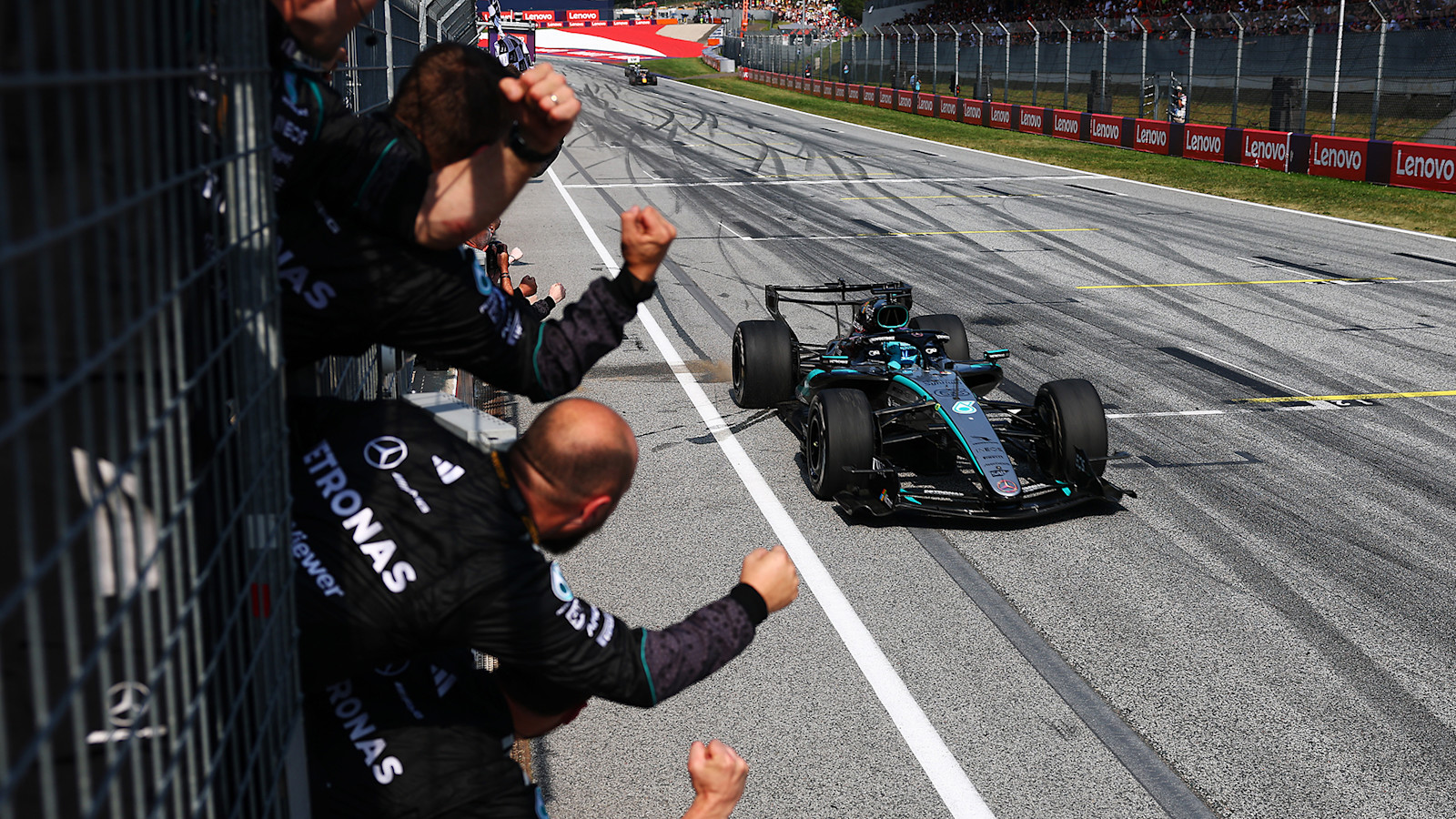
Austria did not just hand Mercedes another strong result. It changed the temperature of the team’s own title fight.
Formula 1’s official race report put George Russell ahead at the flag, with Max Verstappen second and Kimi Antonelli third. Mercedes’ own race report framed Spielberg as a victory day for Russell and a podium day for Antonelli. Motorsport.com, Sky Sports F1 and The Guardian all treated the same result as the main F1 story of the day, which is why it became today’s Daily Dose of F1 rather than another pre-race Ferrari or yellow-flag follow-up.
The cleanest GearPulse angle is not simply that Russell won from pole. It is that Austria gave Mercedes a two-part answer: Russell can still turn a high-pressure weekend into maximum points, while Antonelli can finish third on a day when the team could not completely control Verstappen.
That matters more than a normal race recap because the 2026 season has been starting to feel less settled. Hamilton’s Barcelona win made Ferrari emotionally loud again. Verstappen’s Austria recovery kept Red Bull in the picture. McLaren still has enough underlying pace to complicate Sundays. Mercedes needed a result that did more than defend its lead.
It got one.
Why this was the day’s strongest F1 story
The Austrian Grand Prix had several possible headlines, but the race result carried the best mix of confirmation, consequence and trend weight.
It had official timing and classification from Formula 1, a primary Mercedes report, specialist media corroboration from Motorsport.com and Sky Sports F1, and mainstream pickup from The Guardian. It also followed directly from the stories GearPulse covered over the past three days: Mercedes’ Friday recovery, Russell’s disputed pole, and Ferrari’s front-row threat. The race did not duplicate those pieces; it resolved them.
The skipped alternatives were thinner. A Ferrari post-race disappointment angle was valid, but too close to the earlier front-row story unless the team had produced a clearer technical explanation. A Verstappen recovery article had energy, but the result was still Mercedes-led and had stronger championship implications for two drivers. A McLaren pace piece would need more team-specific evidence than the race order alone provided.
The trend signal was obvious: a pole-sitter converting under pressure, Verstappen charging back to second, Antonelli limiting damage, and Ferrari fading from the front-row optimism that dominated the build-up.
Russell needed this more than the standings admit
Russell’s win lands differently because of who is across the garage.
Antonelli has been the broader Mercedes title story this year. He arrived in Austria leading the drivers’ standings, and his Friday pace made it easy to frame the weekend around the younger driver again. Russell then took pole, survived the rules debate around the late yellow-flag sequence, and converted Sunday into a race win.
That is a complete weekend arc.
For Russell, the value is not only points. It is authority. In a title fight where Mercedes has two credible drivers, winning from pole at Spielberg says he is not waiting for Antonelli to make mistakes. He can make Mercedes manage a real internal contest.
The likely championship effect is sharper than the headline margin suggests:
| Mercedes driver | Austria value | GearPulse read |
|---|---|---|
| George Russell | Win from pole, full response to qualifying scrutiny. | Reasserted himself as a title driver, not a supporting threat. |
| Kimi Antonelli | Third place on a weekend Russell owned. | Damage limitation was strong enough to keep the season tilted his way. |
That second line matters. Antonelli did not win, but third was not a collapse. If he keeps turning off-weekends into podiums, Russell needs more days like Austria to make the title fight genuinely swing.
Verstappen made Mercedes work for it
The race would be easier to file as Mercedes dominance if Verstappen had stayed out of range. He did not.
After the late qualifying crash that shaped Saturday’s yellow-flag debate, Verstappen’s Sunday recovery became the pressure test. Formula 1 and the reliable race reports placed him between the Mercedes drivers at the finish, which is the important structural point: Red Bull could not beat Russell, but it did split the team.
That changes the read on Red Bull’s weekend. The upgraded-car and home-race pressure story looked messy after qualifying. By Sunday evening, it looked more nuanced. Red Bull still had enough race strength in Verstappen’s hands to turn a compromised grid position into second place.
GearPulse’s view: that does not make Red Bull the favorite for the next race. It does make writing them off too easy. A team that can recover to second at a short, traffic-heavy Red Bull Ring still has a car-driver combination worth treating seriously.
Ferrari’s front-row signal met race-day gravity
This is the part that should make Ferrari uncomfortable.
Before the race, the useful question was whether Leclerc and Hamilton could turn Ferrari’s front-row energy into sustained pressure on Mercedes. The answer, based on the final order reported by the official and specialist sources, was not convincing enough.
That does not erase Ferrari’s qualifying step. It does narrow what it proved. Austria showed the Ferrari can be sharp over one lap and close enough to make Mercedes prepare defensively. It did not yet prove Ferrari can keep the tyres, track position and strategic rhythm alive across a full Red Bull Ring race.
The comparison is blunt:
| Team | Saturday promise | Sunday answer |
|---|---|---|
| Mercedes | Pole, two cars near the front, clean Friday pace. | Won the race and protected a podium with Antonelli. |
| Red Bull | Messy qualifying after Verstappen’s crash. | Recovered to second and split Mercedes. |
| Ferrari | Two-car front-row threat after Leclerc and Hamilton qualifying strength. | Less convincing over the race distance. |
| McLaren | Underlying pace without the main headline. | Still relevant, but not the story-defining force in Austria. |
The caveat is that Spielberg is not a universal truth machine. Its 4.326 km lap, heavy braking zones, three DRS areas and fast sequence of short-lap traffic windows can exaggerate tyre and strategy swings. But this was exactly the kind of race Ferrari needed to use after Barcelona. It instead handed Mercedes the cleaner answer.
Austria rewarded control, not just speed
The Red Bull Ring often looks simple because the lap is short and the corner count is low. In race terms, that is misleading. Short laps compress traffic, pit windows and DRS exposure. A small tyre phase can become visible quickly because the same traction demands repeat every 70 seconds or so.
That is why Russell’s win deserves more respect than a “started first, finished first” summary.
He had to convert the pole after a noisy Saturday, manage the opening phase without letting the race become a DRS trap, and keep Verstappen from turning recovery pace into a win threat. Mercedes also had to protect Antonelli’s podium without overplaying strategy.
This is the kind of win that looks calm only after it is done.
Fun fact: the Austrian Grand Prix is run over 71 laps, which means small rhythm changes repeat more often than at longer circuits. At Spielberg, a car that falls half a tenth per lap away from the tyre window can turn a manageable gap into a real problem quickly.
The probability board after Austria
This is editorial analysis, not betting advice:
| Question after Austria | Likelihood | Why |
|---|---|---|
| Mercedes remains the title favorite | 55-65% | It converted pole, still has two podium-level drivers, and leads the season structure. |
| Russell is now Antonelli’s clearest internal threat | 45-55% | Austria was a complete response, but Antonelli’s podium limited the swing. |
| Red Bull is back in the win conversation immediately | 30-40% | Verstappen’s second was strong, yet the team still needs a cleaner qualifying platform. |
| Ferrari’s Barcelona momentum is fully repeatable | 25-35% | One-lap pace is real; race execution still has to catch up. |
The Mercedes number is not higher because the challengers are not imaginary. Verstappen’s recovery was real. Ferrari’s qualifying speed was real. McLaren’s weekend pace remains worth tracking. But Austria gave Mercedes the strongest evidence that its season has not become fragile after Barcelona.
Bottom line
Austria was bigger than a Mercedes victory. It was a stress test of the team’s hierarchy, its race execution and its ability to respond after a weekend full of external pressure.
Russell got the win he needed. Antonelli got the podium he needed. Verstappen made sure Red Bull left Austria with credibility. Ferrari left with proof of Saturday speed and a reminder that Sunday is the harder half of the job.
GearPulse’s read: Mercedes still owns the strongest championship position, but Austria made the internal battle more interesting. Russell did not just score points. He changed how urgently Mercedes has to take both sides of its garage.
Support the site at buymeacoffee.com/gearpulse.site.