
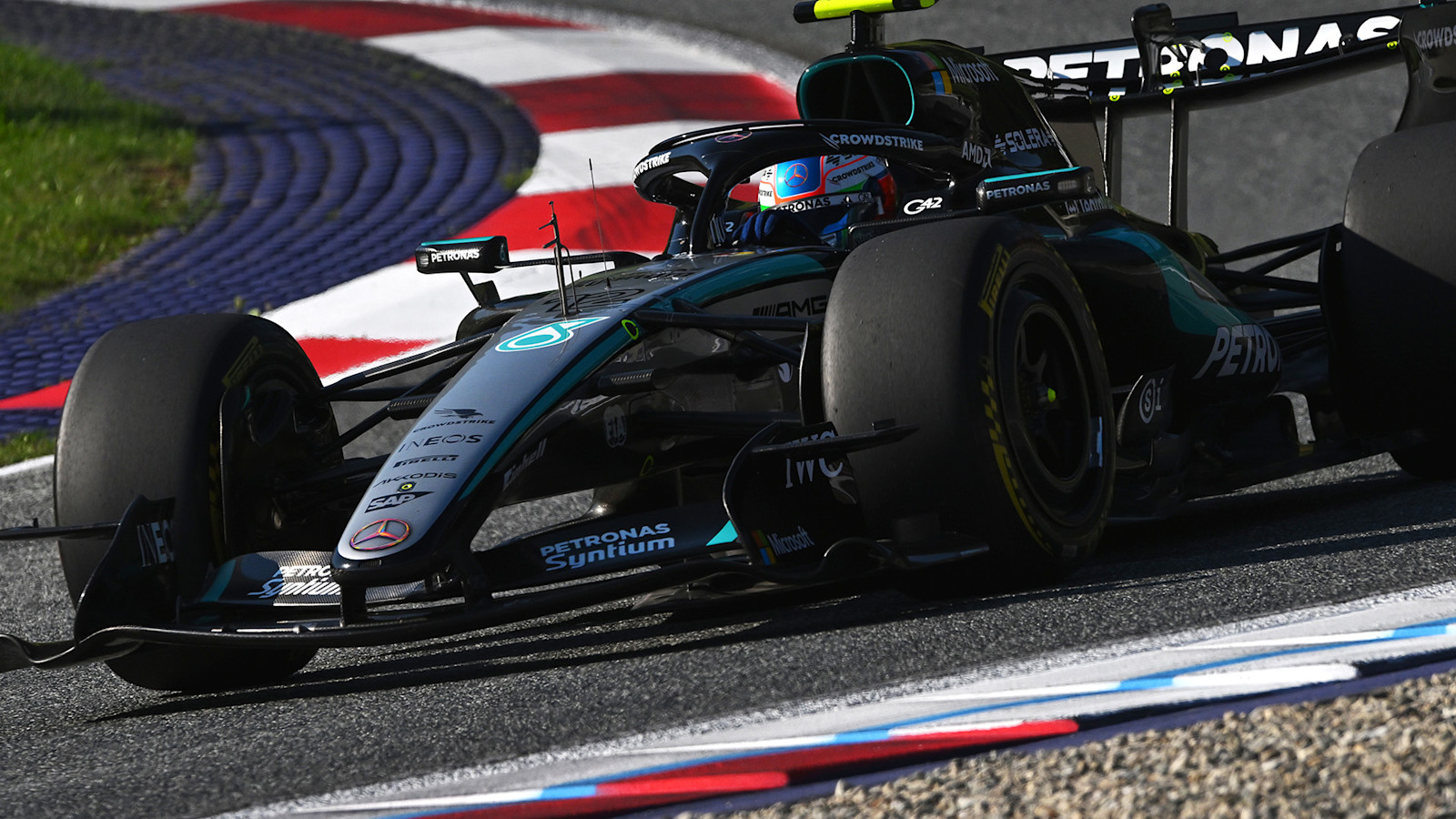
Mercedes arrived in Austria needing something calm. Not a trophy, not a grand statement, and not proof that the weekend is already decided. Just a clean Friday with enough evidence to make Barcelona feel like a contained problem rather than the start of a pattern.
It got that at the Red Bull Ring.
Formula 1’s official second-practice report put Kimi Antonelli on top of FP2 ahead of the two McLarens, Oscar Piastri and Lando Norris. Motorsport.com also treated the day as a Mercedes-forward Friday, while noting the wider context of McLaren pace and Red Bull’s uneven home-weekend start. Mercedes’ own report was careful rather than triumphant: hot conditions, a 50-degree track temperature, busy programmes, useful information.
That is the right tone. Friday practice does not award points. But for Mercedes, this one mattered because the question after Barcelona was not simply “is the car fast?” It was “can the team trust the package again under heat, altitude and pressure?”
Why this became today’s story
The most interesting F1 story of June 26 was not just that Antonelli topped Friday running. It was the way the result landed in the championship narrative.
GearPulse had already covered the broad Austrian Grand Prix setup and the Practice 1/Practice 2 context, so another generic Spielberg preview would have been a duplicate. Cadillac’s upgrade was also yesterday’s Daily Dose of F1 story. The Mercedes angle is materially different because it connects a fresh official session outcome with the title picture, the Barcelona failure, McLaren’s race-threat signal and Red Bull’s home-race pressure.
It also had enough corroboration to stand up. Formula 1 published the session report and the race hub. Mercedes published its own Friday report. Motorsport.com had same-day specialist pickup, while ESPN’s Austria guide showed the mainstream calendar relevance around a weekend that follows Lewis Hamilton’s Ferrari win in Barcelona.
In trend terms, this was the cleanest intersection of timing and substance: a current on-track development, a championship leader involved, and a weekend with several teams trying to prove upgrades or momentum are real.
The Barcelona shadow is the real context
Barcelona changed the emotional weather of the season.
Before Spain, Mercedes looked like the safest structure in the 2026 field: Antonelli leading the drivers’ standings, George Russell inside the title fight, and the team carrying the strongest constructors’ profile. Then Antonelli retired from the race with a failure while Hamilton won for Ferrari, turning a Mercedes-controlled season into something more open.
That is why Austria’s Friday mattered more than the stopwatch alone. The Red Bull Ring is short, fast and hard on traction. It sits at altitude, and the weekend has been run in notable heat. A fragile car can look fine for one lap and still worry a team over repeated runs, cooling margins or electrical deployment. Mercedes did not need to solve every question on Friday; it needed to stop adding new ones.
The team’s own report said both drivers completed busy programmes in hot conditions, with Antonelli describing the car as strong and Russell pointing to McLaren’s long-run pace as a concern. That is a revealing combination. Mercedes has pace, but it is not pretending the weekend is locked.
The McLaren warning is not small
If you only read the top line, Friday looks like a Mercedes response. If you read the shape of the session, McLaren is still the team Mercedes should be watching.
Formula 1’s FP2 report had Piastri and Norris directly behind Antonelli. That matters because McLaren’s 2026 story has been less about no pace and more about converting good underlying speed into full-weekend authority. On a track with three DRS zones and a short lap, race pace and tyre control can be worth more than a Friday headline.
The editorial read is simple:
| Team | What Friday suggested | What still needs proving |
|---|---|---|
| Mercedes | Strong single-lap baseline and no obvious Friday reliability spiral. | Whether the car stays kind to tyres in hotter race conditions. |
| McLaren | Close enough to make Mercedes uncomfortable, especially if long-run pace is real. | Whether qualifying execution puts both cars in clean air. |
| Ferrari | Still relevant after Barcelona, but not yet obviously repeating that high. | Whether Hamilton and Leclerc can recover enough balance for Saturday. |
| Red Bull | Verstappen remains dangerous at home, but the weekend did not start cleanly. | Whether the upgrade and setup direction converge before qualifying. |
That is why GearPulse’s view is more cautious than “Mercedes is back.” Mercedes looked like the benchmark on Friday. McLaren looked like the pressure test.
Antonelli’s response says something
Antonelli’s season has moved quickly enough that it is easy to forget how unusual his situation still is. He is not just a young driver having occasional flashes. He is carrying championship expectations in a Mercedes during a season where Ferrari has Hamilton, McLaren has two sharp race operators, and Red Bull still has Max Verstappen.
So the useful part of Austria was not merely pace. It was the reset after Barcelona.
A driver can respond to a mechanical retirement in two ways. One is to overdrive the next weekend, chasing reassurance. The other is to rebuild the rhythm session by session. Friday at Spielberg looked more like the second version. The car was in the window, the lap time arrived, and Mercedes’ public language stayed measured.
That matters because the 2026 title fight may become less about raw peaks and more about damage control. If Antonelli wins when Mercedes is dominant and finishes second or third when McLaren or Ferrari has the better race car, the championship remains tilted his way. If Barcelona becomes the first of several reliability or execution hits, Hamilton and Russell both gain oxygen.
Friday made the calmer scenario more likely. Not certain. More likely.
Russell is the other half of the pressure
George Russell’s role should not be reduced to support act. He is still third in the drivers’ standings before the Austrian weekend, and his Friday context is important because Mercedes needs two cars to keep Ferrari and McLaren from turning every race into an undercut or tyre-offset problem.
If Russell is close enough to Antonelli, Mercedes controls more of qualifying. If he is half a step behind but still in the first two rows, he can make McLaren and Ferrari split strategy. If he falls into traffic, the team loses one of its cleanest weapons.
There is also an internal title angle. Russell does not need to beat Antonelli every weekend to matter, but he does need to stay close enough that Mercedes cannot comfortably shape the year around one driver. A strong Austrian Saturday from Russell would turn Mercedes’ advantage from “Antonelli looks fast again” into “both cars can own the front of the race.”
What would change the story on Saturday
Practice is evidence, not verdict. The Red Bull Ring can punish small errors because the lap is so short and the field compresses quickly. A lock-up, a track-limits deletion or one badly timed out-lap can turn a strong Friday into a messy qualifying.
Here is the GearPulse probability board after Friday, framed as editorial analysis rather than betting advice:
| Saturday outcome | Likelihood | Why |
|---|---|---|
| Mercedes starts as qualifying favourite | 35-45% | Antonelli’s pace and Mercedes’ clean programme make the team the baseline pick. |
| McLaren puts at least one car on the front row | 25-35% | Piastri and Norris were close enough in FP2 to make this a real threat. |
| Ferrari rebounds into pole contention | 15-25% | Barcelona momentum is real, but Austria Friday did not yet scream repeat. |
| Red Bull turns home pressure into a front-row surprise | 10-20% | Verstappen can still bend a weekend, but the car has to meet him halfway. |
The biggest caveat is tyre temperature. Austria’s layout looks simple on television, but traction zones and kerbs can make the rear tyres pay. If McLaren has the cleaner long run, Mercedes may win Saturday and still have a Sunday problem.
Fun fact that actually matters
The Red Bull Ring is only 4.326 km in its current F1 layout, and the race is 71 laps. That makes it one of the calendar’s easiest tracks to describe and one of the harder tracks to dominate. There are fewer corners to create separation, more cars arriving into traffic windows, and less time to recover from a messy sector.
For a team trying to prove reliability and control, that is a useful stress test. You cannot hide a nervous car for long at Spielberg.
Bottom line
Mercedes did not win anything on Friday. It did something more practical: it made Barcelona look less like a crack and more like a bruise.
Antonelli’s pace gives the title leader a cleaner platform. Russell keeps Mercedes’ two-car threat alive. McLaren is close enough to stop the weekend becoming comfortable. Ferrari and Red Bull still have time to turn the story, but they now have to chase a Mercedes team that looks steadier than it did a week ago.
GearPulse’s read: Mercedes is the Saturday favourite, but not the Sunday lock. That distinction is the whole Austrian Grand Prix right now.