
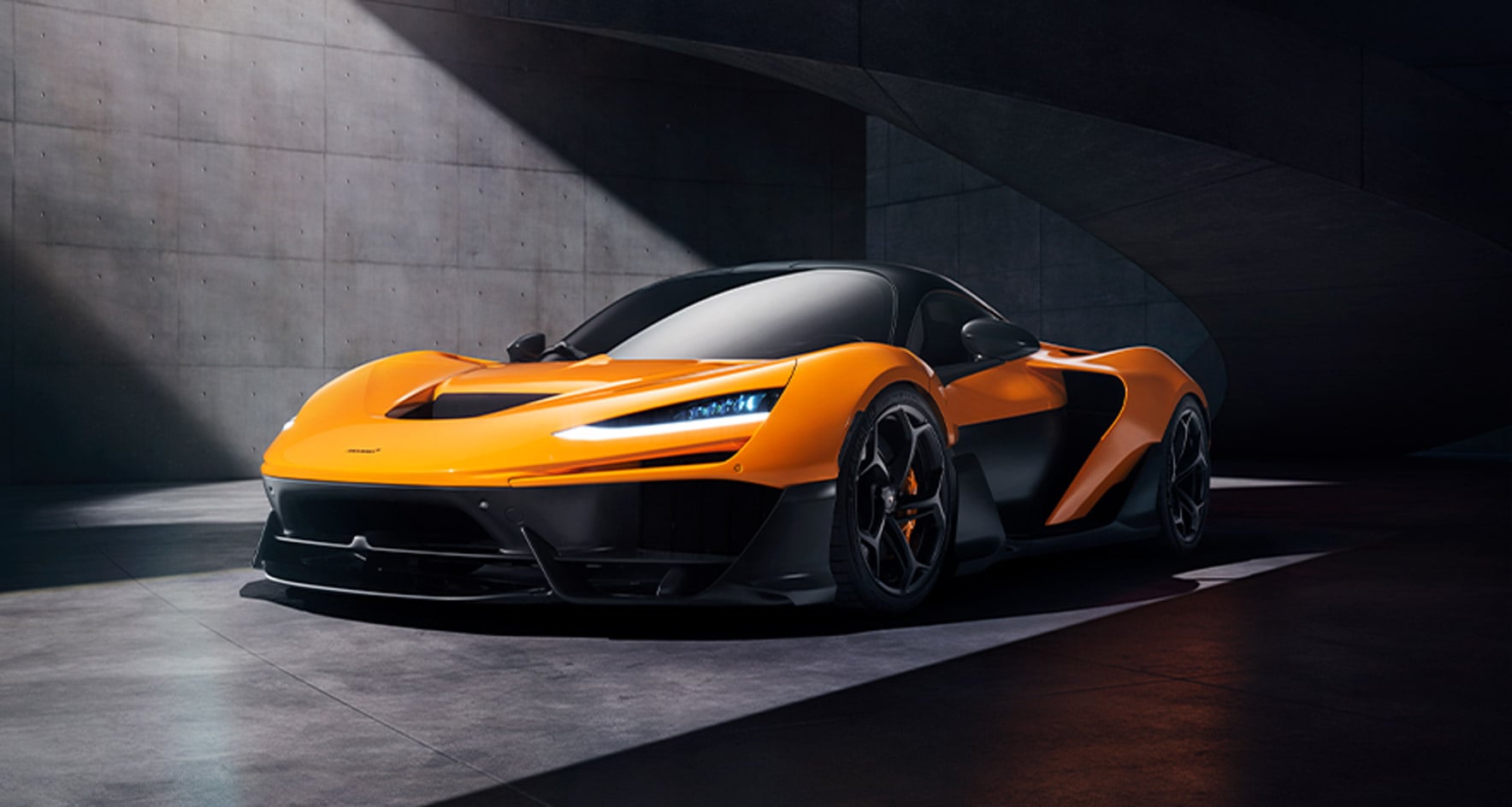
McLaren W1 coverage is finally moving from static reveal awe to the more useful question: what does a 1,258 hp rear-drive hybrid hypercar feel like when people actually drive it?
GearPulse has not driven the W1. The interesting signal comes from the combination of McLaren’s official specification trail and first-drive coverage from outlets and creators that have spent time with the car. Marques Brownlee titled his video “The Best Car I’ve Ever Driven.” Road & Track called the W1 a car that earns its suffix. Hagerty framed it as an “anytime hypercar.” Different voices, same pattern: the W1 is absurdly fast, but the surprise is not just speed. It is how controlled the car is reported to feel.
That is why the W1 is relevant beyond the tiny group of people who can buy one. The car is already sold out, with McLaren limiting production to 399 customer cars. For everyone else, it is a signal of where the next hypercar argument is going: not more power alone, but how gracefully the software, aero, steering and hybrid systems let a human use it.
The verified numbers are ridiculous
McLaren’s official W1 page and press pack give the car headline figures that would have sounded like race-car fantasy not long ago.
| McLaren W1 spec | Official figure |
|---|---|
| Combined output | 1,275 PS / 1,258 bhp |
| Combined torque | 1,340 Nm / 988 lb-ft |
| Powertrain | 4.0-liter twin-turbo V8 high-performance hybrid |
| Transmission | 8-speed dual-clutch with E-Reverse |
| Driven wheels | Rear-wheel drive |
| 0-100 km/h / 0-62 mph | 2.7 seconds |
| 0-200 km/h / 0-124 mph | 5.8 seconds |
| Top speed | 350 km/h / 217 mph |
| Lightest dry weight | 1,399 kg / 3,084 lb |
| Production | 399 customer cars |
The obvious take is that the W1 is a numbers car. That is true, but incomplete. McLaren’s own engineering story leans heavily on weight, aero, driver connection and rear-wheel-drive purity rather than simply claiming the biggest horsepower figure in the room.
That distinction matters because the hypercar world has become easy to parody. Add electric torque, add aero drama, add a seven-figure price, call it history. The W1’s more interesting claim is that it keeps the driver central while deploying technology aggressively around them.
Rear-wheel drive is the stubborn choice
The W1’s most telling technical decision is not the hybrid V8. It is that all of the output goes to the rear wheels.
Many ultra-high-output cars use front-axle electric assistance or all-wheel drive because it makes launch traction and headline acceleration easier. McLaren chose rear-wheel drive, then surrounded it with active aero, an e-differential, hydraulic steering and a chassis package meant to keep the car readable.
That choice gives the W1 a clear identity. It is not trying to be the easiest way to launch from a traffic light. It is trying to be a McLaren: light, direct, aerodynamically serious and a little stubborn about driver feel.
The caveat is that this also raises the burden of proof. A rear-drive car with 988 lb-ft has to manage traction without making the driver feel like the computer is constantly stepping between them and the road. The first-drive tone suggests McLaren has landed closer to confidence than intimidation, but owner reality over time will be the better test.
The active aero is the point, not decoration
McLaren says the W1 uses ground-effect aerodynamics, an active front splitter and the McLaren Active Long Tail. In Race mode, the car changes its stance and deploys a radically different aero attitude. The press pack says the rear wing can extend rearwards by 300 mm, and the system can generate up to 1,000 kg of downforce.
That is not showroom theater. It is the core reason the W1 can be discussed as both road car and track machine without sounding completely absurd.
| W1 system | What it changes | Why it matters |
|---|---|---|
| Active Long Tail | Rear aero surface extends and changes function | Helps the car shift from low-drag road behavior to high-downforce track behavior. |
| Ground-effect floor | Uses underbody airflow for grip | Lets aero work with the car rather than only adding visible wings. |
| Race mode | Alters ride height and aero state | Creates a real road-to-track personality change. |
| Hydraulic steering | Keeps a physical steering feel in a tech-heavy car | Helps preserve the driver-connection story. |
| Fixed-seat cockpit with movable controls | Driver position is built around the carbon structure | Saves weight and reinforces the car’s focused packaging. |
The buyer-facing benefit is not that someone can quote aero jargon at dinner. It is that the W1 appears designed around a broad performance window: calm enough to approach, wild enough to justify the badge.
Why first-drive reactions matter
For normal cars, first drives help shoppers decide whether to buy. For the W1, almost nobody reading this is shopping. McLaren says all 399 customer cars are already allocated.
So the coverage matters differently. It tells us whether the modern hypercar has become too abstract or whether it can still deliver a human experience.
Road & Track’s first-drive framing emphasizes that the W1’s performance does not erase its usability. Hagerty’s review similarly points toward a car that can operate outside a track-only fantasy. Brownlee’s video is valuable because it brings the W1 to a broader tech-and-car audience, where the fascination is not lap-time trivia but how extreme engineering feels from the driver’s seat.
GearPulse’s read: if the W1’s defining impression is control, not terror, McLaren has made the more difficult car. Straight-line excess is common at this level. Trust is rare.
What to be skeptical about
The W1 still deserves caveats.
First, early first drives are usually controlled environments. Roads, tracks, weather, support teams and vehicle condition all matter. A launch drive can reveal a lot, but it is not the same as a year of ownership.
Second, the car’s price and allocation status mean it is effectively cultural technology, not consumer advice. Car and Driver lists a price around $2.1 million, while McLaren’s UK press material referenced pricing from around 2.0 million pounds including taxes, dependent on personalization. Add MSO options and the exact number becomes an owner-by-owner conversation.
Third, hybrid complexity has a long tail. The W1’s small high-performance battery, e-module, cooling systems, active aero and chassis electronics are part of the magic. They are also part of the maintenance story. McLaren says the package includes a 4-year vehicle warranty, 6-year high-voltage battery warranty and 4-year service plan in the press pack, which is sensible given the engineering density.
None of those caveats make the car less interesting. They make it more honest.
Bottom line
The McLaren W1 is relevant because early drives suggest the next top-tier hypercar fight is not just about who posts the biggest number. The W1 already has the numbers: 1,258 hp, 217 mph, 0-62 mph in 2.7 seconds and 399 cars spoken for. The better story is that reviewers are responding to how usable and connected it feels.
That is the standard hypercars should be judged by now. Power is abundant. Screens, modes and torque fills are abundant. The rare thing is a car that uses all of that engineering without making the driver feel like a passenger in a physics demo.
If the first-drive consensus holds up, the W1 is McLaren arguing that the hybrid era can still have steering feel, rear-drive drama and a real sense of occasion. That is a more exciting message than another horsepower war.
Support independent GearPulse articles at buymeacoffee.com/gearpulse.site.