
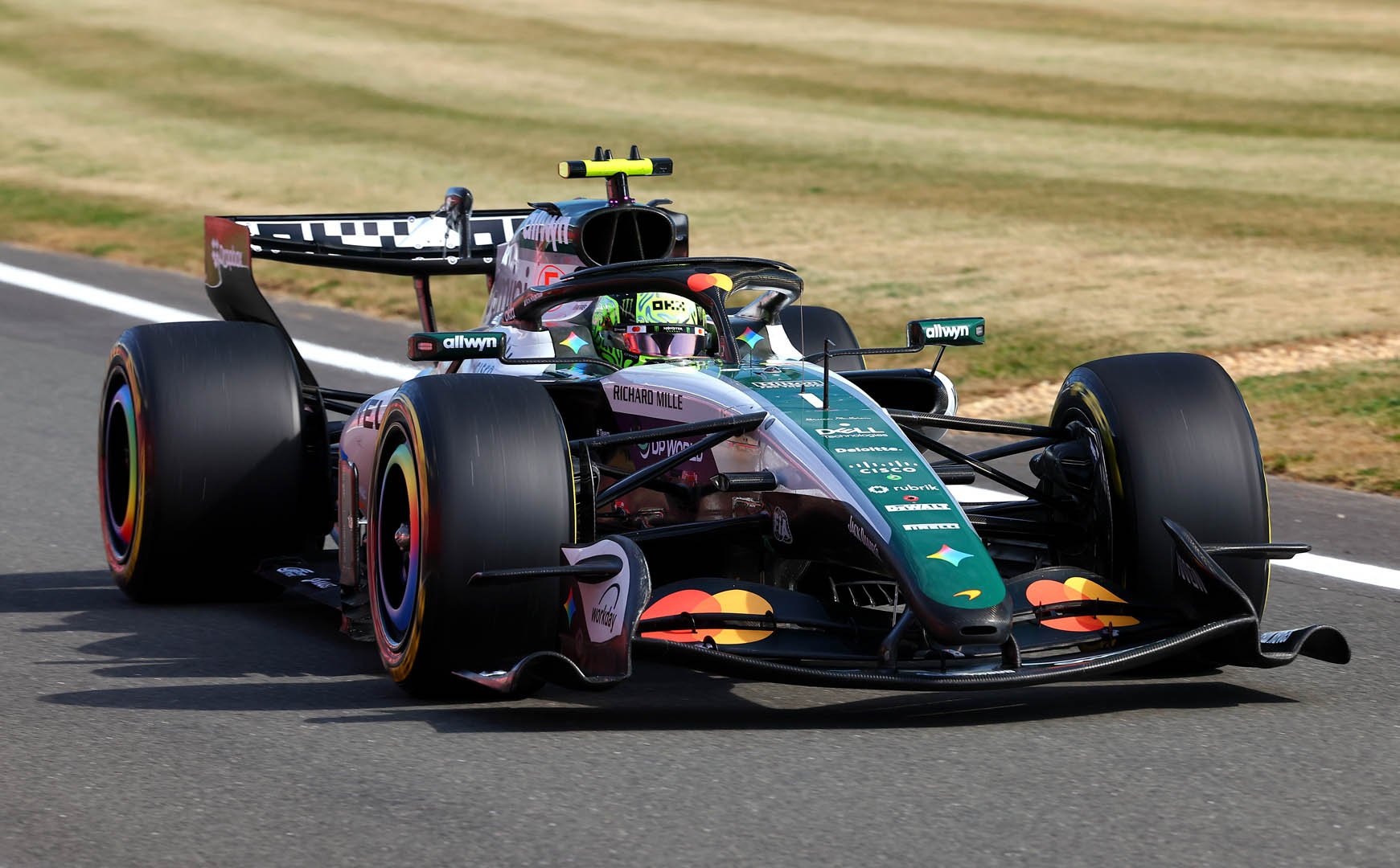
McLaren’s most useful Silverstone story is not the special livery anymore. It is the gap between visible development and visible lap time.
Formula 1’s official British Grand Prix upgrade list says McLaren led the front-running teams on new parts for Silverstone, bringing changes around the front corner and floor furniture. RACER’s technical roundup tells the same story in plainer terms: a new front brake duct, revised floor board and floor furniture aimed at more aerodynamic load and efficiency. Crash.net also grouped McLaren among the teams bringing meaningful British GP development, while noting that Mercedes, Aston Martin, Audi, Alpine and Cadillac had no new components listed.
That should sound like the start of a home-race surge. McLaren’s own Friday report was more restrained. The team described a difficult, windy practice session, then a tighter Sprint Qualifying in which Lando Norris and Oscar Piastri ended up sixth and seventh. Motorsport.com added a second layer: McLaren is the only Mercedes customer team at Silverstone not running the new Mercedes power-unit specification, with CEO Zak Brown saying the update is coming later.
GearPulse’s view: this is the sharper McLaren story today because it shows how hard the 2026 development race has become. New aero parts can move the car forward and still not be enough if rivals have found performance elsewhere.
Why this is not just a bad Friday
The easy take is that McLaren underperformed. That is too blunt.
McLaren’s Sprint Qualifying report says less than a tenth of a second covered third through seventh on the Sprint grid for the third consecutive race weekend. That is a tiny spread, and it changes how we should read P6 and P7. In a normal season, the fourth row might look like a clear deficit. In this field, it can also mean a team is one small balance shift, one cleaner lap or one session-specific issue away from a very different headline.
But that cuts both ways. If the gaps are this compressed, bringing upgrades is not a guarantee of jumping the queue. It is the entry fee.
| McLaren Silverstone signal | What happened | GearPulse read |
|---|---|---|
| Official upgrade list | New front brake duct, floor board and floor furniture | McLaren is still spending development effort on aerodynamic efficiency, not merely trimming setup. |
| Power-unit context | Motorsport.com reports McLaren lacks Mercedes’ latest spec this weekend | The car’s weekend is not only an aero question. |
| Sprint Qualifying order | Norris sixth, Piastri seventh | Better than a collapse, worse than a home-weekend statement. |
| Team explanation | Wind, brake-duct damage and a tight performance spread | The result has caveats, but not enough to erase the pace concern. |
| Race-week opportunity | Sprint plus Grand Prix qualifying on Saturday | McLaren still gets two public stress tests before Sunday’s race. |
The important part is that all of those can be true at once. McLaren can have brought useful parts. Norris can have lost performance through front brake-duct damage. Piastri can have felt he extracted a lot from the car. And the team can still be short of Ferrari, Mercedes and Red Bull over one lap at Silverstone.
That is not contradiction. That is modern F1.
The power-unit timing matters
The most interesting detail in Motorsport.com’s reporting is not that McLaren wants the latest Mercedes power unit. Of course it does. The important detail is timing.
Mercedes introduced a new specification recently, framed in the report as reliability-focused rather than an obvious ADUO performance step. Other Mercedes-powered teams have moved onto newer components around the British weekend, but McLaren has not yet done so. Brown’s comment that the team would like the current Mercedes engine, and expects it shortly, is careful rather than dramatic.
Still, Silverstone is exactly the wrong place to be explaining a deferred power-unit update.
This circuit rewards high-speed efficiency and clean deployment. The 2026 cars already make Silverstone more energy-sensitive than fans are used to, because there are fewer heavy braking zones for recovery than at many circuits. If McLaren is missing even a small reliability, operating-window or deployment confidence gain from a newer spec, the aero package has to carry more of the weekend.
The caveat: this is not proof that the power unit cost McLaren third place. There are too many variables: wind, tyre preparation, Norris’ damage, setup choices, and the fact that Ferrari and Red Bull also brought their own answers. But it is a credible part of the puzzle, and it matters because McLaren’s home-race expectations were not built on livery alone.
Norris’ damage explains some of it, not all of it
McLaren’s report says Norris sustained front brake-duct damage in SQ1, the team repaired it before SQ3, and some imbalance remained. Motorsport.com separately framed that damage as a factor in his Sprint Qualifying result. That is important context because a brake duct is not just a cooling box. It influences airflow around the front corner, tyre temperature and how predictable the front end feels.
Norris still reached SQ3 and beat Piastri by 0.032s in the final segment. That suggests the issue did not ruin the session completely. But it also means McLaren does not get a clean measurement of its new package from his side of the garage.
Piastri’s side is the more uncomfortable reference. He was close to Norris, but Motorsport.com’s same-day reporting quotes him describing McLaren as “pretty slow” after practice and saying he felt he had been on it without finding the pace. That is the kind of driver feedback teams take seriously because it points away from one messy lap and toward underlying car performance.
For Saturday, McLaren’s internal question is simple: was Friday mostly a compromised execution day, or did the upgraded MCL40 simply not land in the window quickly enough?
Why the upgrade list is still encouraging
None of this means the package is a failure. In fact, the details point to a team still working on the right things.
Front-corner flow and floor efficiency are exactly where a Silverstone car needs confidence. The track’s fast direction changes and long loaded corners punish a car that slides or makes the driver wait for the front axle. A cleaner floor and better brake-duct flow conditioning should help the car hold load and protect the tyres over a stint.
The question is whether the gain is immediate enough for a Sprint weekend. With only one practice session before competitive running, teams do not get the normal three-session discovery arc. If a new floor detail needs careful ride-height, cooling or balance work, the format makes that learning curve public.
That is where McLaren’s Saturday becomes useful. The Sprint will show whether the MCL40 is kinder over repeated laps than it looked over one-lap runs. Grand Prix qualifying then tells us whether the team can convert the extra data into a sharper setup.
GearPulse’s likelihood read, as editorial analysis rather than betting advice:
| Saturday McLaren read | Likelihood | Why |
|---|---|---|
| McLaren looks better over Sprint distance than it did in Sprint Qualifying | 35-45% | The upgrade focus should help repeatable load and tyre behavior if the setup is close. |
| Norris becomes the stronger McLaren reference once damage is out of the way | 30-40% | He has the home-track incentive and was slightly ahead even with Friday compromise. |
| Piastri exposes a deeper car limitation | 25-35% | His feedback sounded less like bad luck and more like missing pace. |
| McLaren fights for a front-row Grand Prix qualifying spot | 15-25% | The field is compressed, but Ferrari and Mercedes currently have the cleaner evidence. |
Fun fact: P3 to P7 is basically a setup argument
McLaren’s note that less than a tenth covered third to seventh is almost absurd around a 5.891 km circuit. Spread over the full Silverstone lap, that is roughly 0.017s per kilometre. A tiny gust, a tyre warm-up difference or a slightly damaged aero component can turn “best of the rest” into “fourth-fastest team.”
That is why the upgrade story matters. At this level, development is not only about finding a tenth. It is about making the tenth appear at the right corner, in the right wind, on the right tyre, with the driver still trusting the car at Copse and through Maggotts-Becketts.
Bottom line
McLaren’s Silverstone puzzle is the right F1 story today because it is official, technical, current and materially different from the recent Silverstone narratives. The team brought serious aero changes, has a fresh power-unit timing wrinkle, and still left Friday with Norris and Piastri needing more.
That does not make the upgrade a flop. It makes Saturday a proper measurement day. If McLaren’s new parts show up over the Sprint and Grand Prix qualifying, the livery weekend gets competitive substance. If they do not, Silverstone will look like a reminder that in 2026, development pace is only useful when it arrives fully integrated.