
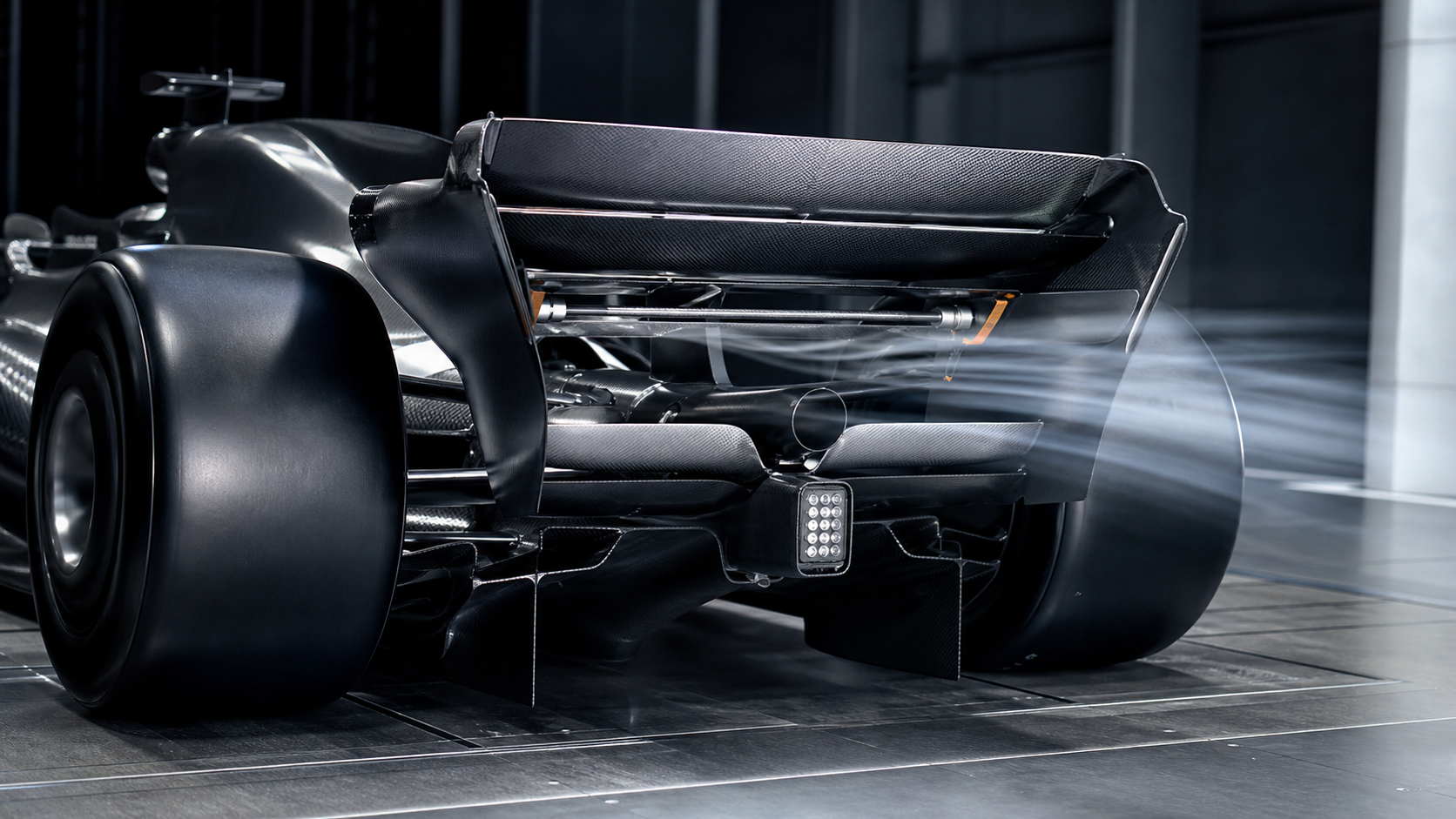
Formula 1’s 2026 active-aero era is doing what new rules usually do: starting wild, then narrowing.
Autosport’s August 9 technical review says McLaren has now adopted the rotating rear-wing idea first made famous by Ferrari and then Red Bull. That matters because McLaren is not a team throwing parts at a lost season. It is the reigning constructors’ champion, third in this year’s standings, fresh from Lando Norris winning in Hungary, and still trying to prove its mid-season upgrade push can travel beyond one high-downforce weekend.
GearPulse’s view: this is today’s most interesting F1 story because it turns the “Macarena wing” from a Ferrari/Red Bull curiosity into a grid-convergence signal. When McLaren decides the concept is worth its aero-testing time and budget-cap spend, the question changes. It is no longer whether the idea is clever. It is whether the idea is becoming too valuable to ignore.
Why this rose today
The current source trail is strong enough for a Daily Dose story. Autosport published a same-day mid-season technical review highlighting McLaren’s move toward the rotating-wing path. Yahoo Sports carried recent reporting on why McLaren has been cautious about introducing its own pivoting rear-wing solution. Formula 1 has official technical explainers for the 2026 active-aero rules and a separate official comparison of Ferrari and Red Bull’s early versions. The Race and Motorsport Technology add useful background on how quickly rivals began studying Ferrari’s solution after testing.
It is also fresh for GearPulse. The July 7 Daily Dose article looked at rotating rear wings through Red Bull’s failure and FIA safety-pressure lens. This is a different chapter. McLaren is not the team with the public failure problem. McLaren is the team deciding whether the fastest path back toward Mercedes and Ferrari includes adopting a rival’s most visible 2026 idea.
The timing helps. F1 is in its summer shutdown, which means no track result can drown out the development story. The next race is Zandvoort on August 21-23, and the second half gives teams 12 more weekends to turn one successful concept into a championship lever.
What the rotating-wing idea actually solves
The 2026 rules replaced the old DRS world with active aero. Formula 1’s regulation explainers describe the basic trade: on straights, the front and rear wing flaps move into a lower-drag Straight Mode; in corners, they return to a higher-downforce Corner Mode.
That sounds simple until teams start looking for the edge. A conventional active rear wing can flatten its elements and cut drag. Ferrari’s more radical interpretation went further by rotating the rear element so aggressively that the visual effect looked almost upside down. Red Bull arrived with its own version in Miami, with a different geometry and mechanism. McLaren, according to the current reporting, has moved toward a concept closer in architecture to Red Bull than Ferrari, using a central-actuator style rather than Ferrari’s endplate-heavy solution.
The performance target is not mysterious. If a team can open a bigger effective slot, reduce induced drag and keep the car aerodynamically stable during the transition back to Corner Mode, it buys speed on the straights without giving away as much confidence in braking and turn-in.
That is why the idea spread. It attacks one of the hardest compromises of 2026: the car needs to be slippery enough in Straight Mode, stable enough when the wing reattaches, and predictable enough for drivers who are already juggling energy deployment, boost and tyre temperature.
Why McLaren’s copy is not just a copy
In F1, copying is rarely plug-and-play. A rear wing is not a detachable clever object. It talks to the beam wing, diffuser, floor edge, engine cover flow, cooling layout and rear suspension packaging. A version that works on Ferrari’s SF-26 does not automatically work on McLaren’s MCL40.
That is what makes McLaren’s decision interesting. The team appears to have waited long enough to understand the concept, watch Red Bull and Ferrari expose its strengths and risks, and then build a version that fits its own car architecture. That is conservative in timeline, but not necessarily conservative in ambition.
The better comparison is McLaren’s own 2026 season arc. Before Hungary, McLaren had spent much of the year looking like a team paying the bill for its 2025 title fight. Norris and Oscar Piastri were still in the mix, but Mercedes and Ferrari had more consistent front-running form. Hungary changed the tone. Norris won, Piastri was fast before retirement, and the upgrade package looked like something more than a one-weekend patch.
Adding a rotating-wing route now suggests McLaren sees more room to grow in the same broad performance family as Ferrari and Red Bull. It is not a confession that McLaren had the wrong car. It is an admission that, under this ruleset, some ideas become standards once the stopwatch keeps validating them.
The risk McLaren cannot ignore
The reason McLaren’s caution matters is that this is not a harmless small flap.
GearPulse has already covered the Red Bull side of the story: when the rear wing does not return cleanly to its cornering state, the driver loses the aerodynamic promise he expected at exactly the wrong point of the lap. That is a safety and confidence issue, not just a lap-time issue.
McLaren’s advantage is that it can learn from the public pain of others. Red Bull had the most visible reliability and trust problem. Ferrari showed that an extreme version can be made race-relevant without the same public pattern of failure. The FIA’s official rules framework still requires active-aero systems to behave predictably and fail safely. McLaren’s task is to make the performance gain boring in operation.
That is the development sweet spot. The wing can look dramatic in photographs. It has to feel undramatic to Norris and Piastri at 300 km/h.
The championship context
Formula 1’s official standings put Mercedes on 379 points, Ferrari on 307, McLaren on 220 and Red Bull on 177. In the drivers’ table, Kimi Antonelli leads with 219 points, Lewis Hamilton has 169, George Russell 160, Norris 128, Max Verstappen 109 and Piastri 92.
That tells the practical story. McLaren is too far back to behave like a team managing a comfortable title lead, but too competitive to stop chasing 2026. Norris is 91 points behind Antonelli, and McLaren trails Mercedes by 159 in the constructors’ fight. Those gaps are large, but the calendar still has a big second-half points pool, including Sprint weekends.
So the rotating wing is not just technical theatre. It is part of the argument for whether McLaren can turn Hungary into a trend. If the MCL40 now has the high-downforce baseline and gains a better Straight Mode solution, Norris can become a bigger problem for Ferrari and Mercedes at circuits where McLaren previously lacked efficiency.
The Piastri angle is different. He needs the same upgrade to restore weekend consistency and keep McLaren from becoming a one-car story. A rotating wing that expands the setup window helps both drivers. A rotating wing that demands narrow confidence or creates awkward balance transitions may favor the driver who adapts faster.
Comparison board
| Team | Current rotating-wing meaning | Main caveat |
|---|---|---|
| Ferrari | Original headline concept and a visible proof of rule creativity. | Extreme solutions must keep correlating across downforce levels. |
| Red Bull | Aggressive interpretation with clear speed temptation. | Public reliability and driver-trust scars raised the burden of proof. |
| McLaren | Later adoption after studying rival paths. | It must integrate the idea without losing the balance that made Hungary work. |
| Mercedes | Championship leader without being the loudest aero-concept story. | If rivals converge successfully, points management gets harder. |
The key is that convergence does not mean equality. It means the development race has found a shared direction. The next gains come from packaging, reliability, transitions and how cleanly each team can make the wing work with its floor.
Probability board
This is editorial analysis, not betting advice:
| Question | GearPulse read |
|---|---|
| McLaren’s rotating-wing route becomes a regular second-half race item | 65-75%, because the team appears to have waited for a mature enough interpretation rather than rushing a visual stunt. |
| The concept spreads further across the grid before the end of 2026 | 70-80%, because active aero rewards drag-reduction efficiency and rivals now have months of public evidence to study. |
| McLaren immediately becomes Mercedes’ main title threat | 30-40%, because the standings gap is large and Hungary alone does not prove every circuit profile. |
| The FIA tightens wording before 2027 if reliability concerns continue | 45-55%, because active aero is now a safety system as much as a performance tool. |
The most likely near-term outcome is not a magic McLaren leap. It is a tighter second-half development race, with McLaren joining the concept family that Ferrari and Red Bull made impossible to ignore.
Fun fact
Formula 1’s rear-wing story has come a long way from DRS, which arrived in 2011 as a controlled overtaking aid. In 2026, the rear wing is no longer just a pass button. It is part of the car’s lap architecture, moving with the front wing and interacting with the energy system. That is why the most interesting innovation of the year looks like a wing trick but behaves like a whole-car philosophy.
The nickname is fun. The real point is harsher: F1 teams are extremely good at turning one team’s weird idea into everyone’s homework.
Skipped candidates
George Russell’s engagement was widely shared and current, but it is a personal-life story with limited F1 sporting or technical substance for Daily Dose.
The final Dutch Grand Prix at Zandvoort remains a strong upcoming calendar angle, especially with the first Sprint there and the August 21-23 date now close. It has official Formula 1 and Dutch GP sources, but the underlying news was already known and today’s pickup was more schedule/travel than a fresh competitive development.
McLaren team-backing debate after Norris’s Hungary win had some media traction, but it overlaps too closely with GearPulse’s July 25 and July 26 McLaren Hungary articles unless the team issues a clearer new policy signal.
Red Bull decline analysis and Cadillac seat chatter were also visible in the news mix. Red Bull has been covered repeatedly through active aero, Verstappen trust and Verstappen Racing. Cadillac was covered on August 6, and today’s related chatter did not add enough confirmed material to justify another Daily Dose.
Bottom line
McLaren joining the rotating-wing club is not shocking because F1 teams copy. It is important because McLaren chose to copy this.
Under the 2026 rules, the rear wing is now a live performance system, not a passive piece of bodywork. Ferrari made the idea visible. Red Bull made it aggressive and controversial. McLaren is now trying to make it useful without inheriting the drama.
GearPulse’s bottom line: if McLaren can blend the rotating-wing gain with the Hungary upgrade’s balance, the second half of 2026 becomes less about who found the trick first and more about who can make the trick repeatable.