
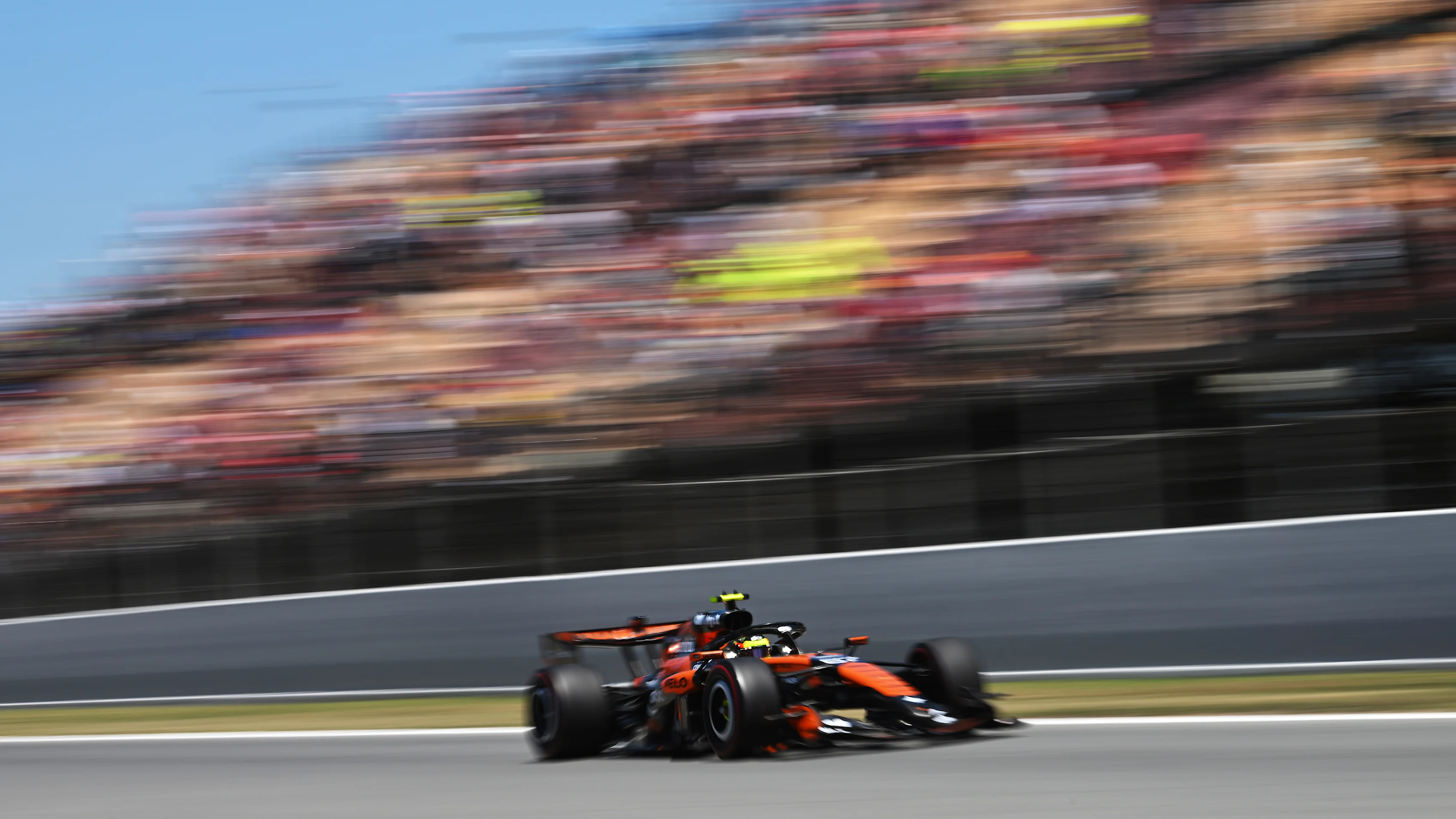
McLaren has picked an awkward weekend to be efficient.
The team arrives at the Hungarian Grand Prix with the upgrade it has been pointing toward for weeks: a new floor, extra aerodynamic parts and a revised version of its experimental rear wing. Formula 1’s own report says Leonardo Fornaroli will drive Oscar Piastri’s car in FP1 while those parts begin their on-track evaluation. McLaren’s preview adds the circuit reason this matters: Budapest rewards high downforce, braking confidence, corner entry and traction, while giving drivers very few long straights on which to recover from a compromised lap.
That is why today’s most interesting F1 story is not simply “McLaren has upgrades.” It is the way McLaren is choosing to learn them.
GearPulse’s view: Hungary is McLaren’s first serious chance to turn the MCL40 from a recovery project back into a front-running car, but the team is spending the first hour with one race driver out of the loop and one experimental aero device not intended to race. That is not necessarily a mistake. It is a tradeoff.
Why this story rose today
The source stack is unusually clean for a pre-weekend technical story. Formula 1 confirmed both Fornaroli’s FP1 run and McLaren’s upgrade package. McLaren’s own preview gave the official team context through senior racing director Randy Singh, who highlighted high downforce, tyre management, power-unit deployment and revised overtaking behaviour as the Budapest priorities. Motorsport.com and Crash.net both detailed the delayed rear-wing test, including the important caveat that the part is planned for FP1 data gathering rather than a Hungary or Zandvoort race debut. RacingNews365 and Speedcafe repeated the Piastri angle: the Australian gives up the opening hour just as the upgraded car needs correlation laps.
There is also a calendar reason the story has traction. Hungary is the last race before the summer shutdown. If the package works, McLaren gets several weeks to turn one useful Budapest read into a second-half development direction. If it does not, the break becomes an autopsy.
That is a sharper story than another general Hungarian GP preview, and it is different from GearPulse’s recent McLaren pieces. The July 8 article was about F1’s customer-engine problem. The July 16 article was about Norris taking a Spa power-unit penalty. This one is about the chassis team’s long-awaited answer.
The Piastri-Fornaroli swap is not just paperwork
The FIA’s 2026 sporting regulations require teams to run inexperienced drivers in each car across the season, and Fornaroli is exactly the kind of driver the rule is designed to help. He is 21, a McLaren reserve and development driver, and already had a Barcelona FP1 run earlier this year.
On paper, this is routine. In practice, the timing is uncomfortable.
Piastri is not giving up a ceremonial install-lap session. He is giving up the first live read on a package that includes a new floor and surrounding aero pieces. The Hungaroring then compresses the learning window because the lap is short, busy and thermally punishing. A driver who misses FP1 still has FP2 and FP3, but the early language of the weekend often gets written in the first 60 minutes: ride height, braking stability, kerb response, cooling, tyre warm-up and whether the simulator map was telling the truth.
For Fornaroli, that is a useful audition. For Piastri, it is a small competitive tax. For McLaren, it is a trust exercise.
The more generous read is that McLaren clearly rates Fornaroli’s preparation enough to put him in the car when the data matters. The harsher read is that Piastri, already trying to regain rhythm after Spa, loses the first touch of a car he needs to understand quickly.
Both can be true.
The rear wing is the headline part that probably will not race
The most shareable part of the story is McLaren’s revised “Macarena” rear wing, the nickname being used for the upside-down rotating-wing concept that has already made Red Bull and Ferrari part of F1’s active-aero safety conversation.
Motorsport.com reports that McLaren intended to try the concept in Austria FP1, ran into garage problems, took it back to the factory and now plans to test a developed version in Hungary. Formula 1 and Crash.net both note the crucial limitation: it is not scheduled to be introduced fully in Hungary or at the next race in the Netherlands.
That makes the wing a research tool, not a weekend miracle.
The context matters because Red Bull’s own attempts with a similar family of idea have been messy. GearPulse covered the rotating-wing safety story earlier this month after Red Bull and Ferrari’s concepts drew attention. The current McLaren plan looks more cautious: run it, measure it, remove it, decide later. That is the sensible way to treat a device that has to work across straight-line drag reduction, braking stability, airflow reattachment and driver confidence.
If the wing test goes well, Monza and Baku are the obvious future targets. Both reward low drag far more than Hungary. If it goes badly, McLaren can still learn from the session without compromising the race package.
The real upgrade is underneath
The floor matters more than the wing.
That is less glamorous, but more important. Modern F1 development still lives and dies around floor load, balance consistency and how predictable the car feels as ride height, yaw and kerb strikes change through a lap. McLaren’s official line is that Hungary will help it gather understanding on the new parts through practice. Motorsport.com adds the bigger context: McLaren has been trying to turn a clearer development direction into physical parts after falling behind the front group.
The Hungaroring is a good place to expose whether that direction is real. It has 14 corners, only a 4.381 km lap, and a race distance of 70 laps. Aston Martin’s circuit guide, useful even outside its own team context, notes the C3, C4 and C5 tyre allocation, limited cooling opportunities, high temperatures and the track’s history of tyre-delta strategy. That is exactly the kind of place where a floor that looks good in clean air but abuses the tyres will be found out quickly.
Fun fact: Hungary’s list of first-time winners includes Fernando Alonso in 2003, Jenson Button in 2006, Esteban Ocon in 2021 and Oscar Piastri in 2024. McLaren does not need another fairy tale this weekend. It needs dull, repeatable correlation.
Norris has the cleaner Friday, Piastri has the sharper question
Lando Norris should benefit most from the schedule. He gets the normal FP1-to-FP2 progression with the new parts, which is valuable when a car needs setup direction quickly. That does not mean he is automatically advantaged for the race, but it does mean McLaren’s earliest comparison will likely lean on Norris’s feedback.
Piastri’s weekend is trickier. He should still have enough running to adapt, especially because Hungary is a standard format rather than a Sprint weekend, but every missed early run matters when the team is trying to understand a new floor.
The probability board, as editorial analysis rather than betting advice, looks like this:
| Question | GearPulse read |
|---|---|
| McLaren keeps the new core package on both cars for qualifying | 70-80%, because the floor and aero pieces are the real Budapest plan. |
| The experimental rear wing races in Hungary | 5-10%, because multiple reports say it is not scheduled for full introduction this weekend. |
| Norris looks more comfortable than Piastri on Friday | 55-65%, mostly because he gets the full first-session progression. |
| McLaren closes meaningful ground on Mercedes and Ferrari immediately | 35-45%, because correlation gains rarely arrive fully formed on day one. |
The upside is obvious. If McLaren leaves Budapest with a cleaner high-downforce car, it can stop talking about survival and start talking about direction. The risk is that the upgrade only confirms how much work remains.
Skipped candidates
Aston Martin’s Hungary upgrade package had strong current pickup, including a Formula 1 explainer and the team’s own Hungary race page. GearPulse already published the core Aston Martin Hungary-upgrade credibility angle on July 14, so today’s new material was useful context but too close to repeat as the Daily Dose lead.
Another Russell/Mercedes Hungary diagnostic piece had official F1 pickup in the race-week storylines, but GearPulse covered that exact Mercedes problem on July 21.
Ferrari’s slow-corner Hungary optimism is relevant after Spa, but the best current material was less official and less concrete than McLaren’s confirmed package plus FP1 driver allocation.
Hungarian GP weather and schedule stories were timely, but they were service pieces rather than GearPulse-grade analysis topics.
Bottom line
McLaren’s Hungary upgrade is the right story because it carries more than one pressure point. The car needs performance, Norris needs a clean development weekend, Piastri gives up the first run in the upgraded package, Fornaroli gets a meaningful audition, and the rear-wing experiment remains fascinating precisely because McLaren is not ready to race it yet.
GearPulse’s bottom line: Budapest will not decide McLaren’s season by itself, but it will tell us whether the team’s second-half recovery is based on real correlation or just another promising parts list.