
Hungary’s qualifying hour did something Friday practice had not: it converted McLaren’s upgrade talk into hard evidence.
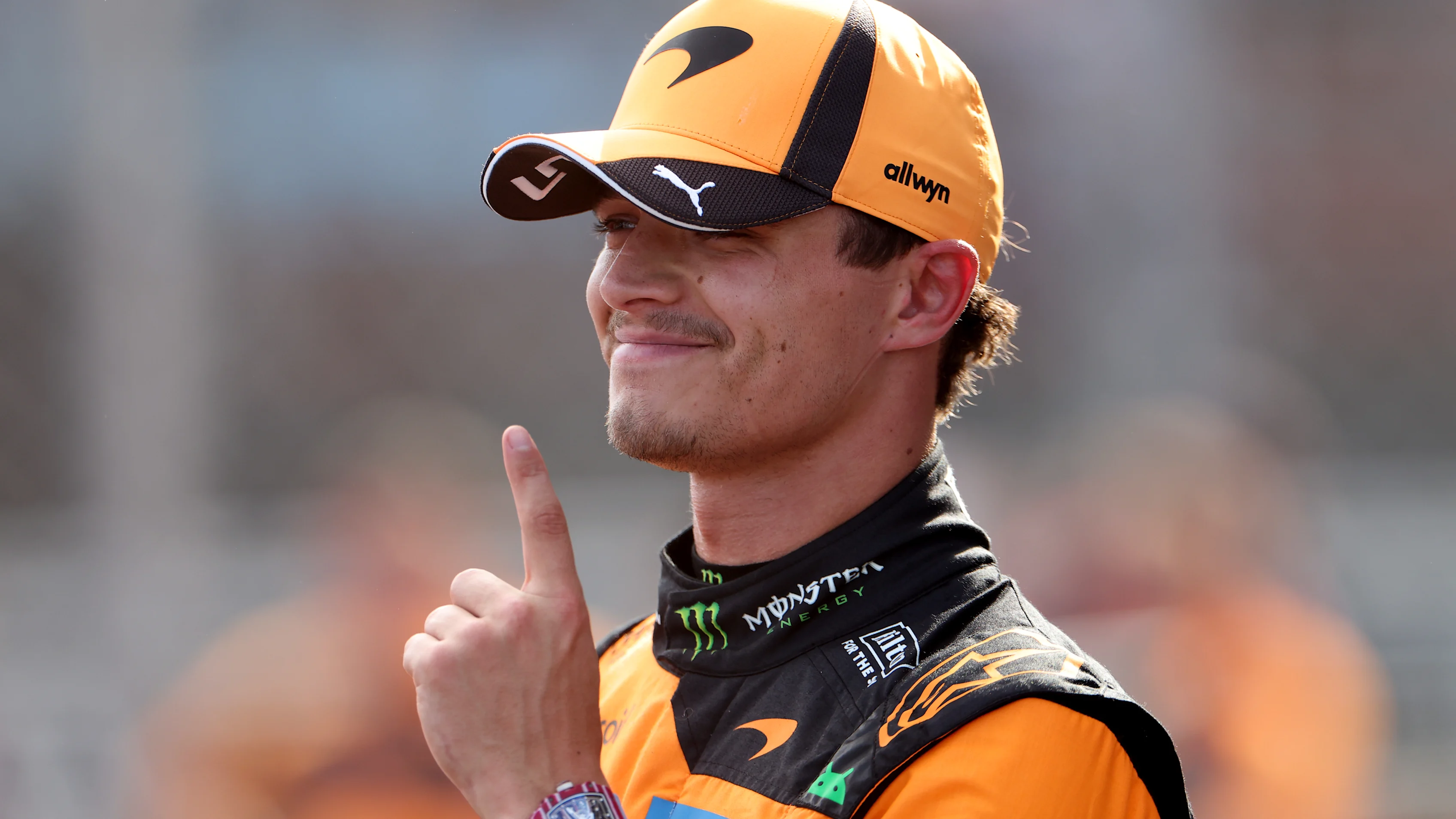
Lando Norris took pole at the Hungaroring with a 1:17.207, beating Lewis Hamilton by 0.012s in a session that had looked ready to reward Ferrari until the final lap. Formula 1’s official report then added the second half of the story: Hamilton was dropped three places for impeding Oscar Piastri, while Kimi Antonelli was hit with the same grid penalty for failing to slow under single yellow flags.
GearPulse’s view: this is the most interesting F1 story of the day because it is not just a pole lap. It is McLaren’s first real proof that its Budapest upgrade has changed the front order, and it arrives with enough penalty noise, tyre variation and title pressure to make Sunday’s race much harder to read than the headline suggests.
Why this story rose today
The source stack is strong and current. Formula 1’s qualifying report has Norris on pole, Hamilton initially second, Charles Leclerc third, Antonelli fourth and Piastri fifth before the penalties reshuffled the race grid. Formula 1’s results page records the exact Q3 order and the penalty notes. McLaren’s own qualifying report says the team left Saturday with pole and encouragement that the upgrade package is working as expected. Sky Sports F1 had already flagged the change in FP3, when Norris topped final practice after Ferrari had controlled Friday.
The reliable-media pickup was also immediate. The Guardian framed Norris as the first driver to deny Mercedes pole this season and noted McLaren’s recent upgrade momentum. Motorsport.com followed the sporting consequences through Hamilton’s penalty, Ferrari’s admission that its communication was at fault, Antonelli’s yellow-flag penalty and the provisional grid.
That makes the story more substantial than a simple qualifying recap. GearPulse covered McLaren’s Hungary upgrade on July 22, but that article was about the plan: the new package, Leonardo Fornaroli’s FP1 run and Oscar Piastri’s lost practice hour. Today’s article is about the proof.
McLaren got the answer it needed
There are two ways to read a new upgrade at a high-downforce track. One is the engineering read: does the car correlate, does it respond to setup, and do both drivers recognise the balance? The other is the brutal F1 read: does it make the stopwatch move when everyone is trying?
McLaren now has the second answer.
Norris had already topped FP3 with a 1:17.939, 0.117s clear of Hamilton and 0.129s ahead of Antonelli, according to Sky Sports F1. That mattered because Friday had belonged to Ferrari. McLaren needed Saturday to show that its Friday programme was not simply a slower start after Piastri gave up FP1 and the team worked through new parts.
Qualifying then gave the team a cleaner signal. Norris was fastest in Q1, competitive through Q2, and quickest when Q3 turned messy. Formula 1’s report says Hamilton chose to run early for his final attempt, while Norris went last and had to thread the lap through late yellow-flag disruption caused by Max Verstappen spinning and George Russell stopping with a water leak.
That is the sort of pole that carries more weight than the margin. A 0.012s gap is tiny, but the context says McLaren’s car was usable when the session was least comfortable.
The Piastri caveat still matters
McLaren’s weekend is not automatically clean because Norris delivered.
Piastri was fifth on the qualifying timesheet, 0.477s off Norris before the grid penalties changed the race order. The gap needs context. Piastri missed FP1 for Fornaroli’s rookie-driver outing, and that mattered more than usual because McLaren was introducing a meaningful Hungary package. Losing the first hour is rarely decisive, but it can make the rest of the weekend feel like translation work: the car has changed, the track is evolving and the driver is rebuilding references while the other side of the garage already has a complete Friday-to-Saturday arc.
The upside for McLaren is that Piastri still starts close enough to be useful in race strategy. Hamilton’s penalty promotes him in the order, and Antonelli’s penalty changes the Mercedes threat behind. The problem is that the team now has one driver with the cleanest launch position and one driver whose weekend still carries a setup-time caveat.
That makes the race more tactical than the pole suggests. McLaren can attack with Norris, but it may need Piastri to cover Ferrari, Mercedes or Verstappen rather than simply chase the same race.
Ferrari lost the part it controlled
Ferrari’s Friday made it look like the team had the best high-downforce car in Hungary. Saturday made that less certain, but not irrelevant.
Hamilton was only 0.012s away from pole, and Leclerc was third on raw pace. On a circuit where passing is difficult, that should have been a two-car platform to squeeze McLaren on Sunday. Instead, Hamilton drops to fifth after the stewards found he impeded Piastri, with Motorsport.com reporting Ferrari accepted responsibility for the late warning.
That distinction matters. This was not a Ferrari pace collapse. It was an execution error on a weekend where execution is half the circuit. The Hungaroring is short, narrow, busy and often compared to Monaco without the walls. Traffic management in Q3 is not a side detail there; it is part of performance.
The practical result is that Leclerc inherits the lead Ferrari role near the front, while Hamilton has to treat Sunday as damage limitation from a grid slot that makes the opening lap and strategy more complicated. Ferrari still has pace, but it no longer has the simple two-car squeeze it had earned on Friday.
Mercedes left with a messy title-risk day
Mercedes entered Hungary trying to show that George Russell’s recent software and deployment issues had moved from mystery to fix. Instead, Saturday created two different problems.
First, Russell was seventh on the qualifying sheet and stopped in Q3 with a water leak. Formula 1’s race hub carried Mercedes’ update as one of the immediate post-qualifying stories, and The Guardian’s live coverage noted Toto Wolff describing the issue as unlucky. That does not sound like a race-ending certainty, but it is exactly the wrong kind of noise for a team trying to look technically settled before the summer break.
Second, Antonelli’s fourth-place qualifying result became seventh on the grid after his yellow-flag penalty. The championship leader had shown enough pace to be in the front fight after missing FP1, but the penalty pushes him into the part of the grid where Hungary can become a queue.
That changes the title arithmetic. Antonelli does not need to win every weekend, especially after Spa strengthened his points position. But he does need clean Saturdays when Norris, Ferrari and Verstappen are close enough to turn one awkward starting spot into a lost podium.
What the grid now says
The raw qualifying order made McLaren, Ferrari and Mercedes look compressed. The penalty-adjusted race picture is more awkward:
| Driver/team | Saturday signal | Sunday question |
|---|---|---|
| Lando Norris, McLaren | Pole by 0.012s, first pole of McLaren’s season. | Can he control a track where Ferrari starts directly behind? |
| Charles Leclerc, Ferrari | Third on pace, promoted after Hamilton’s penalty. | Can he turn Ferrari’s Friday speed into race pressure? |
| Oscar Piastri, McLaren | Fifth on pace after missing FP1. | Can he recover enough rhythm to support Norris strategically? |
| Max Verstappen, Red Bull | Sixth on pace after a Q3 spin, then promoted by penalties. | Is Red Bull’s race pace better than its qualifying drama? |
| Lewis Hamilton, Ferrari | Second on pace, dropped three places for impeding. | Can he pass without overheating tyres or strategy? |
| George Russell, Mercedes | Seventh on pace, Q3 water-leak stoppage. | Is the car reliable and balanced enough for recovery? |
| Kimi Antonelli, Mercedes | Fourth on pace, dropped for yellow flags. | Can the points leader limit damage from the pack? |
The key point is that Norris has the best position, but not a clean mismatch. Ferrari’s single-lap pace was real. Mercedes’ race pace may be less poor than its qualifying looked. Piastri and Verstappen are both close enough to force strategy choices.
Probability board
This is editorial analysis, not betting advice:
| Question | GearPulse read |
|---|---|
| McLaren’s Hungary upgrade is a genuine front-running step | 75-85%, because it produced FP3 pace, pole and positive primary-team feedback. |
| Norris controls the race from the front | 45-55%, because Hungary rewards track position but Ferrari’s start and tyre options are credible threats. |
| Ferrari still has the fastest race car | 30-40%, because Friday pace was strong but Saturday reduced the certainty. |
| Hamilton returns to podium contention from fifth | 35-45%, because his pace is there but Hungary punishes traffic. |
| Antonelli leaves Hungary with his title lead feeling untouched | 40-50%, because the penalty increases first-lap and strategy exposure. |
The most likely race is not domination. It is a track-position contest in which the first stint decides whether McLaren’s upgrade becomes a win threat or simply a Saturday headline.
Fun fact
The Hungaroring’s first Formula 1 race was in 1986, and its reputation for limited overtaking is only half the story. It has also produced some of the sport’s most useful career markers: Damon Hill nearly won in an Arrows in 1997, Fernando Alonso took his first F1 win here in 2003, Jenson Button won his first in 2006, Esteban Ocon won in 2021, and Oscar Piastri became a Grand Prix winner here in 2024.
That history is why qualifying matters so much in Budapest. The place does not always crown the fastest theoretical race car. It often rewards the team that avoids one messy hour.
Skipped candidates
Ferrari’s Hamilton penalty was tempting as a standalone story because it had official Formula 1 coverage, Motorsport.com follow-up and a clear team-error admission. It works better inside the McLaren article, though, because the penalty reshapes the race created by Norris’s pole rather than replacing it as the main sporting point.
Antonelli’s yellow-flag penalty was important for the title fight, but it was narrower than the combined McLaren-Ferrari-Mercedes qualifying story and risked repeating recent Mercedes diagnostic coverage from July 21 and July 23.
Aston Martin’s upgraded AMR26 progress remained interesting after Alonso made Q2, but GearPulse already covered Aston Martin’s Hungary upgrade gamble on July 14. Today’s evidence is useful context rather than a fresh Daily Dose lead.
The wider calendar-contingency chatter around Malaysia and Imola had search interest, but it lacked the same fresh official confirmation and immediate sporting substance as qualifying in Hungary.
Bottom line
McLaren needed Hungary to prove its new parts were not just a better-looking development plan. Norris gave the team that proof at the exact moment Ferrari looked ready to own the weekend.
The caveat is that the race has become more complicated, not less. Hamilton’s penalty removes Ferrari’s cleanest two-car launch, Antonelli’s penalty exposes Mercedes’ title leader to traffic, Piastri still carries the cost of a disrupted Friday, and Verstappen starts close enough to turn any front-pack hesitation into a problem.
GearPulse’s bottom line: McLaren’s upgrade is now real enough to change Sunday’s equation. The question is whether Norris can turn one brilliant lap into the controlled race McLaren has been trying to build toward all week.