
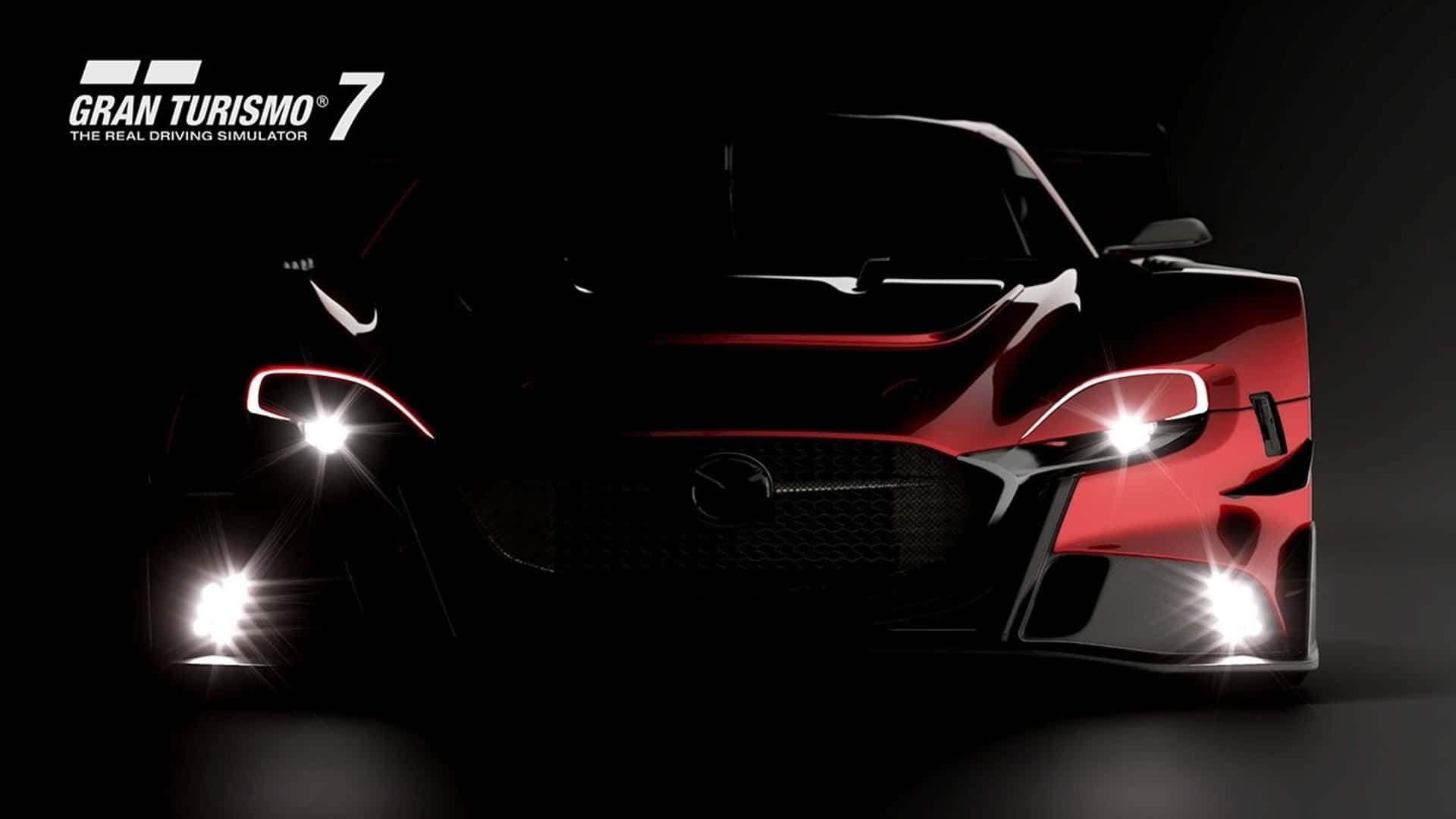
Mazda has found a way to launch another rotary race car without emissions certification, a homologation budget or a production line. The RX-Vision GT3 Evo is headed to Gran Turismo 7 later in 2026, where a virtual engine can rev to the sky and a body can be reshaped around modern racing ideas without troubling an accountant.
That distinction matters. This is not a road-going RX-7 successor and not evidence that Mazda will build one. It is an evolution of the digital RX-Vision GT3 Concept introduced in 2020, itself based on the gorgeous RX-Vision road concept Mazda revealed in 2015.
Once the fantasy is placed in the correct box, the Evo becomes more interesting. Mazda and Polyphony Digital are refreshing a six-year-old Gr.3 flagship at a moment when real GT racing has moved toward more aggressive aerodynamics, cooling and continuous “Evo” updates. A sim-racing grid benefits from the same sense of technical time passing.
What is new—and what is not confirmed
Motor1 reports that Mazda revealed the RX-Vision GT3 Evo during the Gran Turismo World Series event in Berlin, with an in-game arrival planned before the end of 2026. The images show a car made visibly more serious: larger cooling openings, a more complex front treatment, revised side aero, a tall rear wing and a deeper diffuser.
Final performance figures, price in game credits and a precise update date have not been announced in the sources available at publication. It would be easy to copy the old car’s numbers into an “Evo specs” table and imply certainty. That would be wrong.
What Mazda officially specifies for the existing RX-Vision GT3 Concept is already dramatic:
| Official existing-car specification | Mazda RX-Vision GT3 Concept |
|---|---|
| Engine | Naturally aspirated SKYACTIV-R four-rotor |
| Displacement | 2,600 cc |
| Maximum output | 570 PS at 9,000 rpm |
| Maximum torque | 540 Nm at 7,500 rpm |
| Weight | 1,250 kg |
| Weight distribution | 48:52 front/rear |
| Layout | Front-engine, rear-wheel drive |
| Dimensions | 4,590 x 2,075 x 1,120 mm |
Those figures describe the current Concept, not the Evo. Gran Turismo’s Balance of Performance can also alter power and weight for competitive events, so even a future showroom number will not necessarily describe how the car runs in every Sport Mode race.
Why a virtual Evo makes sense
The original car was a co-development between Mazda designers and Polyphony Digital’s modelers. Mazda says the team approached it much like a production design project, moving from component sketches to 3D modeling while considering cooling, downforce, weight distribution, cockpit ergonomics and visibility.
It is fictional, but not careless. The long hood and compact cabin come from the RX-Vision road concept; the wide track, hood outlet, splitter, rear wing and diffuser translate that shape into Mazda’s interpretation of a Gr.3 racer. Gran Turismo added it to GT Sport in May 2020 as the headline car in update 1.59. It later became one of Mazda’s defining competition cars in the series.
Six years is a long life for a race-car design. Real manufacturers use Evo packages to improve cooling, drivability, serviceability and aero balance without replacing an entire homologated model. Polyphony does not have to obey a real GT3 homologation process in its fictional Gr.3 category, but borrowing the visual language of that process helps the grid feel contemporary.
The Evo also gives Mazda players a fresh manufacturer identity. Adding another real GT3 car would improve authenticity; updating a brand-specific fictional car improves continuity. Ideally, Gran Turismo 7 keeps doing both.
Do not mistake digital development for a production promise
The RX-Vision shape has spent more than a decade encouraging speculation about a new rotary sports car. Mazda itself describes the 2015 base concept as a dream vehicle it hoped to make real one day. That history makes every new render feel loaded.
But the GT3 Evo removes the hardest constraints. Its four-rotor engine does not need to pass a drive-by noise test. Its body does not need pedestrian-impact clearance. Its price does not need to recover tooling costs from a small sports-car audience. A virtual racer can express what Mazda loves about the rotary without proving that a showroom business case exists.
The distinction does not diminish the project. Digital cars can be meaningful design work, especially when millions of players can drive them rather than merely circle a motor-show plinth. The steering response, tire use and Balance of Performance will ultimately matter more to regular players than whether the car predicts a future product.
That is also why Polyphony needs to get the release details right. The original RX-Vision’s combination of modest mass, rearward weight balance and high-revving power gave it a distinct character. An Evo that is only a visual reskin would waste the opportunity. Revised aero behavior, useful cockpit detail and competitive but not dominant BoP would make the update feel earned.
Bottom line
The RX-Vision GT3 Evo should be judged as a new tool for Gran Turismo 7, not a coded message from Mazda’s road-car department. On that basis, it is an appealing update: one of the game’s most elegant fictional racers is being pulled toward the look of current GT competition without losing the naturally aspirated four-rotor idea that makes it special.
The caveats are straightforward. Mazda and Polyphony have not supplied final Evo specifications or a firm release date beyond later in 2026, and no one outside the development loop can yet say how it drives. Players should wait for update notes before treating any performance claim as settled.
Still, this is the right kind of fantasy. It gives Mazda a modern Gr.3 hero, gives sim racers a fresh machine to learn and lets a rotary engine do what it does best in the imagination: rev freely, sound outrageous and refuse to become ordinary.