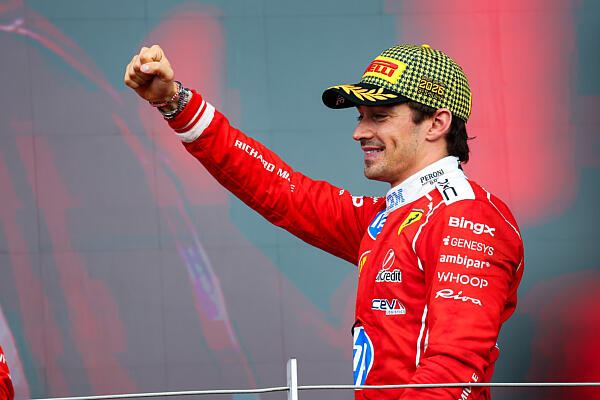
Ferrari’s British Grand Prix weekend had already been interesting. Charles Leclerc made it consequential.
Formula 1, the FIA and Ferrari all confirm the important shape: Leclerc won at Silverstone ahead of George Russell and Lewis Hamilton, Kimi Antonelli fell out of the points after a late car issue, and Max Verstappen’s crash brought the race to a Safety Car finish. The FIA provisional classification put Leclerc only 0.427s ahead of Russell and 0.772s ahead of Hamilton, which tells you how compressed the final order looked once the race was neutralized.
That is why this is today’s Daily Dose of F1 story. GearPulse has already covered Hamilton’s Sprint pole, McLaren’s upgrade puzzle, Antonelli’s dominant Saturday and the pressure of the official starting grid. Leclerc’s win is the next real development, not a duplicate: Ferrari converted, Mercedes lost a likely victory path, and the championship leader took his first heavy Sunday hit of the Silverstone weekend.
GearPulse’s view: this was not a clean Ferrari domination, and that is exactly why it matters. It was a messy, high-value win on a weekend when Ferrari had to prove its pace could survive real race pressure.
The win was earned, but not simple
Leclerc’s race was built at the start. Formula 1 and the FIA both describe the Ferrari driver getting away well from the front row and beating pole-sitter Antonelli into the opening phase. Hamilton also moved ahead of Antonelli early, turning Ferrari’s second-and-third grid slots into immediate leverage.
That first lap changed the strategic geometry. Ferrari was no longer simply trying to harass Mercedes from behind. It had the leader, a second car in the podium fight, and enough pace to force Mercedes to chase rather than control.
The caveat is important. Leclerc did not win by driving away from a perfect Antonelli race. Antonelli recovered after the start, fought back into contention, and looked capable of making the final stint uncomfortable before his late issue. Sky Sports F1 and RaceFans both framed the result around that swing: Leclerc took the trophy, but Antonelli’s failure changed the championship shape.
| British GP marker | Official/public signal | GearPulse read |
|---|---|---|
| Winner | Charles Leclerc, Ferrari | Ferrari finally converted its Silverstone pace into maximum points. |
| Podium gap | Russell +0.427s, Hamilton +0.772s | The Safety Car compressed the finish; it was not a runaway. |
| Antonelli result | Outside the points after late trouble | Mercedes lost a probable major score from the title leader. |
| Verstappen | Crash at Stowe in the closing laps | Red Bull’s weekend moved from recovery chance to damage limitation. |
| Safety Car finish | FIA says procedure was followed after an erroneous message | The result stands, but the ending was messier than F1 needed. |
That blend is the story. Ferrari did enough to win on merit, but the race also exposed how quickly the 2026 title picture can swing when reliability, track limits, penalties and Safety Car timing all stack up in one afternoon.
Ferrari’s double podium changes the argument
Ferrari did not leave Silverstone with a one-car headline. It left with Leclerc winning and Hamilton on the podium at his home Grand Prix.
That matters because Ferrari’s recent problem has not been a lack of isolated pace. It has been converting promising sessions into clean Sundays. Hamilton’s Sprint pole proved the car could hit a peak over one lap. Leclerc’s second on the Grand Prix grid proved it was not just a Hamilton-at-Silverstone emotional spike. The race result did the harder thing: it turned that pace into points.
There are still caveats. Hamilton had a complicated day, including penalty pressure and a late pit decision that left him behind Russell rather than completing a Ferrari one-two. Ferrari also benefited from Antonelli’s trouble and Verstappen’s late crash freezing the order. A team trying to win titles cannot rely on those gifts every week.
But the GearPulse read is that Ferrari has crossed a more useful threshold. It no longer looks like a team that needs a perfect weekend to bother Mercedes. At Silverstone, it had enough race pace, track position and operational resilience to turn an imperfect race into a first-and-third finish.
Mercedes took the title damage, not the disaster
Mercedes can argue this was a bad day with a controlled landing. Russell finished second, reduced Antonelli’s championship lead, and kept Mercedes on the podium after a race that could have disappeared once Ferrari jumped ahead at the start.
The damage is more subtle. Antonelli entered Sunday as the driver with the cleanest weekend story: Sprint win, Grand Prix pole, and the strongest public evidence of Mercedes control. By the end, he was explaining a race that fell apart late. Formula 1’s post-race coverage and Sky’s report both underline the same consequence: the championship lead survived, but it shrank.
For Russell, this is useful. Not season-defining, but useful. He did not beat Leclerc, and he did not dominate Hamilton, but he turned a Ferrari-led race into second place while his team-mate scored nothing. In a long title fight, those are the afternoons that keep a second Mercedes driver relevant.
The comparison inside Mercedes now gets sharper:
| Driver | Silverstone Sunday meaning |
|---|---|
| Kimi Antonelli | Still the benchmark over the weekend, but now carrying the first obvious “lost win” scar. |
| George Russell | Less explosive than Antonelli on Saturday, more productive when Sunday’s chaos arrived. |
| Lewis Hamilton | Not a Mercedes driver anymore, but still directly shaping Mercedes’ title math from Ferrari. |
That last point is the fun part of the 2026 season. Hamilton’s Ferrari move is no longer just a story about sentiment or adaptation. He is taking points from Mercedes while helping Ferrari become a more credible constructors’ threat.
Red Bull and McLaren lost different races
Red Bull’s race ended with the most dramatic visual: Verstappen in the gravel at Stowe and the Safety Car controlling the final laps. Formula 1’s official video and the FIA’s race report both make that sequence central to the ending. The wider Red Bull concern is not just the crash. It is that Verstappen was not dictating the front group before it happened.
That is a bad sign at Silverstone. This is a 5.891 km circuit that rewards aero confidence, efficient energy deployment and tyre stability through long loaded corners. If Red Bull is fighting balance or rear-end confidence there, Verstappen can still create moments, but the car is not giving him the normal control margin.
McLaren’s disappointment was quieter. Lando Norris finished fourth in the FIA classification, close enough to the podium to show there was race potential, but not close enough to make McLaren’s upgrade weekend feel like a breakthrough. After the attention on its Silverstone package, fourth was useful points rather than a statement.
Oscar Piastri’s race made the team picture worse. The Guardian’s live report and wider race coverage pointed to his first-lap trouble and recovery only to the edge of the points. That makes McLaren’s weekend hard to read: the car may be better than the headline result, but the execution did not deliver the proof.
The Safety Car ending needs a narrow reading
The ending was confusing, but it should not be inflated into a stolen-result argument without evidence.
Motorsport.com reported the FIA’s explanation that an erroneous “Safety Car In This Lap” message was displayed because of a software error, while Race Operations still followed the regulation requiring a lap after the unlapping procedure. In practical terms, that means the race ended behind the Safety Car even though teams and viewers were briefly led to expect a restart.
That matters for the spectacle. It does not automatically invalidate Leclerc’s win.
Ferrari, Mercedes and McLaren all had to react to the same neutralization. The official classification is clear. The sporting complaint is narrower: F1 cannot afford mixed race-control messaging at the end of a Grand Prix, especially at Silverstone, especially with the memory of past Safety Car controversies still baked into fan reaction.
GearPulse’s view is simple: the FIA explanation is enough to understand why the race did not restart, but the software-error note is also a reminder that modern F1’s procedural layer is now part of the product. When the messaging is wrong, the race can feel less decisive than the classification actually is.
Likelihood board after Silverstone
These are editorial reads only, not betting advice and not a claim of paddock access or private data.
| Post-Silverstone scenario | Likelihood | Why it fits the public evidence |
|---|---|---|
| Mercedes remains the title reference | 40-50% | Antonelli and Russell still have the strongest combined points and qualifying base. |
| Ferrari becomes the main pressure team | 30-40% | Leclerc won, Hamilton podiumed, and the car was fast across multiple Silverstone sessions. |
| McLaren is a spoiler rather than a title driver | 20-30% | Norris scored well, but the upgrade weekend did not become a front-control weekend. |
| Red Bull needs a reset more than a tweak | 20-30% | Verstappen’s crash and limited control suggest the car is too narrow in its window. |
| Antonelli’s lead starts to feel fragile | 25-35% | One failure day does not undo his form, but it gives Russell and Hamilton oxygen. |
The key distinction is between pace and control. Ferrari showed pace all weekend. Silverstone proved it can also extract a win when control is imperfect. That is a more threatening kind of progress than a single lucky result.
Fun fact with teeth
Silverstone was the site of Ferrari’s first Formula 1 World Championship win in 1951, when Jose Froilan Gonzalez beat Alfa Romeo and gave Enzo Ferrari a defining early breakthrough. Seventy-five years later, the same circuit has given Ferrari another useful reference point: not because this win has the same historic weight, but because Silverstone still measures the same virtues.
Fast direction changes. Wind exposure. Front-tyre load. Commitment through corners where hesitation ruins the lap. A Ferrari that works there is harder to dismiss as a narrow-track specialist or a one-session surprise.
That is the useful fun fact. Silverstone does not make fake contenders look convincing for long.
Bottom line
Leclerc’s British GP win is today’s F1 story because it changes the shape of the season more than another Silverstone subplot would. Antonelli’s Saturday made Mercedes look like the chased team. Sunday’s race reminded everyone that a title lead is not the same thing as control.
Ferrari still has work to do. Hamilton’s messy path to third, the reliance on Antonelli’s late issue, and the Safety Car finish all keep the result from becoming a clean “Ferrari is back” slogan. But the important part is not the slogan. It is the scoreboard.
Leclerc won. Hamilton helped turn it into a double podium. Russell kept Mercedes alive on a difficult day. Antonelli gave points away. Verstappen crashed out. McLaren did not convert its upgrade story into a podium.
That is enough substance for one conclusion: Silverstone did not hand Ferrari the 2026 title fight, but it did make Ferrari a problem Mercedes now has to treat as real.