
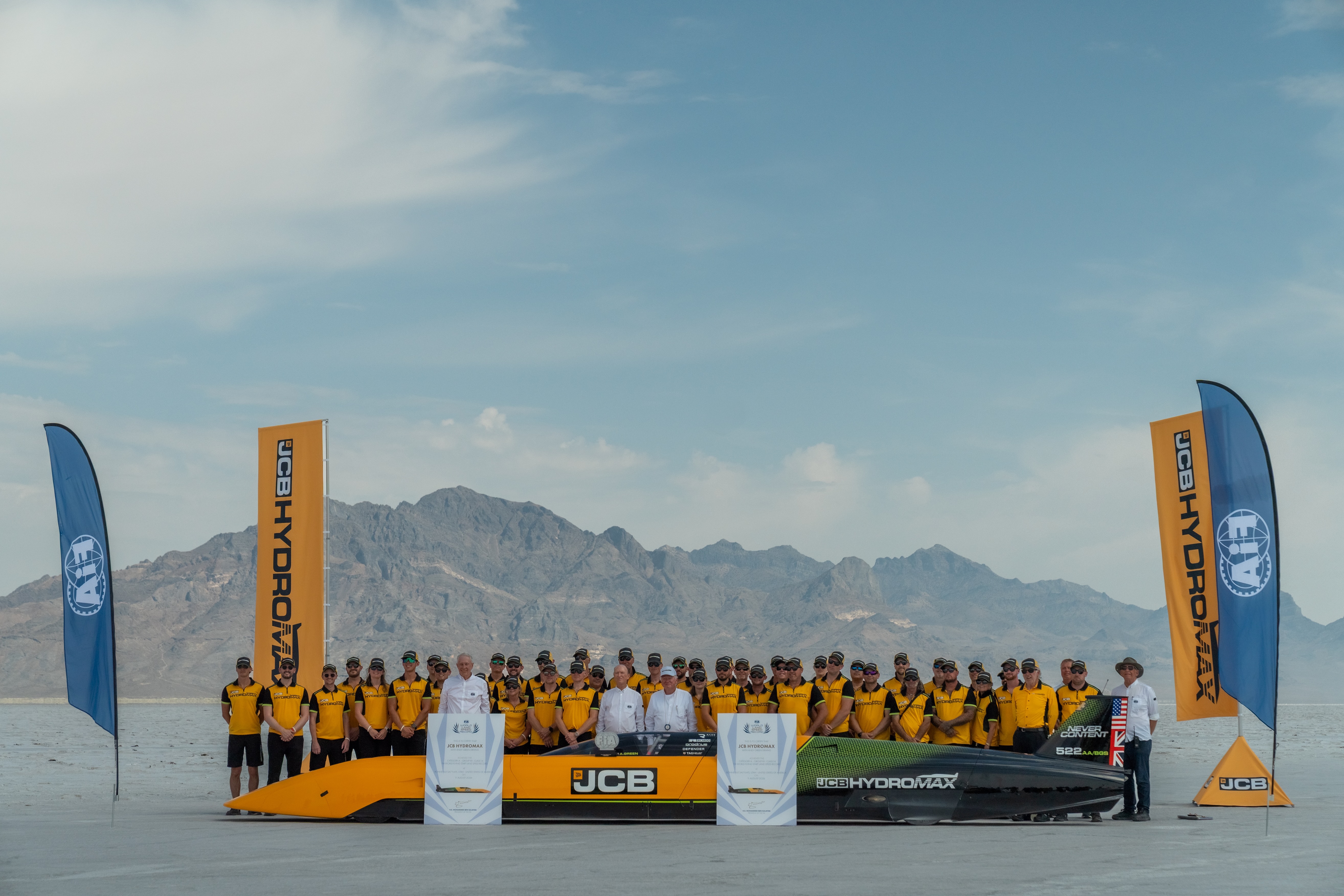
Hydrogen just got a number that even skeptics will remember: 406.320mph.
The FIA has confirmed a new provisional World Land Speed Record for a hydrogen internal-combustion vehicle after the JCB Hydromax ran at Bonneville Salt Flats in Utah on August 11, 2026. Wing Commander Andy Green OBE drove the 32-foot streamliner in the required two directions, with the FIA saying the record is set over a flying mile and kilometre, subject to ratification by the FIA Land Speed Records Commission.
JCB says the Hydromax averaged 400.623mph on its first run and 412.135mph on its second, producing the 406.320mph average. The old FIA-recognised hydrogen combustion benchmark was 185.5mph, set by BMW’s H2R in 2004. JCB also notes that the new run beats the 303mph hydrogen fuel-cell mark, making Hydromax the fastest hydrogen-powered vehicle of any kind in its telling.
My read: this is not a consumer-car breakthrough, and it should not be sold as one. It is more interesting than that. JCB is using the oldest motorsport trick in the book: build something outrageous enough that people pay attention to the engine technology underneath.
The record in plain numbers
| Item | JCB Hydromax record detail |
|---|---|
| Speed | 406.320mph / 653.909kph average |
| Location | Bonneville Salt Flats, Utah |
| Driver | Wing Commander Andy Green OBE |
| Powertrain | Two production-based JCB hydrogen combustion engines |
| Combined output | 1,600bhp, according to JCB |
| Vehicle length | 32 feet |
| Record format | Two runs in opposite directions over a flying mile / kilometre |
| Previous FIA hydrogen combustion mark | 185.5mph / 298.5kph, BMW H2R, 2004 |
| Status | Provisional, subject to FIA ratification |
Green is not a random brave person in a yellow missile. He is the driver who set the outright land speed record at 763.035mph with ThrustSSC in 1997 and drove JCB Dieselmax to the diesel land speed record of 350.092mph in 2006. That continuity is part of why the Hydromax run has weight. It is not only a stunt; it is a sequel by people who understand the salt.
Why hydrogen combustion gets a Bonneville moment
Hydrogen in passenger cars has had a rough public life. Fuel-cell cars remain expensive, refuelling infrastructure is thin, and battery EVs have already won most of the light-duty momentum.
JCB is not really arguing that your next hatchback needs a hydrogen tank. Its better argument is industrial. Heavy machinery, generators, agriculture, construction and remote worksites do not always map neatly to battery-only operation. Machines can be hard to charge, downtime is expensive, and existing engine-manufacturing know-how matters.
That is why the Hydromax uses production-based hydrogen digger engines rather than a sci-fi one-off powertrain. JCB says the engines are made at its Foston, Derbyshire engine factory and are related to the hydrogen engines already powering JCB equipment as part of the company’s hydrogen programme.
| Hydrogen combustion appeal | Reader-facing caveat |
|---|---|
| Familiar engine architecture | Burning hydrogen can still produce nitrogen oxides, so aftertreatment and calibration matter. |
| Fast refuelling potential | Green hydrogen supply is still limited and expensive in many regions. |
| Useful for heavy-duty work | It does not solve passenger-car infrastructure by itself. |
| Tailpipe CO2 elimination | Upstream hydrogen production decides the real climate value. |
| Motorsport proof point | Bonneville speed is not the same as fleet durability, service cost or daily uptime. |
The record is relevant because it makes the engineering argument vivid. Nobody outside JCB’s customer base was going to read a hydrogen engine spec sheet for excavators over breakfast. A 406mph land speed run changes that.
The part I find convincing
Hydrogen debates usually collapse into team sport: batteries good, hydrogen bad, or the reverse. Real engineering is less tidy.
For normal cars, batteries are hard to beat. The infrastructure is growing, efficiency is better, and the ownership case is clearer. For heavy machines that burn fuel all day, work far from chargers, or need quick refuelling, hydrogen combustion may have a more credible job.
That is why the Hydromax matters more as a JCB story than as a car story. A construction company does not need a streamliner. It needs a machine that can run a full shift without diesel. JCB is betting that proving the engine at absurd speed helps convince customers, regulators and workers that hydrogen combustion is not just a lab slide.
There is also an emotional angle here that matters. Motorsport has always been partly irrational. It takes a technology, pushes it past normal use, and gives people a reason to care. The best land-speed records are not practical demonstrations. They are arguments with scenery.
Do not overread the clean claim
JCB’s release says Hydromax beat its diesel benchmark with an engine that produces no CO2 at the tailpipe. That statement is true in the narrow tailpipe sense, but it is not the whole climate story.
Hydrogen only becomes meaningfully low-carbon when it is produced cleanly and moved efficiently. If the hydrogen comes from fossil-heavy production, the emissions simply move upstream. If it is green hydrogen from renewable electricity, the case becomes stronger, especially for equipment that cannot easily electrify.
That distinction matters for readers because “hydrogen-powered” can sound cleaner than it automatically is. The Hydromax record proves speed and combustion capability. The industrial case still depends on fuel supply, cost, safety, maintenance and regulation.
Bottom line
The JCB Hydromax record is relevant because it makes hydrogen combustion impossible to dismiss in heavy-duty engineering, even if it does not change the passenger-car race.
At 406.320mph, the car is a spectacular proof point. The sober takeaway is narrower and more useful: hydrogen may have its best future where batteries struggle, diesel is under pressure, and familiar engine architecture still has practical value.
That is a more interesting claim than “hydrogen cars are back.” It is also a more believable one.
Support independent GearPulse articles at buymeacoffee.com/gearpulse.site.