
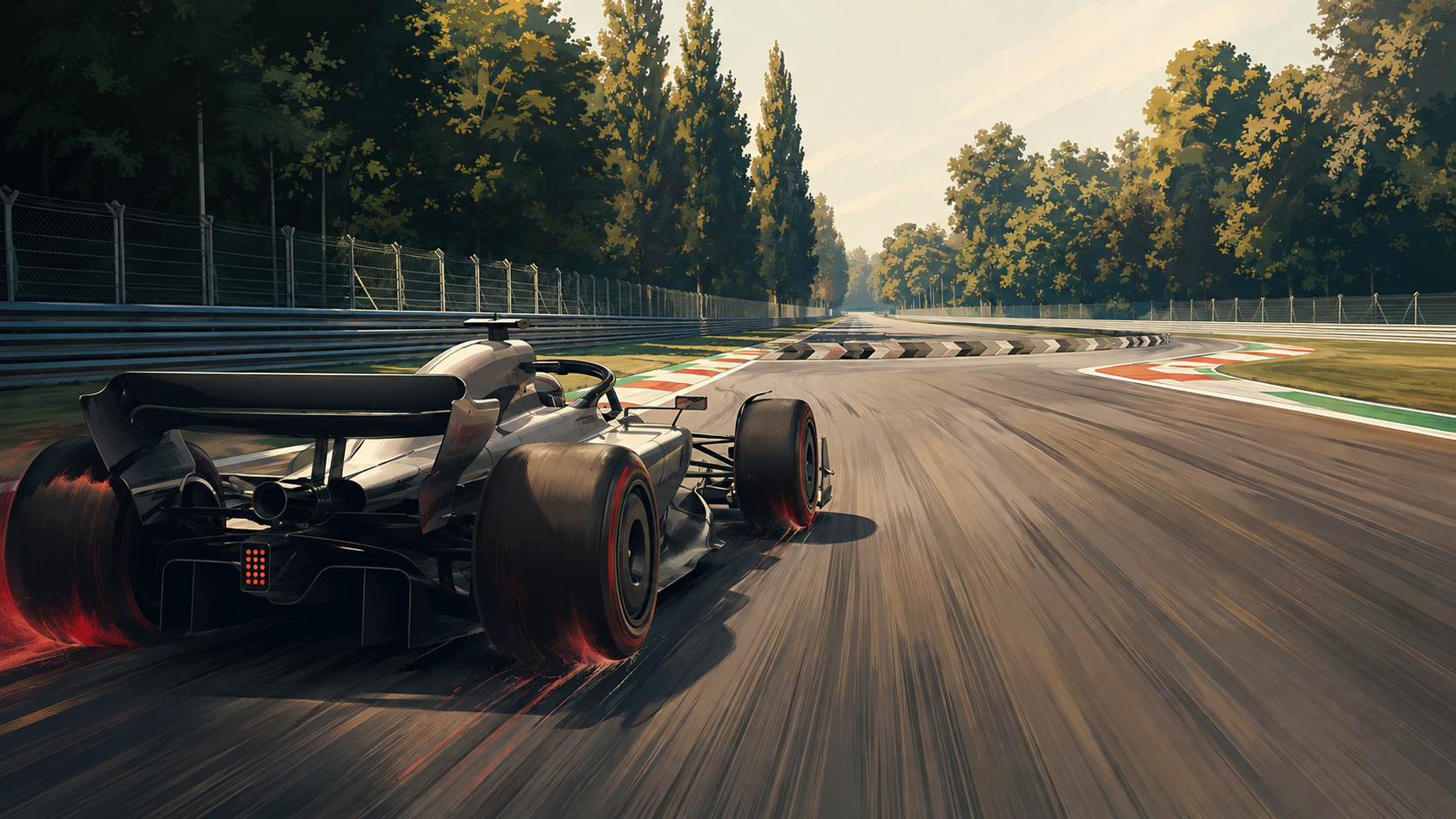
The 2026 Italian Grand Prix starts at 13:00 UTC on Sunday, September 6 — 15:00 CEST at Monza. Formula 1’s official race hub sets the task at 53 laps of the 5.793 km Autodromo Nazionale Monza, or 306.72 km.
This is a race-start preview, not a live report. GearPulse is not trackside, does not use live timing or telemetry, and does not disclose or imply any qualifying, grid or race outcome. That limitation still leaves the part of Monza that matters most: how a car built to be quick in a straight converts that speed into a stable braking zone, a durable rear tyre and a workable energy budget.
The fixed race facts
| Race-start checkpoint | Verified context |
|---|---|
| Start | 13:00 UTC / 15:00 CEST |
| Distance | 53 laps, 306.72 km |
| Circuit length | 5.793 km |
| Layout | 11 corners; long straights and major braking events |
| Tyres | C3 hard, C4 medium, C5 soft |
| Weather outlook | Hot and sunny; around 34C ambient, with track temperatures potentially near 57C |
The historical context makes the engineering contrast unusually clear. Monza hosted a World Championship Grand Prix in 1950 and remains the sport’s Temple of Speed, but the track’s identity is not simply terminal velocity. Formula 1 says cars are at full throttle for roughly 80% of the lap and reach maximum speed on the 1.1 km start-finish straight; the same lap then asks them to brake hard for tight chicanes.
For GearPulse readers, it is a systems problem. A lower-drag setup can reduce the time spent accelerating, but only a car with enough platform control can spend that gain at the Rettifilo, Roggia and Ascari rather than surrendering it under braking.
DRS is no longer the right shorthand
There are no conventional DRS zones in the 2026 rules. The FIA’s new-era regulations replace the old DRS concept with moveable front and rear wings: Straight Mode reduces drag in defined sections, while Corner Mode restores downforce. Overtake Mode is a separate electrical-energy aid, available under its own activation conditions.
That distinction matters at Monza. It is tempting to read the race as an exchange of low-drag phases, but the better comparison is between complete laps:
| Technical choice | Potential gain | Cost to manage |
|---|---|---|
| Aggressive low-drag balance | Faster acceleration and less energy spent on the straights | A smaller braking and rotation margin at the chicanes |
| More stable aero platform | Clearer braking references and repeatable direction changes | More drag across the long full-throttle sections |
| Earlier energy use | A chance to defend or attack at a chosen moment | Less flexibility later in the lap or stint |
Monza rewards the version that repeats. A car that is spectacular once but forces the driver to trim brake pressure or protect rear traction on the next lap is not necessarily the car with the stronger race proposition.
Hot track, soft compounds and a conditional one-stop
Pirelli’s allocation is the softest trio in its 2026 range: C3 hard, C4 medium and C5 soft. In dry conditions, drivers must use at least two slick compounds. The official tyre preview identifies rear-axle demand under traction, especially out of the First Chicane and Ascari, as the core tyre issue. It puts a one-stop strategy forward as the baseline, while warning that rear overheating is the variable most likely to change the calculation.
The weather keeps that caveat meaningful. Formula 1 expects sunny, hot race-day conditions, with ambient temperatures reaching 34C, light winds and a low chance of rain later in the day; it says clear skies could push track temperature towards 57C. Sky Sports and Motorsport.com independently describe the weekend as hot and largely dry. A forecast is not a claim about conditions during the race, but it is enough to make tyre temperature and cooling central to the pre-start strategy.
The useful strategic comparison is not “one stop versus two” in isolation. It is whether the medium can hold its rear grip without asking the driver to give up too much traction, and whether the hard tyre’s durability repays its potential warm-up cost. Autosport’s pre-race analysis similarly frames heat as the factor that can make a nominal one-stop less straightforward.
Ferrari’s home race is a test of usable speed
Ferrari’s home event puts its engineering decisions under an especially bright light, but the Monza question is shared across the field. The team that has trimmed drag most aggressively still needs braking confidence; the team that protects its rear tyres still needs enough efficiency to avoid spending the afternoon defending its energy position.
That makes internal team comparison more revealing than a pre-race pecking order. Each garage needs both cars to arrive at similar conclusions about brake balance, energy deployment and tyre preparation. If their answers diverge, the race is likely exposing a narrow setup window rather than a simple difference in driver preference.
The same applies to drivers. Monza’s big stops reward commitment, but commitment only lasts if the rear axle delivers traction on exit. The driver context is therefore less about a heroic late-braking moment than about who can apply the same braking reference and throttle release across a hot stint without turning tyre temperature into a limit.
What to watch without chasing a result
Watch the exits of the First Chicane and Ascari. The relevant sign is not the biggest slide; it is a clean exit that builds speed without overheating the rear tyres before the next long acceleration.
Watch the balance between Straight Mode and braking stability. The 2026 active-aero rules make Monza’s traditional low-drag compromise more visible, but a straight-line advantage only matters if Corner Mode returns a car to the braking zone settled.
And watch the first pit-window logic. A one-stop has an obvious appeal at a circuit with overtaking opportunities and a costly detour through pit lane. Yet high surface temperatures can turn a long stint into a traction-management exercise, giving fresh rubber a value that is hard to see from the opening laps alone.
The confirmed starting point is straightforward: 13:00 UTC, 53 laps, 5.793 km, C3-C4-C5 tyres and a hot-weather forecast. The race’s technical question is harder: which package can turn Monza’s low drag into repeatable braking, rear-tyre life and energy control for the full 306.72 km?