
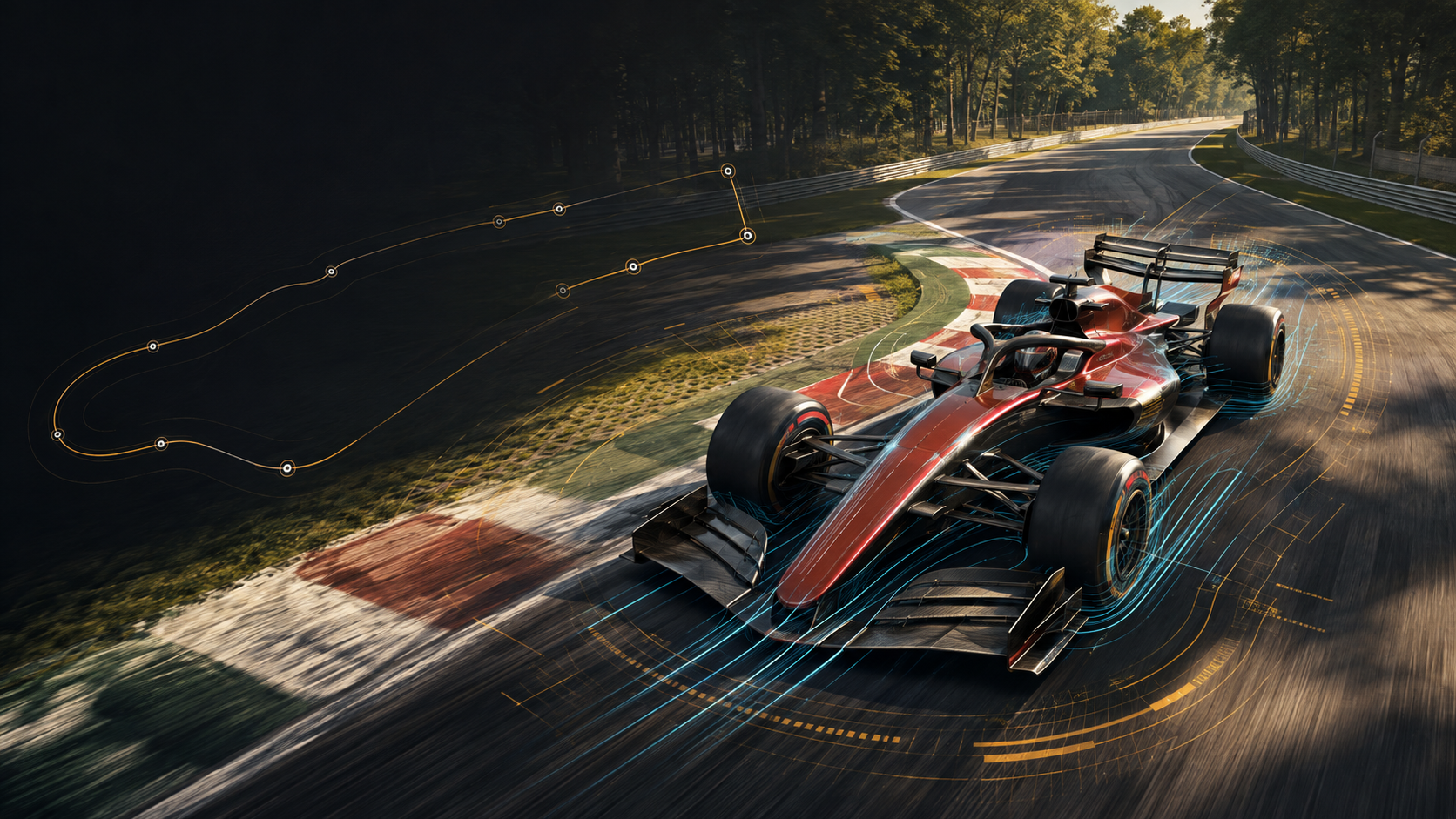
Italian Grand Prix Qualifying starts at 14:00 UTC on Saturday, September 5 — 16:00 CEST at Autodromo Nazionale Monza. Formula 1’s official race hub identifies the 5.793 km circuit and one-hour session. This is a start-of-session preview, not a live report: GearPulse is not trackside, has no live timing or telemetry access, and does not disclose or imply any qualifying, Sprint or race outcome.
At Monza, a qualifying lap is less a pure top-speed contest than a negotiation. Teams want low drag for the long accelerations, but they also need a car the driver can stop and rotate at the Rettifilo, Roggia and Ascari. The 2026 active-aero rules make that compromise more visible, because aero state and energy use now share the same lap with brake temperature, tyre preparation and confidence.
Straight-line speed must survive the braking zones
Monza has 11 corners and its long straights leave little time to hide a weak braking platform. Formula 1’s circuit guide says cars run at full throttle for around 80% of the lap, including the 1.1 km start-finish straight. The circuit’s 1950 World Championship debut and its continued place on the calendar make the history obvious; the engineering relevance is just as current.
| Qualifying choice | Monza consequence |
|---|---|
| Lower-drag aero state | More speed on the straights, but a smaller cushion when the driver commits to the chicanes. |
| Braking stability | Lets the driver use a repeatable reference at Rettifilo and Roggia rather than surrendering time on entry. |
| Rear-tyre preparation | Determines whether traction out of the chicanes translates into a useful next straight. |
| Cooling margin | Warm weather can make extra cooling necessary, bringing a drag cost that affects the full lap. |
That is the useful comparison for GearPulse readers: a car that looks spectacular at terminal velocity may be slower if its driver has to manage an uncertain rear axle at every major stop. The valuable setup is the one that turns speed into a sequence the driver can repeat.
DRS has become an active-aero and energy question
There are no conventional DRS zones to count under the 2026 rules. The FIA says the new cars use moveable front and rear wings, with Straight Mode reducing drag in designated sections and Corner Mode restoring downforce. Overtaking help is separately managed through Overtake Mode and its activation rules.
For qualifying, the distinction matters. Active aero should not be treated as a straight-line bonus detached from the rest of the lap. A low-drag phase is valuable only if the car arrives at the next braking zone settled, with the driver able to carry the brake pressure and rotate cleanly. At Monza, a slightly more conservative configuration can beat a peak-speed gamble if it preserves trust through the chicanes and Ascari.
Tyres and weather set a narrow window
Formula 1 and Pirelli confirm the C3 hard, C4 medium and C5 soft allocation for the Italian Grand Prix. The soft tyre is the natural qualifying tool, but the circuit still asks the rear axle to accelerate hard from low speed and the driver to brake from very high speed. A tyre that begins the push lap too cool sacrifices the first braking zone; one that overheats early can make the final sector costly.
The pre-session forecasts from Formula 1, Motorsport.com and Sky Sport F1 point to a dry, hot Saturday, with air temperatures around the high twenties to low thirties Celsius. That is a forecast, not a claim about the conditions once the session is underway. It is enough, however, to make tyre temperature, brakes and cooling part of the same preparation problem.
Sunday’s Grand Prix is scheduled for 53 laps and 306.72 km. That race-distance fact is not a prediction about qualifying, but it explains why teams cannot completely abandon long-run stability for one lap: the setup they choose this afternoon still has to give them a workable starting point for the rest of the weekend.
A home event makes the technical story louder
Ferrari’s home race creates a uniquely charged backdrop, but Monza’s trade-off is shared by every team. The FIA’s Thursday press conference captures why the venue matters emotionally to Ferrari drivers, while McLaren’s event preview describes it as the Temple of Speed and notes the circuit’s place in the sport’s founding season.
The team context is not about crowning a favourite before the session. It is about the different answers teams can bring to the same question. One package may chase a very low-drag balance; another may protect braking confidence and rear stability; another may seek the most efficient use of its active-aero states. Qualifying rewards the answer that gives a driver one clean lap rather than the most dramatic number in one sector.
What to watch without chasing a result
Watch how cars behave at the end of the long accelerations. A car that is calm under the initial braking load gives its driver a bigger margin to attack than one that arrives fast but nervous.
Watch the exits of the chicanes and Ascari. The best exit is not necessarily the flashiest slide; it is the one that builds speed without overheating the rear tyres or compromising the next energy phase.
And watch team language around cooling, brake confidence and tyre preparation. With a dry, warm forecast and Monza’s long full-throttle sections, those details reveal more about the package than a simplistic DRS-era speed comparison.
The confirmed starting point is clear: 14:00 UTC, 16:00 local time, 5.793 km, 11 corners, C3-C4-C5 tyres and a 53-lap Grand Prix to follow. The unknown is which team has found the Monza configuration that is not merely quick in a straight line, but quick enough to trust at the end of it.