
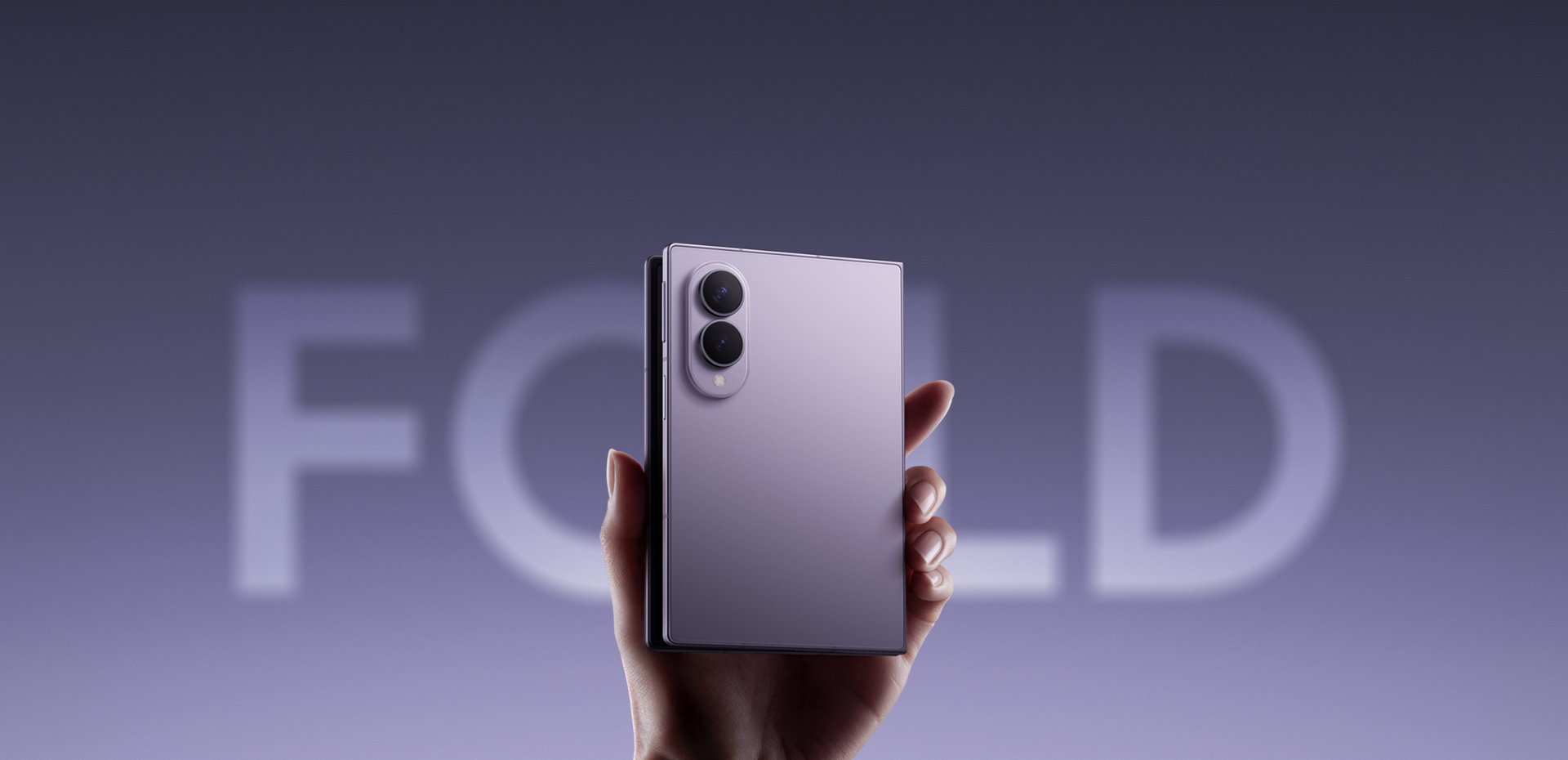
The iPhone Duo and Galaxy Z Fold8 have the same 7.6-inch inner-display diagonal, but they are not chasing the same experience. Apple has made a dense, premium, full-featured first foldable that keeps an iPhone-like aspect ratio across both screens. Samsung has made a markedly lighter book-style phone with a deliberately narrow, tall cover display for scrolling and a wide 4:3 inner panel for reading and video.
The cleanest way to read this comparison is not as a benchmark contest. Apple and Samsung use different operating systems, testing methods, and camera processing. The figures below are the companies’ published specifications, with no attempt to turn unlike battery or performance tests into a fake winner.
The key specifications
| iPhone Duo | Galaxy Z Fold8 | |
|---|---|---|
| U.S. starting price | $1,999 | $1,899.99 |
| Inner display | 7.6-inch OLED, 1,878 × 2,670, 430 ppi | 7.6-inch Dynamic AMOLED 2X, 4:3 |
| Cover display | 5.4-inch OLED, 1,398 × 2,034, 460 ppi | 5.5-inch, 10:16 |
| Refresh rate / outdoor brightness | Up to 120Hz / 3,000 nits | Up to 120Hz / 3,000 nits |
| Open thickness | 5.2 mm | 4.5 mm |
| Closed thickness | 11.3 mm | Samsung does not state this figure on its U.S. product page |
| Weight | 254 g | 201 g |
| Processor | Apple A20 Pro | Snapdragon 8 Elite Gen 5 for Galaxy |
| Storage | 256GB, 512GB, 1TB, 2TB | 256GB, 512GB, 1TB |
| Water / dust rating | IP68 | IP48 |
Both inner and cover displays run at up to 120Hz and reach 3,000 nits outdoors, so neither arrives with an obvious screen-spec deficit. The palpable difference is mass: Samsung lists the Fold8 at 201 g, 53 g lighter than Apple’s 254 g Duo. Apple’s 5.2 mm open thickness is still exceptionally thin, but the Fold8 is 4.5 mm when open.
Design: Apple emphasizes continuity; Samsung emphasizes shape
iPhone Duo is 164.6 × 117.8 mm when open and becomes 84.1 × 117.8 × 11.3 mm when closed. Its 5.4-inch cover panel and 7.6-inch inner panel share an aspect ratio, a decision Apple says helps content scale proportionally as the phone opens. The hardware uses a grade 5 titanium enclosure, Ceramic Shield 2 on the front, Ceramic Shield on the back, a precision hinge, and a nano-texture inner screen.
Samsung’s Fold8 is designed around two intentionally different canvases: a 5.5-inch 10:16 cover screen for the tall, social-feed phone state, and a 7.6-inch 4:3 panel for a wider reading and viewing state. The chassis uses Armor Aluminum, Gorilla Glass Ceramic 3 at the front, Gorilla Glass Victus 2 at the rear, an Armor FlexHinge, and a dual titanium layer beneath the display. It is rated IP48, while Apple rates Duo IP68.
The practical call is simple. Duo’s outer display should feel closer to a compact conventional iPhone, while Fold8 makes a stronger argument for opening it when content gets more involved. Buyers who are particularly sensitive to pocket weight will notice the Fold8 advantage immediately.
Battery: capacity versus different test methods
Samsung publishes a 4,800mAh battery for Fold8 and rates it for up to 26 hours of video playback. Apple describes Duo’s two-battery architecture but does not state a capacity. Its official ratings are up to 31 hours of inner-display video playback, up to 44 hours on the outer display, and up to 24 hours of typical use with both displays used equally.
Those figures are not directly comparable: the companies are measuring different modes and do not disclose matching test procedures. The fair takeaway is that Duo has an unusually large claimed gap between inner- and outer-screen playback, while Fold8 provides the useful capacity figure Android buyers tend to expect. Both claim fast charging to 50 percent, but Apple specifies about 20 minutes wired or 30 minutes wirelessly for Duo; Samsung’s Fold8 U.S. page does not state a matching 0–50 figure.
Cameras: Apple has a different kind of flexibility; Samsung has a balanced pair
Apple gives Duo a 48MP Fusion Main camera and a 48MP Fusion Ultra Wide. The main camera offers an optical-quality 2x telephoto option, while the ultra-wide supports macro. The cover display has a 12MP Center Stage camera, and the inner display hides a FaceTime camera beneath the panel. Its form factor unlocks rear-camera selfies, an outer-screen subject preview, and simultaneous front/rear FaceTime views.
Samsung lists a dual 50MP rear system: 50MP Wide and 50MP Ultra Wide, with a 10MP cover camera and 10MP main-screen camera. Fold8 adds Dual Recording and its ProVisual Engine processing, plus up to 10x digital zoom. On paper, this is not a resolution blowout either way. Apple has the clearer preview-and-selfie advantage from its two-display camera workflow; Samsung’s dual 50MP description gives it a straightforward wide/ultra-wide system.
Actual photo quality — especially moving subjects, skin tones, low light, and video — needs side-by-side testing. A megapixel table cannot settle it.
Software and who should choose which
The software split is as decisive as the hardware. iPhone Duo runs iOS 27.1 with Apple Intelligence and is scheduled to add Apple Pencil (USB-C) support later this year. Fold8 runs Samsung’s Galaxy AI experience on Android, with Multi Window, DeX, app continuity, a taskbar, and Samsung’s content-first 4:3 layout.
Pick iPhone Duo if an iPhone ecosystem, its compact outer-screen proportions, IP68 rating, Apple’s camera preview ideas, or 2TB storage matter more than weight and price. Pick Galaxy Z Fold8 if you want the much lighter device, a wider inner layout for reading and media, DeX and Android multitasking, and a $100 lower U.S. entry price.
Neither is a universally better foldable. They share a headline screen size, but Apple is selling the most complete folding iPhone it can make; Samsung is selling the more portable 7.6-inch foldable.