
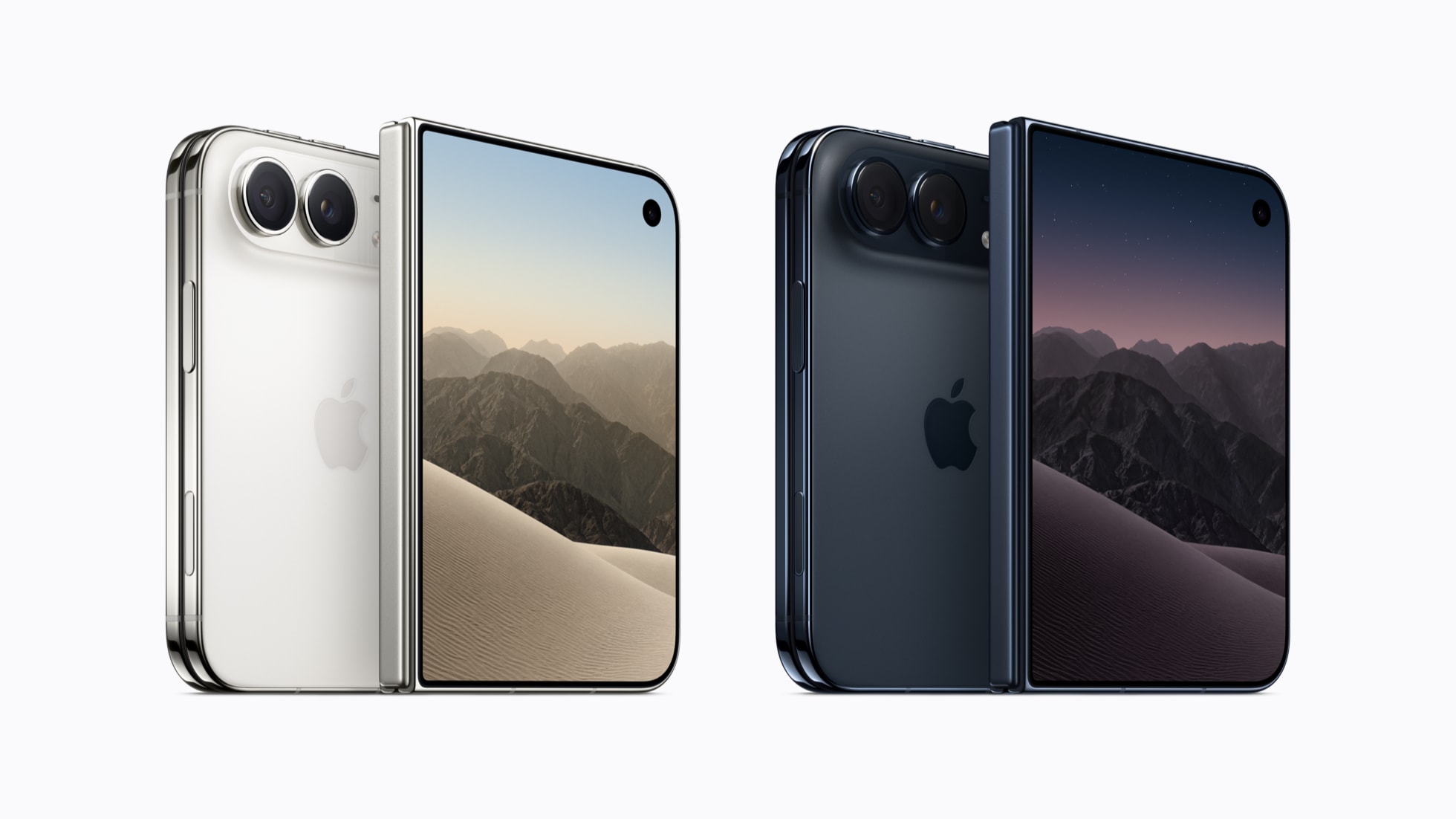
Apple has finally entered the folding-phone category. iPhone Duo is a book-style foldable that opens to a 7.6-inch display, closes around a 5.4-inch cover display, and uses the A20 Pro chip found in the new Pro iPhones.
The headline is not simply that the screen is bigger. Apple is trying to make the two states feel like the same phone rather than a small phone bolted to a tiny tablet: the two displays use the same aspect ratio, so content is intended to scale proportionally between them.
A very Apple kind of foldable design
Opened, iPhone Duo measures 164.6 by 117.8 by 5.2 mm. Closed, it is 84.1 mm wide, 117.8 mm tall, and 11.3 mm thick. It weighs 254 g. The enclosure is grade 5 titanium with a mirror-polished finish; Apple says the hinge cover is 3D printed, while Ceramic Shield protects the back and Ceramic Shield 2 covers the outer display. It is rated IP68 for splash, water, and dust resistance.
The inner screen is a 7.6-inch, 1,878-by-2,670 OLED panel at 430 ppi with a nano-texture finish. The outer screen is a 5.4-inch, 1,398-by-2,034 OLED panel at 460 ppi. Both support Always-On, ProMotion up to 120Hz, HDR, and up to 3,000 nits of outdoor peak brightness.
Apple’s folding-screen solution includes a custom polymer cover layer, high-strength glass above and below the panel, adhesives designed to let layers move during a fold, and a titanium plate underneath. Those are engineering claims rather than a lifetime guarantee, but they make clear that durability is one of the product’s central bets.
A20 Pro, two batteries, and iOS built for two displays
iPhone Duo uses A20 Pro with a custom vapor chamber and a new display engine that can drive both panels together. Apple rates the chip’s 6-core CPU as up to 20 percent faster than A19 Pro, the 7-core GPU as up to 40 percent faster and more power efficient, and its Dual 16-core Neural Engine as providing twice the compute power for on-device AI models.
The dual-battery architecture places one battery in each half. Apple does not publish an mAh capacity, but rates Duo for up to 31 hours of video playback on the inner display, up to 44 hours on the outer display, and up to 24 hours of typical use when the two screens are used equally. It says the phone can reach 50 percent in around 20 minutes by cable or around 30 minutes wirelessly with MagSafe or Qi2.
iOS 27.1 adapts to the shape with large-screen multitasking and two-display experiences. Apple Pencil (USB-C) support is due later this year. Touch ID lives in the side button, while the inner display includes an under-display FaceTime camera. It is a notably different authentication choice from the Face ID-focused Pro phones.
Cameras use the fold as a feature
The rear system pairs a 48MP Fusion Main camera with a 48MP Fusion Ultra Wide. The main camera supplies an optical-quality 2x telephoto option; the ultra-wide also handles macro. Apple lists a 12MP Center Stage camera on the outer display alongside the under-display inner camera.
More important than the count is how the form factor is used. Duo Preview puts the live view on the outer display for the subject, while users can take selfies with the rear cameras and frame them on the cover display. There is also Dual Capture in FaceTime and a hands-free open position for calls and photography.
| Key iPhone Duo specification | Official figure |
|---|---|
| Inner / outer displays | 7.6-inch / 5.4-inch OLED |
| Open / closed thickness | 5.2 mm / 11.3 mm |
| Weight | 254 g |
| Rear cameras | 48MP Main + 48MP Ultra Wide |
| Storage | 256GB, 512GB, 1TB, 2TB |
| U.S. starting price | $1,999 |
Availability and bottom line
iPhone Duo comes in star white and night sky, with 256GB through 2TB of storage. U.S. preorders begin October 16, and availability starts October 23.
This is an expensive first-generation product, and Apple will need real-world hinge and inner-display durability to earn confidence. But the specification is unusually complete: a bright high-refresh inner screen, full water-and-dust rating, a serious chip and cooling system, and cameras designed to exploit the fold rather than merely survive it. The first foldable iPhone is not a concept device. It is Apple’s attempt to make the large-screen phone a normal premium iPhone choice.