
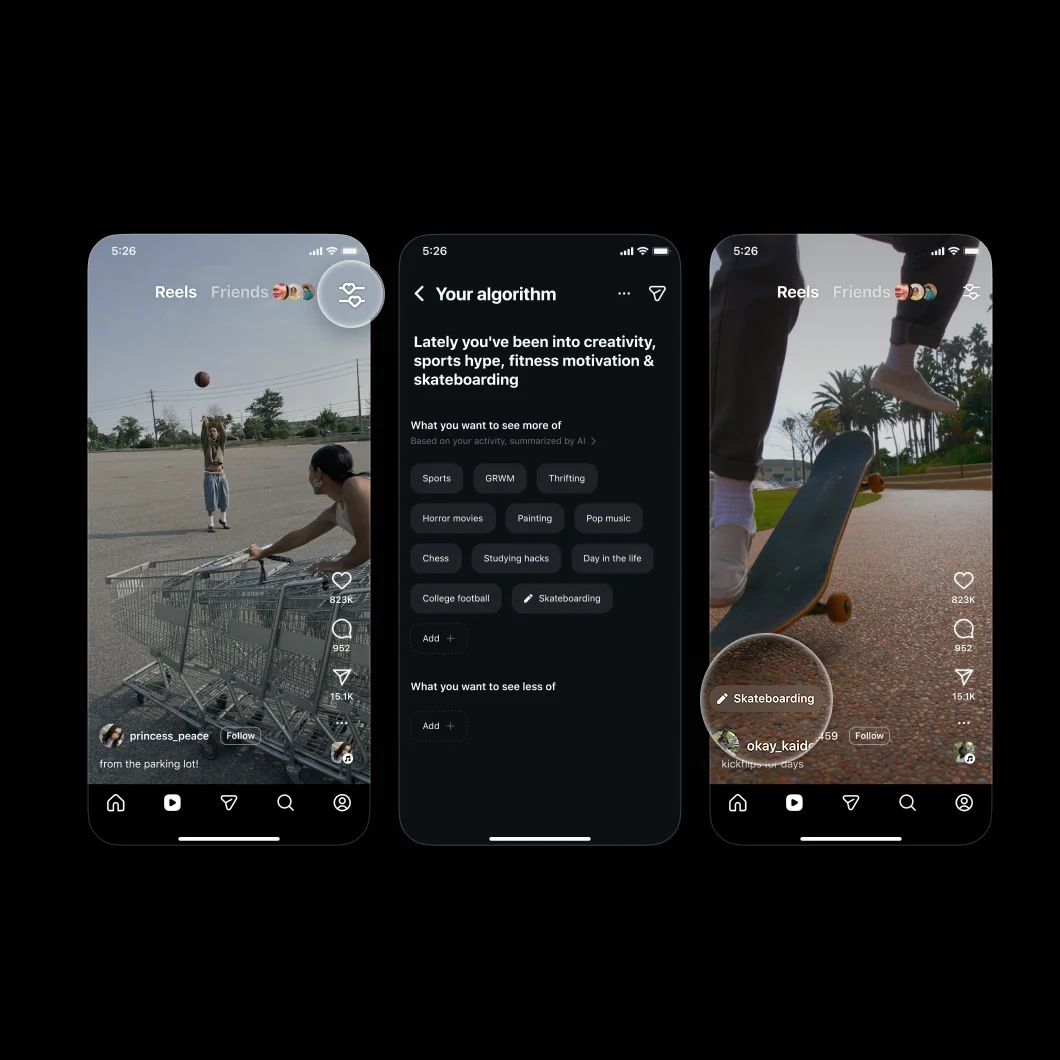
Instagram is trying to make algorithm tuning feel less like a buried settings page and more like part of using the app.
That is the right direction. The question is whether it becomes meaningful control or just a friendlier wrapper around the same recommendation machine.
TechCrunch reports that Instagram head Adam Mosseri showed tests for new entry points into “Your Algorithm,” including access from the main feed, a prompt after swiping from a Reel, and buttons under Reels that would let people ask for more or fewer posts like the one they are watching. Instagram’s own Reels algorithm page frames the existing feature around choosing interests and improving recommendations.
The idea is simple: instead of only reacting to every like, watch, share, skip, mute, and follow, Instagram would ask users for a clearer signal.
What Instagram is testing
The current “Your Algorithm” framing is mostly topic-based. You tell Instagram which subjects you want to see more of or less of, and the app uses that signal to adjust recommendations, especially around Reels.
The newer tests appear to move those controls closer to the surfaces where recommendations actually happen.
| Control surface | What it could change | Why it matters |
|---|---|---|
| Feed pull-down menu | Faster access to Your Algorithm | Makes tuning less hidden. |
| Reel swipe prompt | Contextual feedback while watching | Lets people react when the recommendation feels wrong. |
| More/less buttons under Reels | Direct signal for similar videos | Easier than going into settings after the fact. |
| Topic interests | Broader preference steering | Useful, but less precise than account-level or source-level control. |
That last caveat is the important one. Topic sliders can help Instagram learn that a user wants less celebrity gossip or more car builds, but they do not answer the common complaint: people often want more from accounts they already follow and less from strangers chasing engagement.
The trust problem is bigger than the UI
Algorithm controls sound empowering because the word “control” does a lot of work. In practice, a recommendation system still decides how much weight to give the user signal.
If someone taps “less like this” and then sees similar posts the next day, the control starts to feel decorative. If Instagram lets people tune topics but keeps the main feed heavily optimized for time spent, users may not feel the product has become more respectful.
That is why the most useful version of Your Algorithm would make the tradeoff visible. A person should be able to understand whether they are tuning topics, creators, formats, recency, language, popularity, or followed-account priority.
Why this still matters
Instagram has a difficult product problem. A fully chronological feed can feel predictable but stale. A highly optimized recommendation feed can feel addictive but alienating. A good control layer sits between those extremes.
For creators, clearer controls could also be healthy. If users can state their interests more deliberately, the app may not need to infer everything from engagement spikes. That could reduce some pressure to package every post for instant reaction.
For users, the win is more basic: fewer moments where the app feels like it has wandered away from their taste.
What to watch next
The test will be worth taking seriously if Instagram expands the control model beyond broad topics.
| Needed feature | Why it would help |
|---|---|
| Followed-account priority | Addresses the most common feed complaint directly. |
| Format controls | Separates Reels, photos, carousels, and suggested posts. |
| Clear reset option | Gives users a way out of a recommendation rut. |
| Visible feedback history | Shows what the user has already asked Instagram to change. |
| Per-topic strength | Lets people choose “less” without fully blocking an interest. |
Without that, Your Algorithm may improve the mood of the interface without changing the power balance very much.
Bottom line
Instagram is right to make recommendation controls easier to reach. A social app that relies this heavily on algorithmic feeds should not make users dig for the steering wheel.
But the real test is not whether the menu is easier to find. It is whether Instagram lets people meaningfully prioritize who and what they came to the app to see. Topic sliders are a start. Actual feed agency needs more than that.