
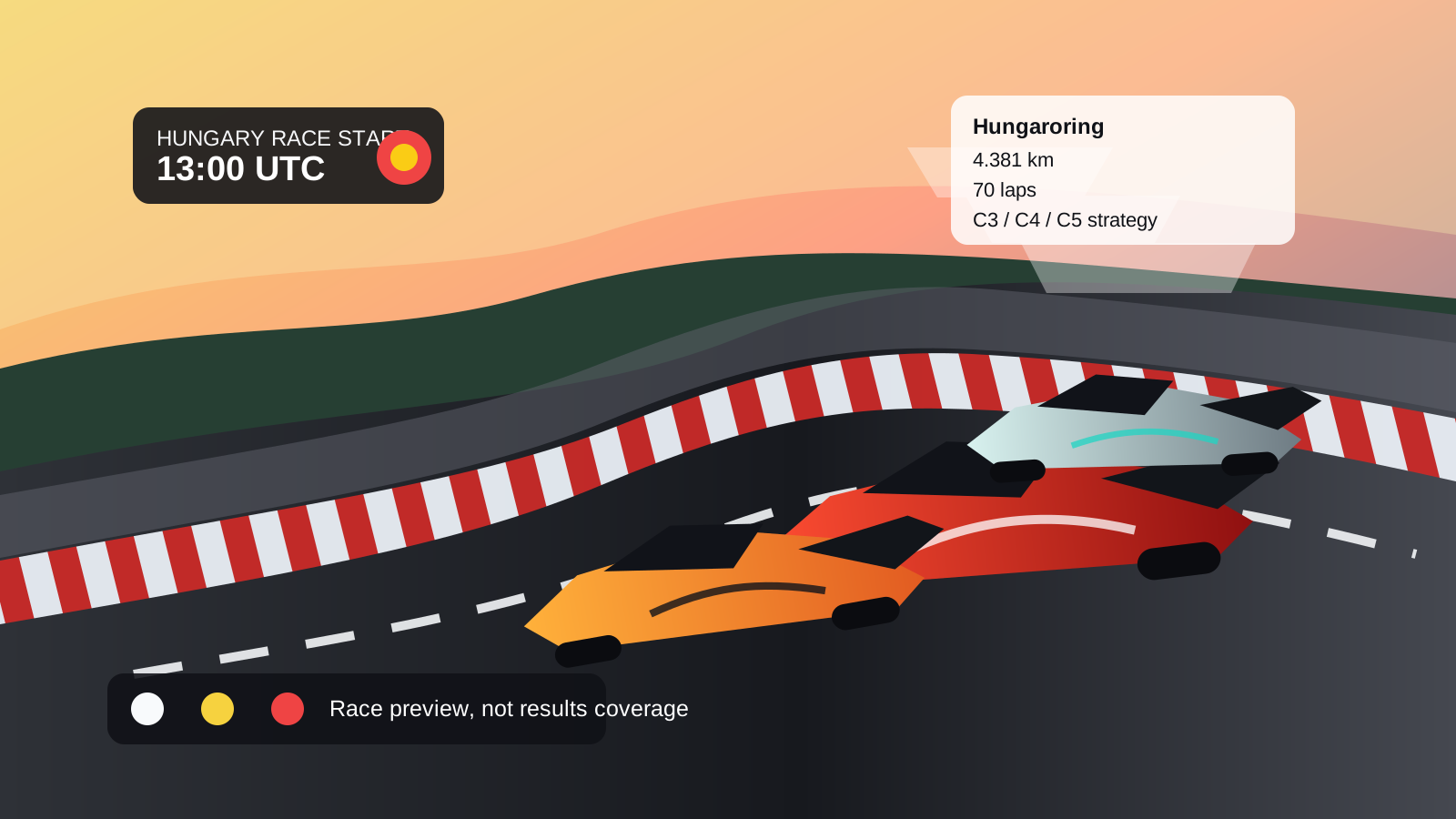
The 2026 Hungarian Grand Prix starts at 13:00 UTC on Sunday, July 26, which is 15:00 local time at the Hungaroring. Formula 1’s official race page lists a 70-lap Grand Prix on the 4.381 km Hungaroring, for a race distance of 306.63 km.
This is a race-start preview and context article. GearPulse is not trackside, is not using live timing and has no telemetry access. It does not publish the qualifying result, starting grid, pole sitter, race result, podium, fastest lap, classification-revealing penalty or championship change.
That constraint is useful, because Hungary is one of the places where the pre-race fundamentals can tell you a lot without needing to reveal the grid. The track is narrow, short, high-downforce and hard to pass on. The tyre range is soft. The temperature is expected to be high enough to make rear degradation a real race variable. And this is the final Grand Prix before Formula 1’s summer break, so teams are balancing today’s result against the need to understand their latest car directions.
The fixed race facts
Formula 1’s official race hub gives the Hungaroring the numbers that define Sunday’s task: 4.381 km, 70 laps, 306.63 km, first Grand Prix in 1986 and Lewis Hamilton’s 1:16.627 race lap record from 2020. Pirelli’s preview adds the track shape: 14 corners, one real straight and a stop-start rhythm that asks for Monaco-like downforce without giving drivers Monaco’s barriers as a natural brake on ambition.
| Race-start checkpoint | Verified context |
|---|---|
| Start time | 13:00 UTC, 15:00 local at the Hungaroring |
| Distance | 70 laps, 306.63 km |
| Circuit length | 4.381 km |
| Track character | Tight, twisty, high downforce, limited overtaking |
| Tyres | C3 hard, C4 medium, C5 soft |
| Weather caveat | Warm, low rain risk, heat-sensitive track surface |
The fun fact is the continuity. Pirelli notes that the Hungarian Grand Prix reaches its 41st edition and every one has been held at the Hungaroring. That makes Budapest a rare modern F1 reference point: teams know the broad demands, but the same old demands still punish small setup mistakes.
Tyres make this more than a track-position race
Formula 1 and Pirelli confirm the weekend allocation as the softest part of the range: C3, C4 and C5. Each driver has two sets of the hard, three mediums and eight softs for the weekend, with intermediates and wets available if required. In a dry race, drivers must use at least two different slick compounds.
That sounds simple until the Hungaroring adds heat and traffic. Pirelli says Turns 1 and 12 have been resurfaced for 2026, while older parts of the lap remain rougher and lower-grip. It also flags high track temperatures, rear thermal degradation and possible graining on softer compounds as central risks.
The strategic consequence is a tighter one-stop versus two-stop argument than the track map suggests. A one-stop has the clean appeal of fewer pit-lane losses and less traffic re-entry risk. A two-stop has the appeal of protecting tyre pace on a circuit where the rear axle can overheat through traction zones. The catch is that overtaking difficulty can make a faster tyre look theoretical if the car returns into traffic.
That is why the race should be read through stint quality, not just early position. If the first medium or hard stint stays consistent, the race leans toward control. If the rear tyres slide or graining appears, the pit wall has to choose between track position and lap-time rescue.
Weather narrows the operating window
Formula 1’s weather guide for Hungary expects race-day temperatures to reach around 30 Celsius with a low likelihood of rain. Its separate weather forecast for the weekend described dry running and high track temperatures, while Motorsport.com and Sky Sports F1 both framed Budapest as warm and mostly dry rather than weather-led.
That does not remove uncertainty. The Hungaroring is often called a karting-style circuit because the corners keep arriving, and that means tyres do not get much recovery time. In cooler conditions, teams can be more aggressive with the soft end of the range. In heat, a car that slides at the rear can turn its strategy into damage limitation within a handful of laps.
Wind is a smaller but useful caveat. Formula 1’s weather forecast flagged gusts earlier in the weekend, and on a lap with several medium-speed direction changes, a nervous rear axle can turn into tyre temperature faster than the timing screen initially admits.
Mercedes, Ferrari and McLaren bring different pressure
Mercedes starts the race with the strongest championship context. Sky Sports F1 listed Kimi Antonelli ahead of Lewis Hamilton and George Russell in the drivers’ championship before the Hungarian race, with Antonelli coming off a Belgium win and Russell trying to close a large intra-team gap. That makes Antonelli versus Russell one of the most important comparisons, even without discussing the grid: Antonelli has the points cushion, Russell needs a clean response before the break.
Ferrari brings the circuit-fit argument. Sky’s preview said the corner-heavy Hungaroring should suit Ferrari, and Formula 1’s Friday context had Russell treating Ferrari as a serious threat after the opening day. Hamilton versus Charles Leclerc is the key Ferrari read. Hamilton has unmatched Budapest history, while Leclerc is usually one of the grid’s sharpest high-downforce rhythm drivers. The caveat is tyre life: Ferrari can look spectacular on a short run and still need proof over 70 hot laps.
McLaren brings the upgrade question. The team’s own Hungary preview said its package was aimed at increasing performance on high-downforce circuits like the Hungaroring, including a new floor among other parts. Sky Sports F1 also noted McLaren’s strong recent Budapest record and the hope that its upgrade would move it closer to the front.
That sets up a clean Norris versus Piastri comparison. Lando Norris is the known Budapest benchmark from recent McLaren form. Oscar Piastri’s value is in how quickly he converts the new package into repeatable race pace. If both drivers can protect the rear tyres while keeping enough front bite through the middle sector, McLaren has a credible path to being more than a qualifying story.
Red Bull and Aston Martin are the wild cards
Red Bull’s case is narrower but not empty. The Hungaroring reduces the pure power premium and rewards confidence on entry, rotation through long corners and traction without overheating the rear tyres. That keeps Max Verstappen and Red Bull relevant if the car is balanced enough to attack in clean air. It also means a slightly nervous car can get trapped in the same dirty-air queue as everyone else.
Aston Martin is the development watch. Formula 1’s technical coverage described Hungary as the team’s first proper upgrade location of 2026, while Sky Sports F1 reported Fernando Alonso’s positive reaction to the improved car and Adrian Newey’s short-term target of restoring respectability. That is not the same as calling Aston Martin a win contender. It is a signal that the AMR26 may finally give the team a better platform for the second half of the season.
For the race itself, the Aston question is whether the upgrade keeps its tyres alive in traffic. A better car over one lap is useful; a predictable car over long stints is the proof Budapest demands.
GearPulse editorial probability board
These are non-betting editorial ranges for likely race winners or race-defining standouts at the start of the Hungarian Grand Prix. They are not odds, betting advice or a claim about the actual result.
| Candidate | Editorial range | Why it fits the preview |
|---|---|---|
| Mercedes driver | 24-34% | Best championship baseline, strong Antonelli season, Russell response factor. |
| Ferrari driver | 22-32% | Circuit profile and Friday context point toward a serious Budapest chance. |
| McLaren driver | 18-28% | Recent Hungary strength and a high-downforce upgrade package raise the ceiling. |
| Red Bull driver | 10-18% | Verstappen keeps the ceiling alive if balance and tyre temperature cooperate. |
| Strategy-led upset | 8-14% | One-stop versus two-stop tension could reward the cleanest pit-wall call. |
| Aston Martin points story | 4-8% | Upgrade progress matters, but the target is credibility more than victory. |
The ranges are deliberately conservative because Hungary can make pace look trapped. A car that is two tenths faster but stuck behind another car may become a strategy problem rather than a race-winning weapon.
What to watch after lights out
Watch the first stint tyre shape. If the leading group can keep rear degradation stable, the race becomes more about air, pit windows and mistake avoidance. If the rears overheat early, the two-stop case grows quickly.
Watch Ferrari’s stint comparison. Hamilton’s Hungary record and Leclerc’s qualifying-style precision are different strengths, and Budapest will show whether Ferrari has a race car or only a sharp lap car.
Watch Mercedes under pressure. Antonelli has the championship cushion, Russell has the urgency, and the Hungaroring is unforgiving if a driver spends too long managing temperatures instead of attacking.
Watch McLaren’s upgrade over a full fuel run. A high-downforce floor can help everywhere at this circuit, but only if it keeps balance consistent as fuel burns off and the track temperature changes.
Watch the pit-lane timing. Track position is valuable, but staying out too long on fading tyres can be just as expensive. The best strategy may be the one that avoids both extremes.
Bottom line
The Hungarian Grand Prix starts with unusually clear knowns and unusually awkward unknowns. The knowns are the official facts: 13:00 UTC start, 70 laps, 4.381 km, 306.63 km, C3-C4-C5 tyres and a warm, low-rain-risk race day.
The unknown is how much of the race is decided by pace and how much is decided by tyre survival. Mercedes has the championship reference. Ferrari has the circuit-fit case. McLaren has the upgrade and recent Hungary argument. Red Bull has the driver-ceiling caveat. Aston Martin has the development story.
For a spoiler-safe preview, that is enough. Budapest is not a place where the fastest theoretical car automatically wins. It is a place where heat, rhythm, tyre life and timing can turn a clean race start into a 70-lap strategy exam.