
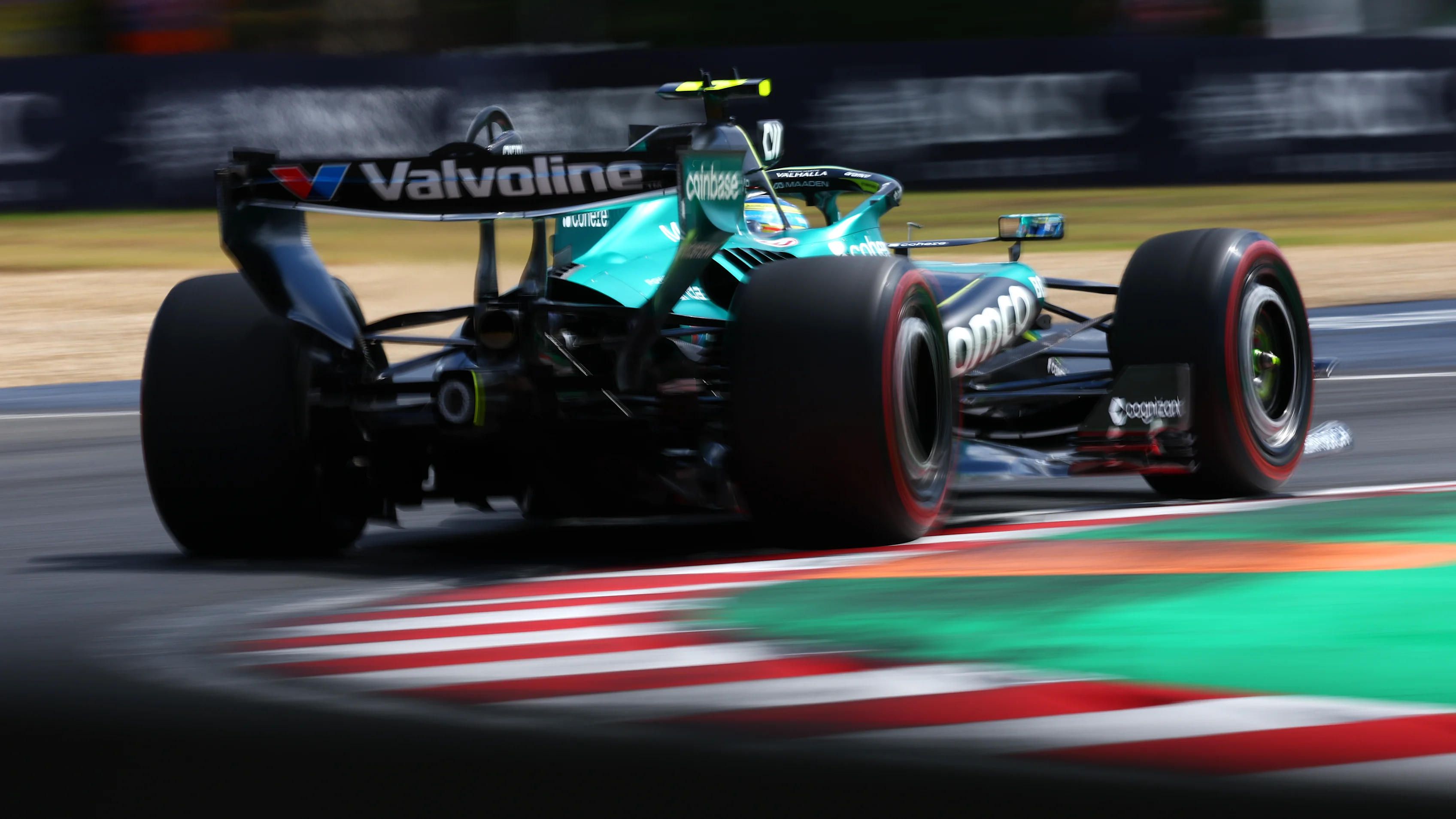
Honda’s upgraded Formula 1 power unit has now done the one thing a troubled engine programme eventually has to do: leave the dyno story behind and run in the actual car.
Formula 1 reported today that Honda’s new-specification unit ran on-track for the first time during Aston Martin’s Hungaroring filming day, after Honda had already said it planned to use Wednesday’s run before the summer shutdown. The race debut is still pencilled in for the Dutch Grand Prix at Zandvoort, not for a secret competitive session in Hungary.
That distinction matters. A filming day is not a disguised Grand Prix weekend. The mileage is limited, teams run on demonstration tyres, and nobody should treat any rumoured stopwatch number as proof. But this is still the most interesting F1 development of July 29 because it changes Aston Martin’s second-half question from “will the upgrade arrive?” to “can the chassis and Honda power unit finally work as one system?”
GearPulse’s view: Aston Martin does not need Zandvoort to become a podium car. It needs Zandvoort to show that the AMR26 is no longer two separate recovery projects bolted together.
Why this rose above the rest
The trend signal was clean. Formula 1 put the Honda filming-day confirmation high on its official news feed. Honda’s own Hungarian Grand Prix report supplied the primary setup, with Shintaro Orihara saying the new-spec unit would be run in the AMR26 before its planned Netherlands introduction. Motorsport.com, The Race and RacingNews365 all carried the same core story and treated it as a meaningful technical checkpoint, not a silly-season rumour.
It also beat the other candidates because it has a clearer forward edge. Stefano Domenicali’s comments on a possible European finale if Qatar and Abu Dhabi cannot run were important, but GearPulse covered the broader calendar-resilience story through Sepang two days ago. Bearman’s Ferrari-or-Haas future was interesting, but it is still more career positioning than actionable team performance. Pirelli’s Hungary tyre test had useful technical value, but less mainstream pickup.
The Honda-Aston story sits in the sweet spot: official confirmation, specialist coverage, immediate competitive stakes and enough uncertainty for analysis.
Aston finally gave Honda a better chassis question
Aston Martin’s Hungarian weekend did not look spectacular on paper. Lance Stroll finished 13th and Fernando Alonso 14th. No points, no headline result, no sudden leap into the front group.
But the baseline changed. Formula 1 noted that Aston Martin’s major AMR26 package in Hungary included 16 developments, and the update helped Alonso reach Q2 for the first time this season. Honda’s race report quoted Alonso calling the weekend a step forward and pointed directly toward the Zandvoort engine update. Adrian Newey’s post-race view was more important than the finishing positions: he said the performance was in line with the team’s data predictions, which is exactly the kind of correlation Aston Martin had been desperate to prove.
That is why the power-unit run matters. A weak car can make an engine look worse than it is. A difficult engine can make a chassis look confused. In 2026, with active aero, energy deployment, cooling, drivability and software behaviour all tied together, the old split between “engine problem” and “car problem” is too neat.
Honda and Aston Martin need the same answer: does the whole package give the drivers more usable lap time?
| Aston Martin checkpoint | What Hungary suggested | What Zandvoort must prove |
|---|---|---|
| Chassis direction | The AMR26 moved closer to the midfield and matched internal expectations. | The gains travel to a different circuit profile. |
| Honda power unit | The updated unit has completed its first on-track AMR26 run. | It survives full race-weekend load without creating new drivability issues. |
| Alonso/Stroll confidence | Alonso made Q2 and both cars raced closer to the pack. | The drivers can attack, not only describe progress. |
| Team integration | Honda and Aston are now collecting shared car-and-engine data. | Setup choices stop looking like compromise management. |
The filming-day caveat is not small
This is where the story needs discipline. A filming day can reveal whether the engine starts cleanly, packages correctly, talks to the car, behaves under basic running and avoids an obvious installation drama. It cannot reveal race pace with confidence.
RacingNews365 noted the familiar filming-day limits: restricted distance and special tyres. The Race also pointed out that the run is an opportunity to check how the new engine works in the chassis rather than a full development test. That makes today’s news useful but incomplete.
The optimistic reading is that Honda has enough confidence to put the revised unit in the car before Zandvoort, giving Aston Martin time to catch integration problems before the Dutch Grand Prix weekend begins. The cautious reading is that a first run after a difficult half-season is merely the start of the actual test.
Both can be true.
Zandvoort is awkward in exactly the right way
Zandvoort is not Spa. It will not reduce Aston Martin’s recovery to one long straight and a simple power deficit. It asks for rotation, traction, confidence through banking, good tyre preparation and clean energy use between short acceleration zones.
That makes it a better first verdict than a pure horsepower circuit. If Honda’s revised power unit improves deployment, drivability or reliability, Alonso and Stroll should feel it in how consistently the car exits corners and defends through the lap. If the upgrade is mostly theoretical, Zandvoort’s traffic and tyre sensitivity will expose that quickly.
The competitive bar should be modest. Aston Martin is not chasing Mercedes, Ferrari or McLaren next month. It is chasing the ability to race Alpine, Haas, Williams, Cadillac, Audi and Racing Bulls without needing chaos. That sounds small until you remember how far away Aston looked earlier in the year.
GearPulse’s editorial likelihood read, not betting advice:
| Zandvoort outcome | Likelihood | Why |
|---|---|---|
| Aston Martin becomes a regular points threat immediately | 30-40% | Hungary showed a chassis step, and Honda’s update could add usable performance, but the team is still climbing from a low base. |
| The upgrade improves drivability but not results yet | 35-45% | This is the most realistic first step for a new-spec power unit after limited filming-day running. |
| Reliability or calibration issues hide the progress | 20-30% | First major 2026 power-unit updates can create secondary problems, especially when car integration has already been difficult. |
| Aston Martin jumps into top-six contention | 5-10% | Too much evidence says this is a recovery project, not a miracle package. |
The bigger Honda story
Honda returned to full works responsibility with Aston Martin at exactly the wrong kind of moment: a new rules cycle where power-unit performance is not only combustion, not only electrical deployment, and not only reliability. It is all of those things at once, filtered through chassis packaging and software.
That is why Orihara’s language about integration matters. Honda is not simply sending Aston Martin more power. It is trying to make the AMR26 use the whole system better after a first half of the season that exposed both sides of the partnership.
There is a useful historical echo here. Honda’s best F1 eras have usually been about making the engine feel like part of the car, not a supplier component. The McLaren-Honda domination of the late 1980s is the famous version, but the modern lesson is more relevant than the nostalgia: integration wins when the rules become complex.
Aston Martin hired Newey because it wants to become a whole-car team. Honda’s update is the power-unit side of the same argument.
Bottom line
Honda’s Hungaroring filming-day run is not proof that Aston Martin has fixed 2026. It is proof that the rescue plan has moved from promise to installation.
That is enough to make Zandvoort one of the most interesting technical reads after the summer break. If the AMR26’s Hungary chassis gains and Honda’s new-spec power unit reinforce each other, Aston Martin can start measuring progress against real midfield rivals instead of its own disappointment. If they do not, the team will have a harsher answer: the project still has pieces, but not yet a package.