
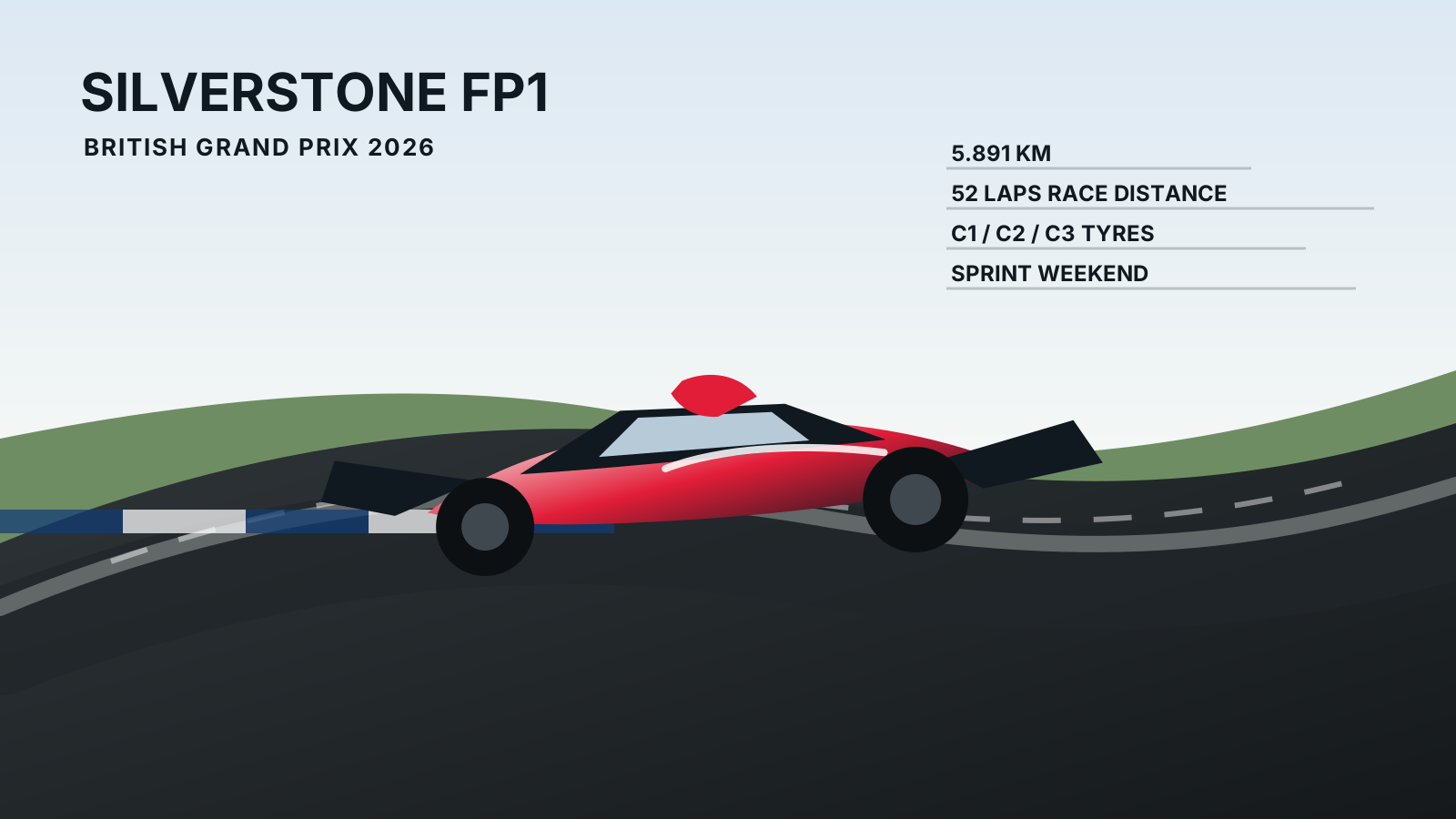
Formula 1’s British Grand Prix weekend starts its only practice session at 11:30 UTC on Friday, July 3, and Silverstone gives teams very little time to turn curiosity into a usable setup. Formula 1’s official race hub lists Practice 1 from 11:30 to 12:30 UTC, then Sprint Qualifying at 15:30 UTC, so this is not a gentle opening act. It is the one public hour before the first competitive F1 session of the weekend.
This is a Practice 1 start preview, not a results article. It does not use or reveal any Practice 1 timing, Sprint Qualifying outcome, starting grid, pole sitter, race result, podium, fastest lap, penalty classification or live-session information. GearPulse is not trackside and has no hidden telemetry. The question is simpler and more useful: what should this first Silverstone hour tell us before the sprint format removes the safety net?
Why this practice hour matters
Silverstone is long by modern F1 standards at 5.891 km, and Formula 1 lists the Grand Prix distance as 52 laps over 306.198 km. The track’s identity is still built around speed: Abbey, Copse, Maggotts, Becketts and the Hangar Straight ask for aero stability, driver trust and a car that does not punish the tyres every time the driver leans on the front axle.
The twist for 2026 is energy. The Guardian’s pre-weekend reporting, based on comments from Lewis Hamilton, Lando Norris and Max Verstappen, frames Silverstone as an “energy-starved” test under the current power-unit rules because the lap has fewer heavy braking zones for recharge than many other circuits. That does not mean the fastest car becomes slow. It means the cleanest Silverstone package may be the one that balances deployment, lift-and-coast discipline and high-speed confidence without making the lap feel disjointed.
The practice checklist is therefore unusually dense:
| Practice clue | Why it matters at Silverstone |
|---|---|
| High-speed balance | Copse and Maggotts-Becketts expose cars that cannot hold a stable aero platform. |
| Energy deployment | A weak deployment map can make the straights and fast corners feel less connected. |
| Front-left tyre load | Silverstone’s right-handers stress the front axle, especially across longer runs. |
| Sprint setup choice | Teams need a baseline that works for Sprint Qualifying, the Sprint, qualifying and race. |
Pirelli’s British GP tyre note confirms the hardest trio in the range: C1 hard, C2 medium and C3 soft. That selection fits Silverstone’s high severity and means FP1 is less about showing a headline lap than learning how the car treats the front axle and how quickly the tyres come alive.
Mercedes starts with the cleanest form line
The official Formula 1 standings put Kimi Antonelli on 171 points, George Russell on 131 and Lewis Hamilton on 125 before the British weekend. Motorsport.com’s standings page mirrors that top order, which makes the first comparison fairly clear: Mercedes has the strongest season-level base case, while Ferrari, McLaren and Red Bull need to prove how much Silverstone changes the shape.
For Mercedes, Practice 1 is about confirming whether its 2026 advantage travels to a track where energy deployment and high-speed aero load matter together. Antonelli’s championship lead makes him the benchmark for repeatable pace, but Russell’s home-race context matters too. If Russell is quickly comfortable through Silverstone’s fast sections, Mercedes has two live references for the rest of the weekend rather than one.
The caveat is that sprint weekends can make good cars look unfinished. With only one practice hour, an early setup direction that protects Sprint Qualifying can still compromise longer-run information. Mercedes may have the best pre-session evidence, but it still needs a clean data run before the competitive sessions begin.
Ferrari and McLaren carry different pressure
Ferrari’s Silverstone story starts with Hamilton. Sky Sports notes his nine British Grand Prix wins, and the emotional pull is obvious, but Practice 1 should be judged more coldly than that. Hamilton and Charles Leclerc need to learn whether Ferrari can keep enough deployment and front-end confidence through the fast parts of the lap. If the car spends too much of the lap managing energy or leaning hard on the front-left tyre, the weekend gets harder quickly.
McLaren’s question is narrower but just as important. Lando Norris and Oscar Piastri should care less about one isolated soft-tyre lap and more about whether the car looks kind over repeated high-speed corners. Sky’s weekend guide makes Norris part of the obvious British storyline, while the standings put Piastri one point ahead of Norris. That teammate comparison gives McLaren useful internal pressure: if both drivers find the same balance window, the team becomes a serious sprint-weekend problem.
The practical difference is this: Ferrari needs a clean platform to turn Hamilton and Leclerc’s upside into repeated laps, while McLaren needs setup certainty quickly enough to attack Sprint Qualifying without overcorrecting for the race.
Red Bull is the volatility case
Red Bull’s Practice 1 is about proof, not reputation. Verstappen’s pre-weekend concern about Silverstone’s deployment profile is relevant because it points to the exact area that can turn a famous track into a compromise exercise under the 2026 rules. If Red Bull looks calm on direction changes and does not bleed speed late in the straights, the team’s ceiling rises.
The second comparison is Isack Hadjar. Formula 1’s standings place him inside the top eight before the weekend, and a useful second Red Bull matters more on a sprint weekend because strategy and setup calls are compressed. If Hadjar can validate Verstappen’s direction rather than chase a separate setup path, Red Bull can learn faster. If the two cars split their answers, the team may spend the only practice hour sorting symptoms instead of building confidence.
Editorial probability board
These are non-betting GearPulse editorial ranges for likely Practice 1 standouts. They are not odds, advice or a claim about actual session results.
| FP1 standout candidate | Editorial probability | Why this range fits before the session |
|---|---|---|
| Mercedes | 30-40% | Best season form, two strong references and likely deployment strength. |
| McLaren | 20-30% | Norris and Piastri should be dangerous if the car is stable over fast repeated loads. |
| Ferrari | 18-28% | Hamilton and Leclerc have upside, but energy management could be a sharper constraint. |
| Red Bull | 12-22% | Verstappen can still define a session, but the package must answer the deployment concern. |
| Midfield setup surprise | 5-10% | One-hour practice can flatter efficient run plans, especially before the fuel comes out. |
The ranges are deliberately wide because FP1 is a poor place for certainty. Fuel loads, engine modes, tyre sequencing and run interruptions can distort the order. The more useful signal is whether a team looks calm enough to trust its next setup change.
Track facts and caveats
Silverstone hosted the first Formula 1 World Championship race in 1950, and Formula 1’s race hub still lists the official fastest race lap as Max Verstappen’s 1:27.097 from 2020. The venue’s current Grand Prix layout is a 5.891 km lap, while Silverstone’s own timetable confirms the packed Friday program around the F1 sessions.
Weather looks less disruptive than a typical British GP fear. Sky Sports’ guide says the forecast points to no rain across the three days of track action and temperatures in the mid-20s Celsius. That is useful, but not absolute. Silverstone wind direction, cloud cover and track temperature can still change the balance from one run to the next.
The tyre caveat is just as important. C1, C2 and C3 should keep degradation under control compared with softer allocations, but Silverstone’s loading can still punish a car that slides. A team that chases one-lap bite in Practice 1 may pay for it across the Sprint or race runs later in the weekend.
What to watch first
Watch how early the drivers commit through the fast corners, how many steering corrections appear on corner entry, and whether teams spend long radio exchanges on deployment and lift points. Those details matter more than a single practice ranking.
Mercedes has the best pre-session evidence. McLaren may have the cleanest high-speed upside if both drivers agree on the balance. Ferrari has the strongest emotional and driver-quality storyline with Hamilton and Leclerc. Red Bull has the biggest range, because Verstappen can make a difficult car look better than it is but cannot rewrite the physics of an energy-sensitive lap alone.
That is the right frame for Practice 1 at Silverstone: not a verdict, but the first map of where the weekend’s compromises live.