
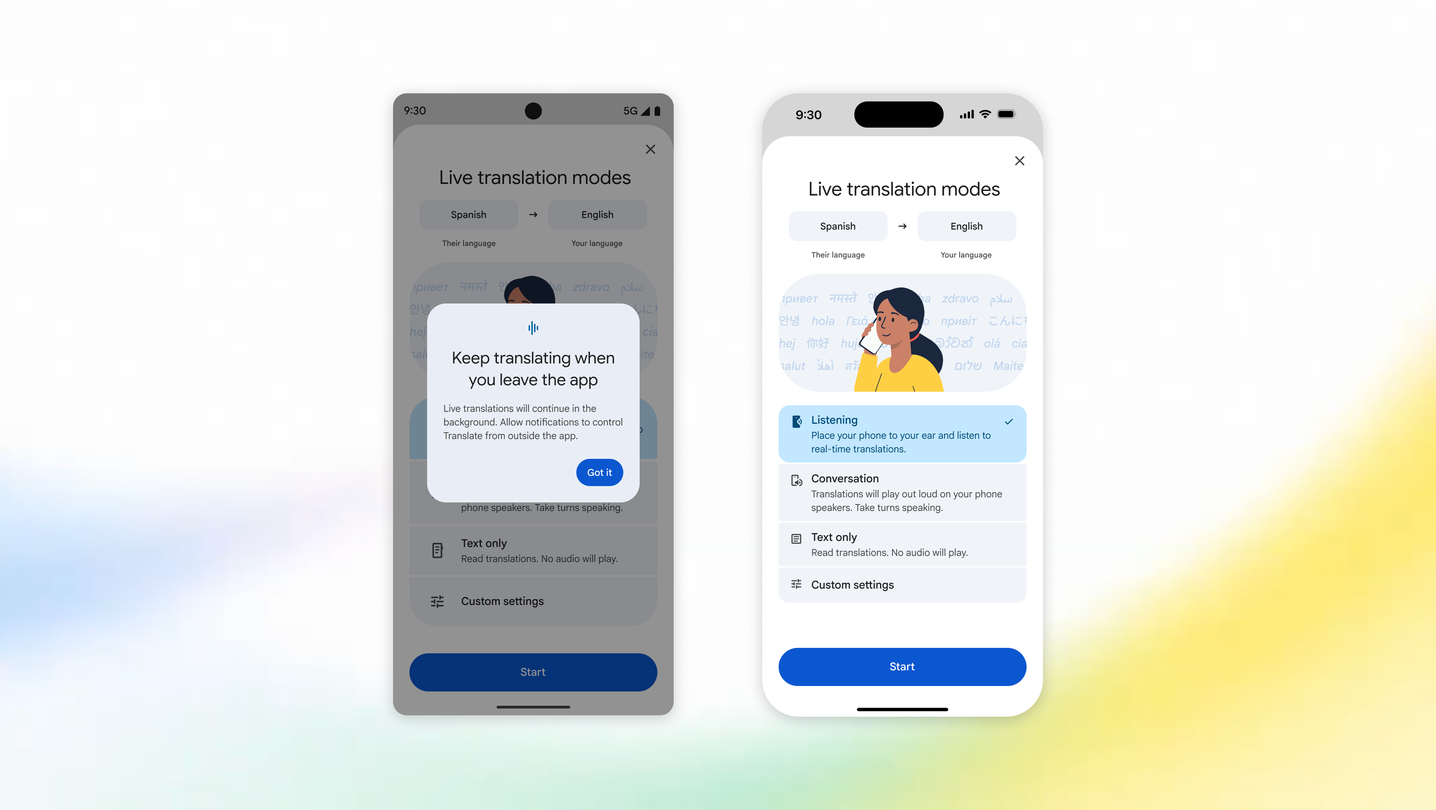
Real-time translation is most useful when it stops demanding that you stare at a translation app. Google’s latest Translate update moves one step closer to that: on Android, Live Translate can keep running when you switch apps or lock the screen. On iPhone, the same service can now play translated speech through the earpiece when headphones are not handy.
Neither change promises a new language model or a miraculous replacement for a human interpreter. The appeal is more grounded. A phone used for translation is usually also holding a boarding pass, a map, a hotel message or a note. Letting the audio continue while the user reaches for those things makes the feature feel less like a demo and more like travel equipment.
Google announced the updates on September 4. It says Live Translate provides near-real-time audio translation in more than 70 languages, and that over a third of its sessions last longer than five minutes. Android Authority, Droid Life and Android Central independently reported the Android background behavior and the iOS listening option.
The change is about staying in the conversation
The new Android behavior is narrowly defined: a Live Translate session can continue while Translate is in the background or after the display is locked. Google says iOS support for that background capability is coming later; it did not attach a date.
The iPhone change is different. Google says iOS users worldwide can hold the handset to their ear to hear the translated audio through the earpiece. Android already had that listening mode. This is not the same as background operation, and it is worth keeping the two features separate rather than assuming iPhone users received the whole Android update.
| Capability | Android now | iPhone now | Important boundary |
|---|---|---|---|
| Live Translate | Available in 70+ languages, according to Google | Available in 70+ languages, according to Google | Language availability is not a guarantee of equal quality for every pair or situation. |
| Keep translating in the background | Yes | Not yet; Google says it is coming soon | Locking an Android phone should no longer end the session. |
| Keep translating with screen locked | Yes | Not yet announced as available | Useful for longer listening sessions, not a substitute for checking context. |
| Listen through the phone earpiece | Already available | Now available worldwide | It is an audio-output option when headphones are unavailable. |
That distinction also sharpens the audience relevance. Visitors, commuters and multilingual families do not need a translation app to become their primary screen. They need it to remain reliable while the primary screen does something else.
Why background audio is the meaningful upgrade
Live translation has always had an awkward physical constraint: the person using it often has to choose between keeping the translation visible and doing the practical task the translation made necessary. Check a platform number and the audio stops. Open a booking confirmation and the conversation is interrupted. Lock the phone during a lecture, tour or announcement and the tool can become less useful precisely when the session gets longer.
Background support resolves that product mismatch. It puts Live Translate in the same category as maps, a podcast or a call: a service that can continue while the phone is used for something adjacent. Android Authority’s coverage captures the everyday case well—following an explanation while checking a location or another detail in a separate app.
There is a privacy dimension too. Holding a lit phone up in a crowded place can announce exactly what a person is doing. Listening from the earpiece is not private in the way headphones are, but it can be more discreet and less cumbersome than putting a phone on speaker. It makes the iPhone option practical for an airport announcement or a guided visit without pretending it is a confidential channel.
Keep the caveats in the frame
Google’s claim is about capability and availability, not perfect interpretation. A natural-sounding voice can still mishear a name, soften a qualifier or miss slang. This is especially consequential in health, immigration, legal, safety and high-stakes financial conversations, where a human interpreter remains the appropriate choice.
Users should also distinguish spoken translation from understanding. If an instruction matters—an address, a gate, a medication dose, a cancellation term—pause and verify it in text or with the speaker. Background operation lowers friction; it does not make the output authoritative.
The product conditions matter as well. Google says the broader Live Translate experience is built around Gemini capabilities, while this week’s announcement only specifies the new behavior, not a new model or a new paid tier. There is no price attached to the September 4 update in Google’s post. A rollout can also arrive unevenly, so an updated app may not show every option immediately.
A better standard for ambient AI
The interesting thing here is not that a phone can speak another language. That was already true. It is that Google is designing the feature for the moment after the first impressive sentence: when someone needs to walk, search, read, lock the device or simply stop holding the app open.
That is the standard more consumer AI features should meet. The useful ones respect the task surrounding the model rather than forcing the task to orbit the model. In this case, Translate earns attention because it is becoming easier to use while doing something ordinary.
Bottom line
Android users should find the background and lock-screen behavior genuinely helpful on longer Live Translate sessions. iPhone users get a more modest but welcome convenience in earpiece listening, while they wait for comparable background support.
Use the tool as a bridge, not a guarantee. For ordinary travel and daily conversation, this update makes that bridge less fiddly—and that is a better measure of progress than another dramatic AI label.