
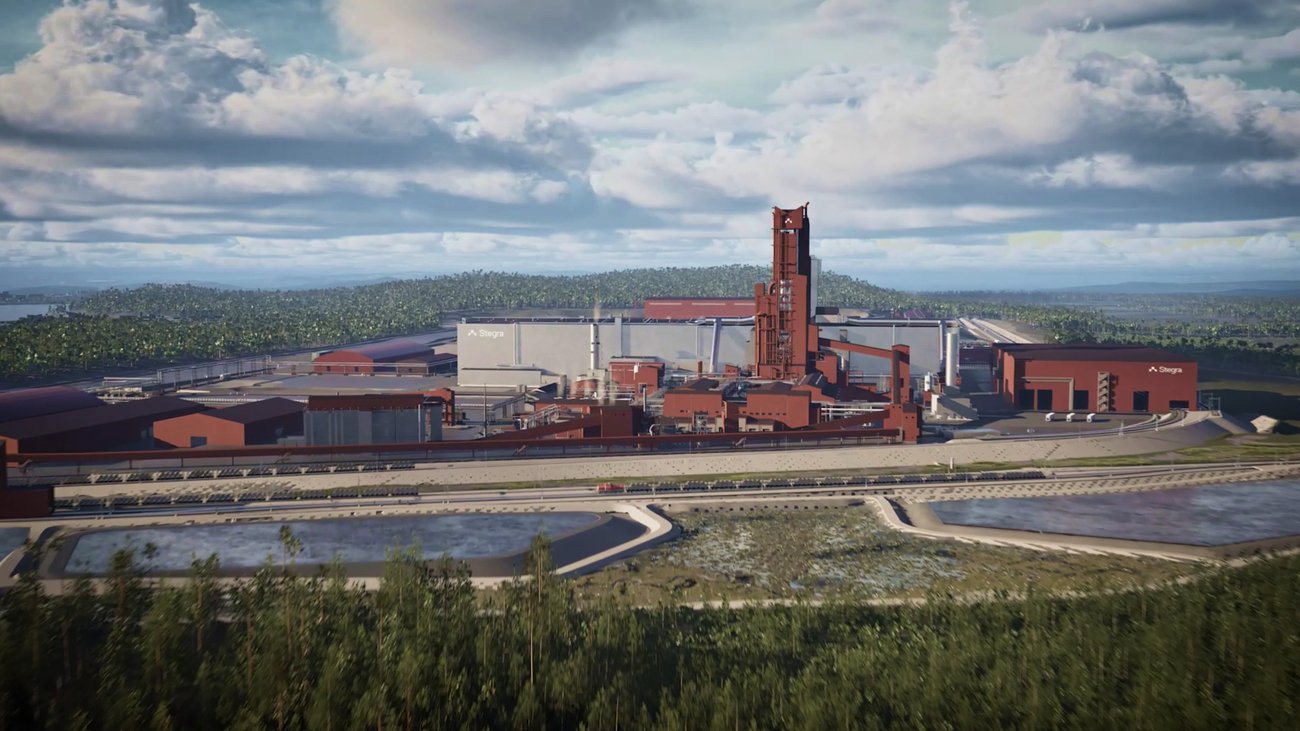
Google’s latest sustainability purchase is deliberately hard to picture. There is no stack of Swedish steel headed to a Google construction site, and no new data centre being announced beside a mill. Instead, Google has agreed to buy environmental attribute certificates associated with up to 91,000 metric tonnes of Stegra’s first-year output from its hydrogen-based steelworks in Boden, Sweden.
That distinction is the whole story. The agreement is not physical procurement; it is a book-and-claim style purchase that separates the steel from the claimed environmental benefit. Google says the certificates are intended to help create demand and financing for near-zero-emissions material. Stegra says the revenue supports its ramp-up. SVT and Canary Media both report the same core arrangement: certificates first, with an option to add volume later.
For an industry that has spent years announcing clean-cloud ambitions while its buildings quietly consume concrete and steel, this is a more honest experiment. It puts a price on lowering the embodied emissions of infrastructure—but it also asks buyers to accept a market mechanism that must earn trust.
What Google actually agreed to buy
Google’s ceiling is 91,000 tonnes of certificates in Stegra’s first production year. The company says the purchase will be linked to steel that meets the International Energy Agency’s definition of near-zero-emissions steel production. Stegra’s announcement describes the certificates as a way to scale supply; it does not say Google will receive the matching metal.
| Item | What the agreement says | What it does not mean |
|---|---|---|
| Buyer | Google becomes a steel customer for that volume. | |
| Instrument | Environmental attribute certificates (EACs) | A shipment of 91,000 tonnes to Google. |
| First-year volume | Up to 91,000 metric tonnes | The plant’s full annual capacity. |
| Climate purpose | Support demand and finance for lower-emissions steel | Google’s construction has zero embodied emissions. |
| Next step | Parties aim to add volumes over the agreement’s life | A commitment to a fixed future total. |
This is easy to dismiss as accounting until one considers the financing problem. New industrial processes need someone to pay for their environmental advantage before costs have fallen to commodity-steel levels. A certificate lets a company that cannot use a particular physical batch still support that advantage. That can be useful, provided one tonne’s claim is issued once, tracked well and not confused with a tonne of delivered product.
Canary Media makes the important correction to a tempting headline: the deal supports the project, but it is not a conventional purchase order for green steel. That is why Google should be judged on the quality and transparency of the certificates, not on an implied stockpile of cleaner girders.
Why this plant is worth watching
Stegra’s Boden site has a physical case behind the financial mechanism. The company plans to use fossil-free electricity to make hydrogen, then use that hydrogen to reduce iron ore rather than relying on coal. The resulting iron is melted in an electric-arc furnace powered with renewable electricity.
The European Climate, Infrastructure and Environment Executive Agency describes a 690 MW electrolyser at the project. Stegra describes its adjacent hydrogen plant as 700 MW and says it is targeting deliveries to customers during 2026, with a goal of supplying 5 million tonnes of steel by 2030. The small difference is a reminder to treat capacity figures as project descriptions, not a finished-factory scorecard.
| Plant detail | Publicly stated position | Why it matters to a technology audience |
|---|---|---|
| Location | Boden, northern Sweden | Clean-power access and industrial logistics are part of the product. |
| Hydrogen system | 690–700 MW electrolyser described by public sources | The energy equipment is central, not an offset around a conventional mill. |
| Process | Hydrogen direct reduction plus electric-arc furnace | Replaces coal’s role in converting iron ore. |
| Emissions claim | Up to 95% lower CO₂ than blast-furnace production, per Stegra | A target that depends on electricity, inputs and accounting boundaries. |
| Scale ambition | 5 million tonnes by 2030, per Stegra | Large enough to matter only if the ramp-up holds. |
Stegra’s “up to 95%” figure is a company comparison against conventional blast-furnace steelmaking, not a universal measurement for every tonne it may make. Electricity source, iron-ore supply, transport and the exact emissions boundary all matter. The European agency also describes the project as a major low-carbon steel initiative, which gives the underlying process more support than a single corporate blog post—but it does not remove execution risk.
The data-centre connection is becoming more concrete
The consumer-facing version of AI is a chat box or a phone feature. The industrial version is a much larger question: how the buildings, racks, substations and grids behind that experience are made. Google says lower-carbon concrete, steel or both have already appeared in more than 20 of its construction projects during 2025, and estimates that using such materials could reduce data-centre infrastructure’s embodied carbon by up to 40%.
Those are Google estimates, not independently audited project results. Still, the direction is sensible. As we noted in Google’s Finland infrastructure plan, big compute expansions are beginning to expose their power arrangements. Steel is the parallel material question: a cleaner electricity contract does not erase the carbon locked into the facility itself.
The best outcome from this agreement would not be a neat marketing statistic. It would be a credible model that lets a project like Stegra prove its economics, while buyers publish enough detail for everyone else to see how volumes, accounting and claims connect. The worst outcome would be a certificate market that lets companies sound as though they installed cleaner steel when they only financed a claim tied to it.
What would make the claim convincing
This deal should be treated as an early test, not a finished answer. Three things matter next:
- Stegra needs to start commercial deliveries on a dependable timetable. A strong technology pathway is not the same as a working, scaled industrial operation.
- The certificate system needs clear rules on ownership, retirement and emissions methodology, so the same claimed benefit cannot be sold twice or used to obscure a higher-emissions supply chain.
- Google and other buyers should explain where certificates sit alongside direct material procurement. Certificates can accelerate a market; they should not permanently substitute for buying the lower-carbon materials a company actually uses.
Bottom line
Google’s Stegra agreement is more interesting because it is narrower than a typical green-building announcement. It buys a defined climate attribute, not a vague halo—and it says so.
That does not make it automatically transformative. A certificate is only as credible as the production it represents and the rules that prevent double counting. But tying a hyperscaler’s construction footprint to a real, hydrogen-based mill in its difficult first year is the kind of demand signal heavy industry has been missing. If the accounting stays rigorous and the plant delivers, this could be a useful bridge from clean-steel promise to a market that actually scales.