
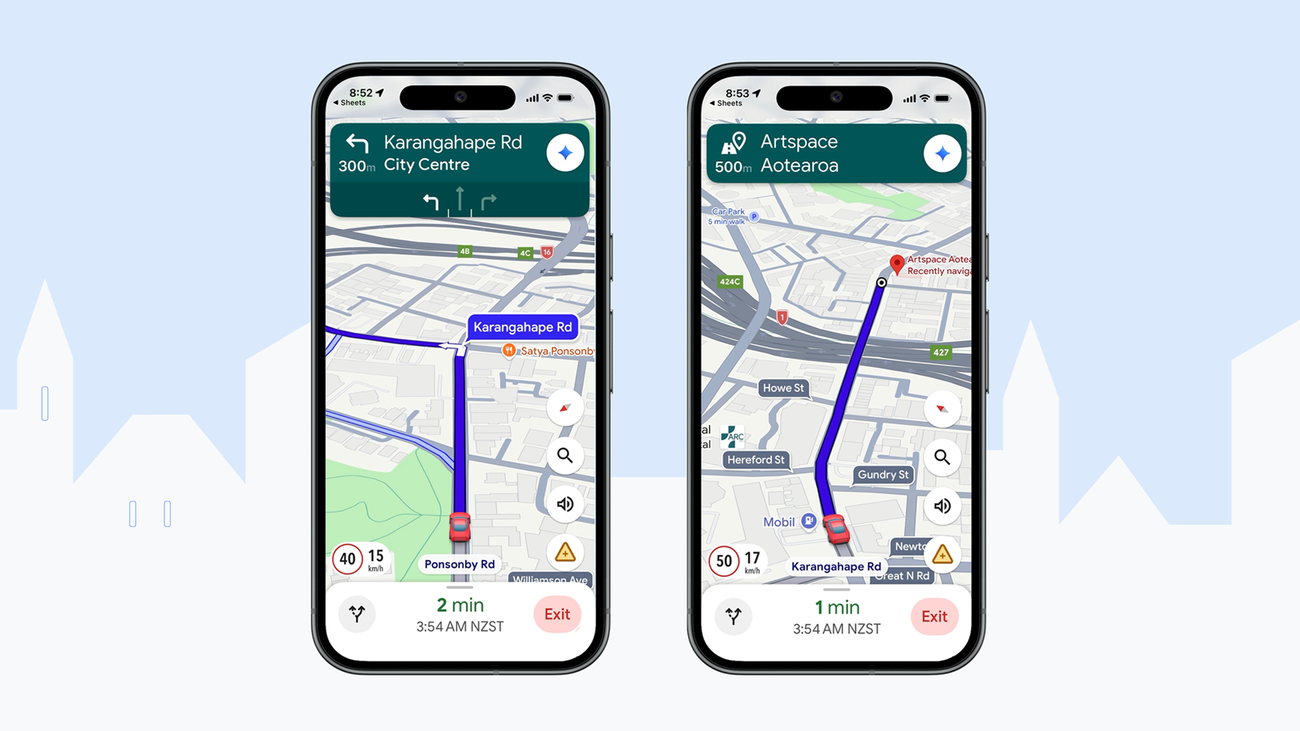
Google Maps has added a New Zealand English voice that can pronounce Māori place names more accurately, and this is one of those AI updates that is more meaningful than it first sounds.
Google says the new voice is rolling out globally on Android, iOS, Android Auto and CarPlay, and that users can try it by setting Maps to English (New Zealand). The company says the voice speaks English with a Kiwi accent while handling te reo Māori place names more correctly, with language experts involved in the work.
That matters because navigation audio is not a demo surface. It is a daily-use product. People hear it while driving, walking, taking public transport, meeting friends, visiting family, and moving through places whose names carry local history. If a global app repeatedly mangles those names, the error becomes part of the ambient technology layer. Fixing it does not solve language revival by itself, but it stops one very large app from working against it.
GearPulse’s view: this is the kind of AI feature that earns attention because it makes a mainstream product more locally competent. It is not asking users to admire a model. It is taking a recurring annoyance and making the default experience less careless.
What changed in Google Maps
The verified change is narrow but practical. Google Maps now offers a New Zealand voice that is designed to pronounce cities and towns in te reo Māori while still speaking English navigation instructions.
Google’s own post says the update starts rolling out now and works across the main Maps surfaces: Android, iOS, Android Auto and CarPlay. The Guardian adds useful context from Google New Zealand and Te Taura Whiri i te Reo Māori, the Māori Language Commission: the model is not a fully bilingual system. It is an English voice informed by Māori pronunciation data and expert guidance.
That distinction matters. This is not Google claiming it has built a complete Māori navigation assistant. It is a targeted text-to-speech improvement for place names inside an English navigation product.
| Detail | What is verified | Why it matters |
|---|---|---|
| Product | Google Maps voice navigation | The feature sits inside a daily-use consumer app |
| Region/language | English (New Zealand) with te reo Māori place-name pronunciation | The fix targets local pronunciation rather than generic English output |
| Platforms | Android, iOS, Android Auto and CarPlay | It reaches both phone and in-car navigation use |
| Technology | AI text-to-speech model, according to Google | AI is being used for a constrained localization problem |
| Caveat | Not a fully bilingual Māori Maps voice | Users should not read it as complete language support |
The user action is also simple: set the app language to English (New Zealand). That makes the rollout easier to understand than many AI features that require a subscription tier, a waitlist, a new app, or a vague promise about future availability.
Why pronunciation is product quality
Navigation apps usually get judged on routing, traffic, speed cameras, lane guidance and arrival estimates. Pronunciation often gets treated as a softer issue. In New Zealand, that framing misses the point.
Place names are part of the interface. If the route says the right road but says the name badly, the product is still communicating poorly. For visitors, correct pronunciation helps avoid learning the wrong version. For locals, it signals whether the app understands the place it is mapping. For Māori speakers and learners, it removes a small but repeated public friction point.
The Guardian reports that the work follows years of pressure around Māori pronunciation in Maps. A 2017 Say It Tika campaign invited people to submit mispronounced place names. Te Ao Māori News reported in 2022 that the effort had stalled because the technology was not ready to handle the language properly. That history makes the 2026 update feel less like a feature drop and more like Google finally catching up to an old promise.
The audience relevance is straightforward: this is a test of whether global consumer AI can be useful without being flashy. The best version of AI localization is almost boring. It notices local speech patterns, respects community guidance and disappears into the product.
The bigger AI lesson
A lot of consumer AI has been sold as a universal layer: one assistant, one model, one interface for everyone. Pronunciation shows why that idea breaks down in real life.
Language is local. Names are local. Acceptable pronunciation is local. A model that sounds impressive in a demo can still fail a place name that everyone in the area recognizes instantly. That is why the human and institutional layer matters here. The Guardian reports that Te Taura Whiri i te Reo Māori worked with Google and that the commission retains guardianship over language data used in the project.
That is the part other platforms should study. Local AI quality is not just a bigger training run. It is the boring governance work around who supplies data, who checks it, who benefits from it and who can correct the output when it is wrong.
There is also a competitive point. Apple Maps, Waze, in-car assistants and voice systems from automakers all have the same localization burden. As more interfaces become voice-first in cars and wearables, pronunciation stops being a nice-to-have. It becomes a trust signal.
What users should expect
The update should be judged on actual road use, not only on the launch promise. A few practical questions will decide whether it feels successful:
| Question | Why it matters |
|---|---|
| Does it handle small towns and street names, not just headline cities? | Launch coverage suggests major place names were prioritized first |
| Does it remain understandable in noisy car cabins? | Correct pronunciation still has to work as navigation audio |
| Can users report bad pronunciations easily? | Local language quality needs a feedback loop |
| Does the model improve without drifting into awkward overcorrection? | Pronunciation updates can create new errors if unchecked |
| Will similar work reach other Indigenous and minority languages? | This is the broader product precedent |
The caveat is that Maps still has to earn this in practice. Google says the voice is rolling out, but local users will find the edge cases faster than any launch post can. Street names, regional variants, macrons, compound words and less-traveled places are where the model will prove whether it is robust or merely better than before.
Bottom line
Google Maps’ new New Zealand voice is relevant because it makes AI feel useful in a place where normal software often feels generic. Correctly saying Māori place names will not carry the whole burden of language preservation, but it does change what millions of navigation prompts sound like.
The best read is cautious optimism. Google appears to have narrowed the task, worked with local language expertise and shipped it inside the product people already use. Now the standard is simple: if Maps can know the fastest route through Aotearoa, it should also learn how to say where it is going.