
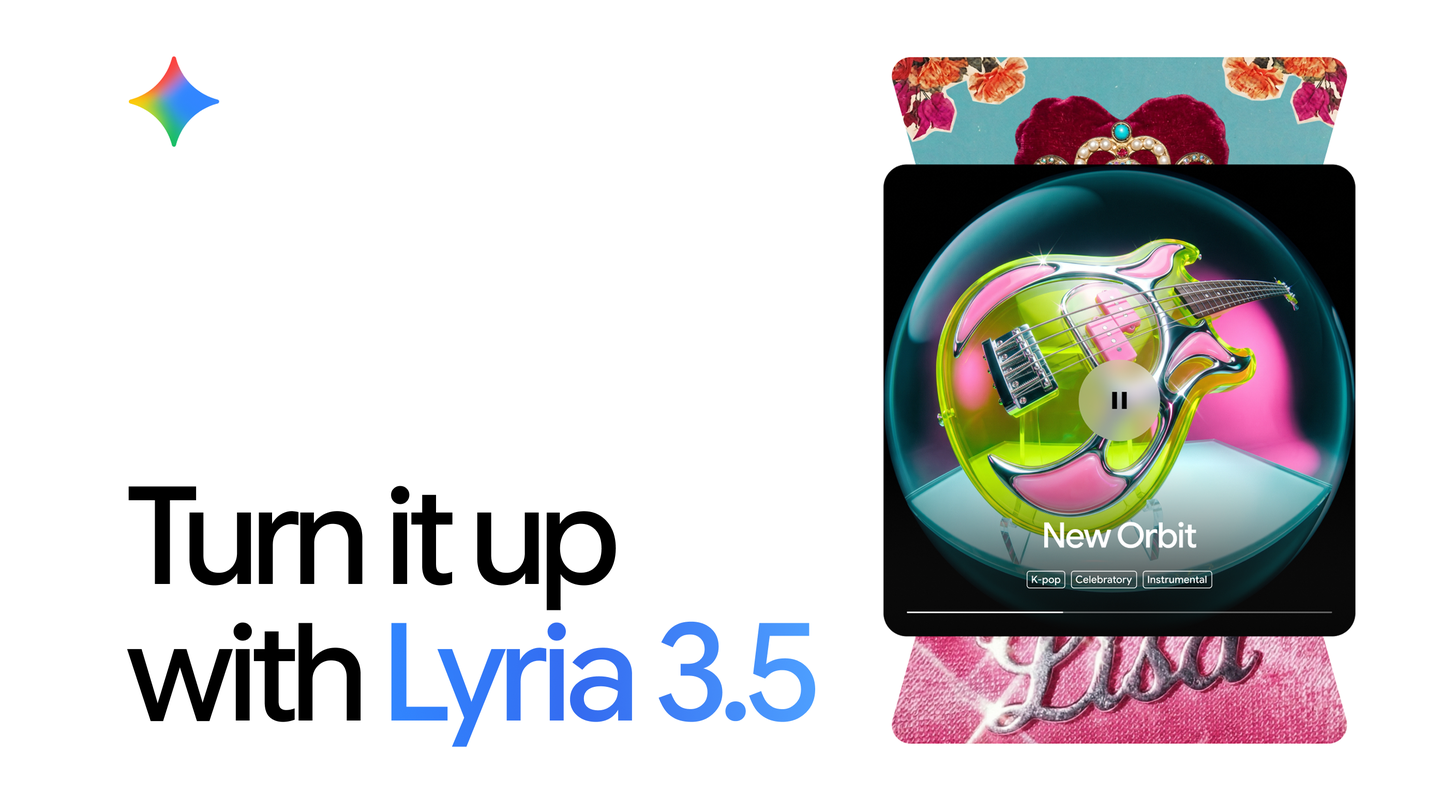
Google has moved Lyria 3.5 out of its specialist Flow Music environment and into the Gemini app. That is a bigger product decision than another model-version number: people who would never open a dedicated music tool can now ask the assistant they already use for a backing track, a birthday song or a short piece of sonic branding.
The September 4 rollout also puts the model in the Gemini API. Google says Gemini users worldwide can access it on the web and mobile, while developers can reach it through AI Studio and Google Vids. Android Authority and The Next Web independently reported the same expansion from Flow Music into Gemini and the API.
That reach does not turn Gemini into a replacement for a digital audio workstation. Lyria is designed to make a coherent song in one generation, not to let a producer reopen a generated chorus and surgically change its snare. For video makers, small teams and people making something with a deadline, that distinction may be exactly what makes it useful.
What the Gemini release actually adds
In the app, Google says users can select or describe a genre, choose vocal or instrumental output, start from templates and choose a short or longer track. The company points to video backing tracks, brand jingles and ringtones as examples. Those are practical prompts because they begin with a job to do, rather than the fuzzier request to “make a good song.”
The API tells the more precise story. Google describes lyria-3.5 as a preview model that creates 44.1 kHz stereo MP3 audio from text or image input, and returns lyrics as text. Up to 10 images can accompany a prompt. A prompt can also use section labels such as [Verse], [Chorus] and [Bridge], or timestamps, to steer the progression.
| Capability | What Google documents | Why it matters |
|---|---|---|
| Output | 44.1 kHz stereo MP3 audio | A broadly familiar music-delivery format, though not a promise of studio-master quality. |
| Inputs | Text and up to 10 images | A visual reference can provide a useful creative brief for a clip or campaign. |
| Structure | Section tags and timestamps | Creators can specify a shape rather than hoping a long prompt produces one. |
| Length | From short clips to a requested full song, up to three minutes | It fits an edit, explainer or social package better than an album-length session. |
| Workflow | One generated output at a time | Revision remains a prompt-and-regenerate process, not multitrack editing. |
Google’s own guidance is unusually candid about that last point: use the faster Clip model to explore prompts before committing to a full Lyria 3.5 track. That is sensible workflow advice, but it also reveals the tradeoff. The system rewards a clear brief and selection discipline; it does not preserve an editable musical state between turns.
A friendly interface changes the audience, not the hard parts
Lyria 3.5 launched in Flow Music in July with controls around tempo and duration. Bringing it to Gemini strips away some of the specialist framing. A marketer looking for a 20-second intro or a student putting music under a presentation can work through a familiar assistant interface instead of learning a new creative application.
That lowers the first barrier. It does not settle the questions that arrive after generation: whether a result fits the project, whether its output is sufficiently distinct, who has authority to use it, and how a client or audience should be told that it was made with AI.
Google says Lyria output carries SynthID, its imperceptible watermarking technology. The developer documentation also describes guardrails around requests involving specific artist voices and copyrighted lyrics. Both are meaningful product choices, but neither should be misread as blanket clearance for every commercial use or as proof that a track cannot resemble existing work. A creator still needs to apply the relevant platform terms, project contract and rights review.
The useful way to judge it
The quality claim deserves proportion. Google calls Lyria 3.5 its flagship music-generation model and says it improves vocal expression, arrangements and fidelity. Those are the company’s claims, not independent audio benchmarks, and a 44.1 kHz sample rate alone cannot tell a listener whether a track is convincing.
What is concrete is the product shape. A generated song can be given a genre, instrumentation, tempo, structure and intended duration; it can be inspired by an image; and it can arrive fast enough to become part of an everyday media workflow. For GearPulse readers, that makes Lyria less interesting as a novelty composer than as a new source of rough-cut soundtrack material.
The strongest use case is bounded: make a draft track for a specific video, pitch, game prototype or event moment, then decide whether it earns its place beside human-made audio and licensed libraries. Treat it as a creative input, not a magic music department.
Bottom line
Lyria 3.5 in Gemini is Google putting a capable but constrained music tool where ordinary creators can actually find it. Its controls and three-minute format are well matched to content production, but the absence of an iterative edit loop means the best results will still come from people who know what they want before they press generate.
That is a healthier promise than pretending AI music has solved production. Gemini has made the front door easier to open; the editorial and rights decisions remain firmly on the other side.