
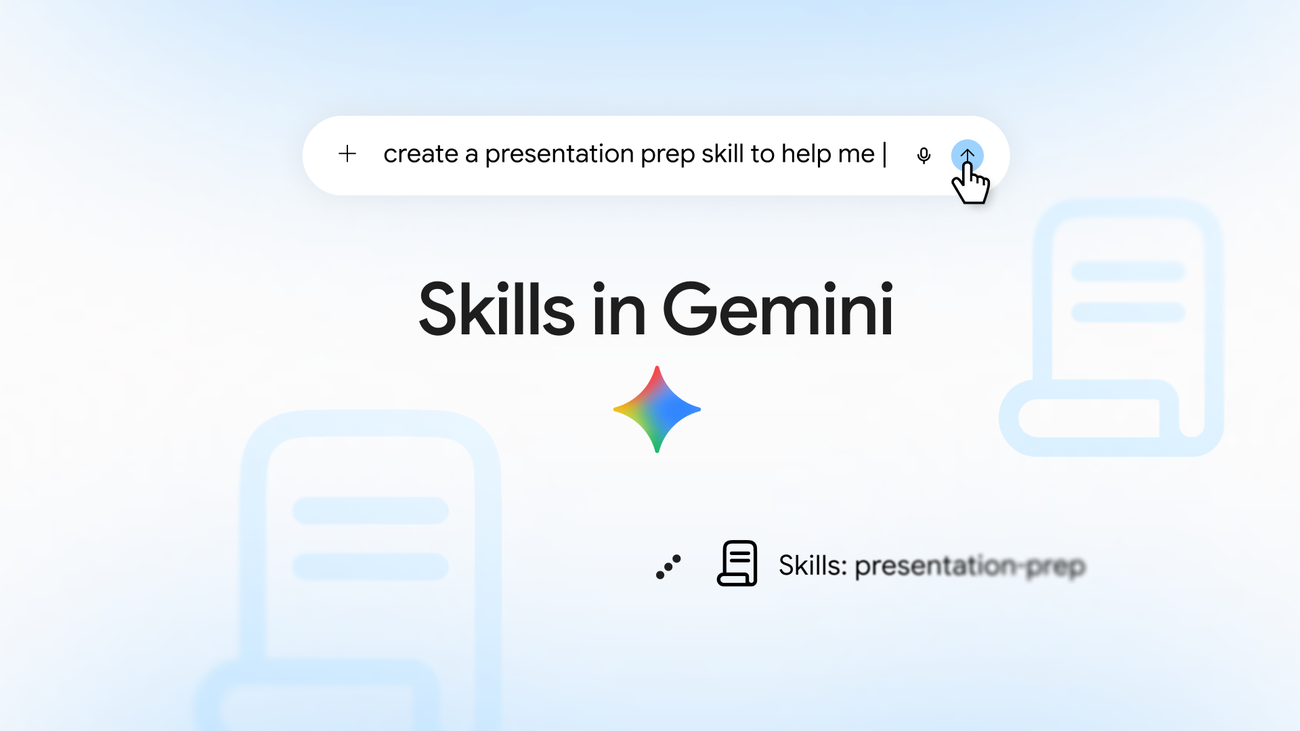
Google’s Gemini has long had a way to save a tailored assistant: make a Gem, give it instructions, then go find it again when the job comes up. The company is now replacing that destination with Skills, reusable instruction sets that live closer to the working chat.
That sounds like housekeeping. It may be a more consequential product decision than another model benchmark. Google says a Skill can be invoked with / and its name, combined with other Skills, or applied automatically when Gemini judges it relevant. It is rolling Skills into Gemini chat globally, with Workspace customers due in the coming weeks. Existing Gems will be migrated as the old format is retired.
The promise is not that an AI suddenly knows a reader’s work. It is that a useful set of constraints—voice, briefing format, brand terminology, a preferred way to challenge assumptions—does not have to be rebuilt every time a blank chat opens.
The meaningful change is where customisation happens
Gems made people leave the conversation to enter a separate custom-assistant interface. That is manageable for a few recurring helpers, but it turns something potentially routine into a destination. Skills move the reusable part back into the prompt flow.
| Before: Gems | Now: Skills | Why the distinction matters |
|---|---|---|
| A custom Gemini version selected from its own area | Reusable instructions available inside chat | A recurring workflow is less likely to be forgotten when it is part of the normal interface |
| Usually one tailored persona or task at a time | Multiple Skills can be combined | A writing-style constraint and a research brief can travel together without becoming one giant prompt |
| Existing Gems stay in place until migration | Google says eligible Gems will migrate automatically | People should still inspect important helpers rather than assuming a new format preserves every behavior |
| Drive and Notebook support were associated with Gems | Google says equivalent Skills support is still coming | The transition is a migration, not evidence of full feature parity on day one |
The mechanics matter because the popular description—“Gems are becoming Skills”—can hide a shift in use. 9to5Google reports that Gems were reached through a side-panel manager, whereas Skills can be called with a slash in the prompt and stacked. The Verge independently reports the chat-level launch and separate Workspace timing. In other words, Google is treating customisation less like building a bot and more like applying a layer to a task.
That is a better mental model for everyday work. A person preparing a presentation might want one reusable instruction set that asks for a narrative, anticipated objections and a two-minute opening; another might enforce a team’s terminology. Those are not personalities. They are repeatable pieces of working judgment.
Migration dates are not one deadline
Google’s own announcement says support for Gems begins ending in November for personal accounts, March 2027 for Workspace business, enterprise and nonprofit customers, and June 2027 for Workspace education accounts. The reporting around the in-product notice puts the personal-account transition at November 17.
That staggered plan is sensible operationally, but it creates a practical trap: colleagues may be using different formats for months. A team should not write a process that assumes everyone can share the same Skill immediately.
| Account setting | What Google says is happening | Sensible next move |
|---|---|---|
| Personal Gemini account | Gems begin transitioning in November 2026 | Copy the instructions from any critical Gem and test a Skills version before the cutover |
| Workspace business, enterprise or nonprofit | Migration starts in March 2027 | Check the admin and rollout position before standardising a team workflow |
| Workspace education | Migration starts in June 2027 | Treat availability and policy controls as local decisions, not a consumer-app assumption |
| Google Labs Gems / Opal workflows | Google says these do not follow the normal Gems migration path | Export or document useful logic; do not count on automatic preservation |
TechCrunch and Android Central both confirm the automatic-migration promise, but also make clear why it should be read cautiously. A Gem could include context files, a default tool or a shareable link. Google says Skills will gain the familiar sharing, Drive-file and Gemini Notebook capabilities in coming weeks—not that every capability is interchangeable today.
Better reuse is valuable only if it stays inspectable
The best use of a Skill is specific and legible. “Write like us” is vague enough to create inconsistencies; “start with the decision, flag unknown facts, use Romanian product names unchanged and end with three actions” is something a colleague can audit and improve.
That is especially relevant for the more consequential work people increasingly hand to chat tools. A reusable instruction can reduce repetitive prompting, but it can also spread a bad assumption quickly. Stacking several Skills makes the question sharper: when an answer is strange, can the user see which instruction shaped it?
Google says Gemini may automatically run a matching Skill. That convenience should remain an assist, not a mystery. For any workflow involving client information, health, money, compliance or public claims, users should know which Skill was applied, what reference material it can use and whether an output still needs review.
The broader context is Google’s push to make Gemini a working layer across devices and apps, as its Chrome integration has already illustrated. Skills could be the more durable part of that strategy: not a flashy new AI character, but a way for useful instructions to show up where the work is actually happening.
Bottom line
Replacing Gems with Skills is a welcome correction to an awkward interface. The upgrade is not the name; it is the move from a separate collection of custom bots to reusable constraints that can be called, combined and—ideally—examined inside a live task.
For personal Gemini users, the right move is simple: identify the one or two Gems that genuinely save time, save their instructions somewhere readable, and test their Skills equivalents before the November migration begins. If the new system preserves the important context while making reuse less ceremonial, Google will have made custom AI more useful by making it feel less like a special destination.
Support the site at buymeacoffee.com/gearpulse.site.