
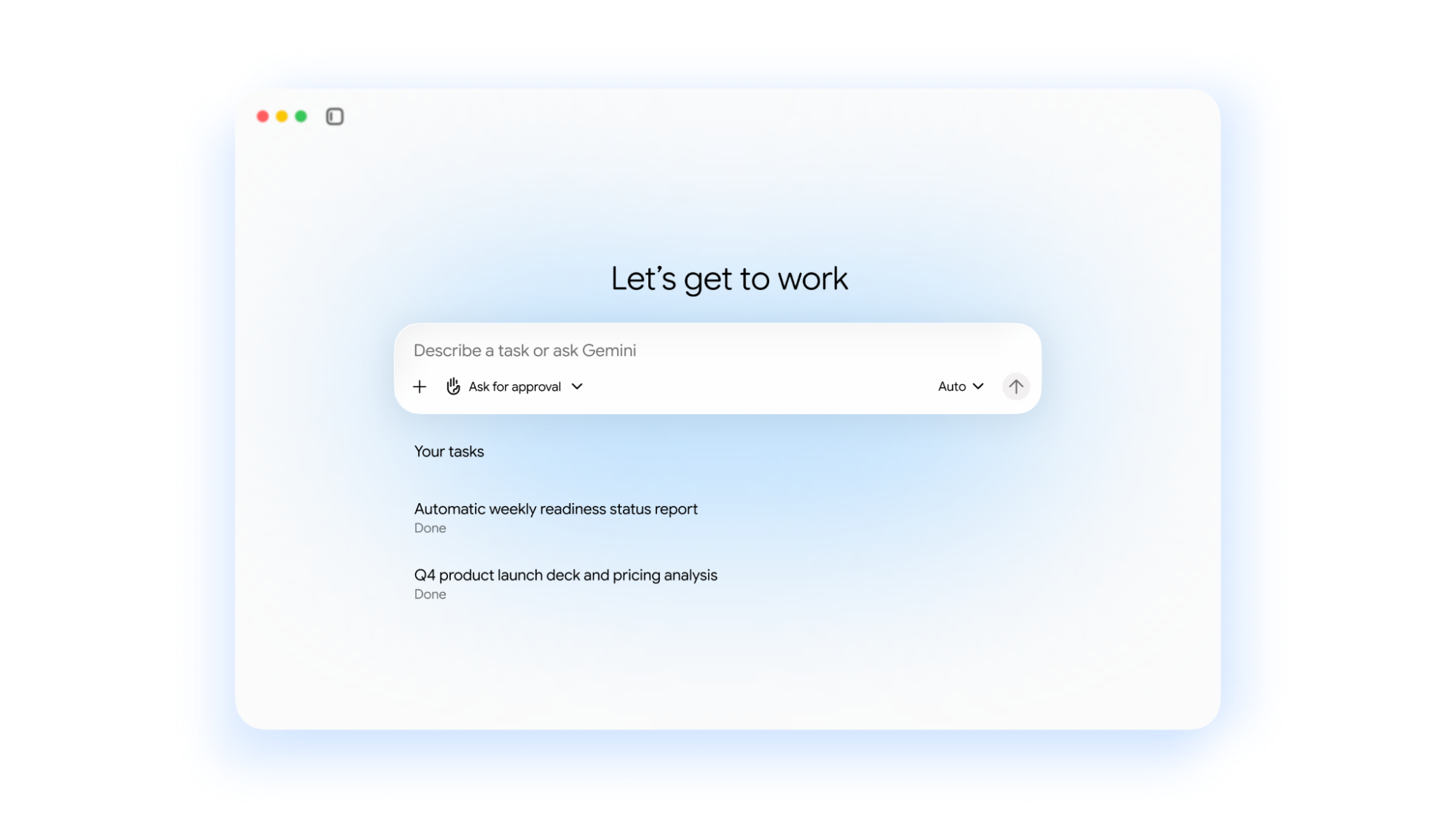
Google Cloud’s Gemini agent is not being pitched as a smarter chatbot. The October 8 announcement imagines software that can be assigned an objective, connect to workplace systems, keep going after a laptop is closed and return work in the tools where a team already operates. The revealing detail is the identity model: Google says a “coworker” agent can receive its own Workspace account, email address and audit trail.
That is a more consequential product choice than a fresh model name. Once software can work across calendars, documents, code and internal systems, the important question becomes less “can it write?” than “whose authority is it using, and can a human reconstruct what happened?”
Google says the agent can plan work, use tools and skills, select a model for a task, and operate through Google Workspace, Microsoft 365, Slack, command line and other surfaces. TechCrunch and Reuters both report that the first focus is business use, with enterprise connections and controls central to the rollout. Google has announced the product; it has not made a general consumer rollout the story.
The real feature is a separate identity
Giving an agent its own account can sound like a bit of workplace theater. It is actually a practical boundary. An agent that acts through a named identity can be added to a shared space, granted access deliberately, and leave activity attributable to the system rather than quietly borrowing an employee’s credentials.
Google says a coworker agent sees only the context people share with it and can have a dedicated email address and storage. That is a useful design direction, but the outcome rests on the implementation. A separate mailbox is not a security control if broad folders, connectors or approval rights are handed over without care.
| What Google describes | The useful operational question | A boundary to set before rollout |
|---|---|---|
| Long-running, cloud-based execution | Can the task continue without someone watching a browser tab? | Set a time limit, a spend cap and a clear owner for each task. |
| Connections to business systems | Which systems can the agent read or act in? | Start read-only; add write actions one narrowly scoped workflow at a time. |
| A dedicated coworker identity | Can people tell when the agent, rather than a colleague, did something? | Keep a visible activity log and require a human approver for consequential changes. |
| Dynamic sub-agents and skills | Can the primary agent delegate work further? | Define which skills and delegated tools are permitted, then test failure paths. |
| Model choice, including third-party models | Where does a task’s content travel and which model processes it? | Make model routing explicit for sensitive work rather than accepting the default blindly. |
The last row deserves special attention. Google says Gemini can choose a model for the job and that Anthropic Claude models are among the initial choices, with more options planned. That flexibility can help a team balance speed, capability and cost. It also means a buyer must understand data handling, retention, regional availability and approval conditions for each route—not merely for the Gemini label on the front door.
A task inbox is more useful than a magic button
The agent’s promise is attractive because it converts a fragmented workflow into an outcome: inspect material, coordinate steps, produce a draft, and surface it in the right place. But a task that spans multiple systems also expands the blast radius of a mistaken instruction or an overconfident conclusion.
The right interface for that kind of work is not a magic button; it is an accountable task inbox. TechCrunch reports that Google plans an interface showing task progress, skills, code and delegation. That visibility is a good start. A mature deployment should add a few unglamorous policies: who can initiate high-impact tasks, which actions pause for approval, where the final record lives, and how a user stops work that has become wrong or irrelevant.
This is why the company’s own position on cost controls is more than an enterprise checklist. Google says customers can set real-time project spend caps that pause an agent if reached. A cap is valuable, but it only works when tasks are assigned to a project with a sensible budget. Teams should not judge agent economics by the cost of a polished demo; they should measure retries, tool calls, human review and failed work in the actual process.
The audience benefit is simple: less tab-switching, more traceability
For people who work in a mix of documents, chat, tickets and code, the most promising version of this product is modest. An agent can prepare a project update from approved sources, route a routine request to the right team, or assemble a first pass at a release checklist—then leave a readable trail for a human to inspect. That is more credible than asking it to become an autonomous manager.
The distinction matters because users have already seen how a powerful model can be useful without being ready for every workflow. In our look at Gemini 4 Argon, the central caveat was access and independent testing. Here, the equivalent test is governance in ordinary work: can the organization constrain an agent’s reach while still getting enough value to justify the extra administration?
Google points to customers and early deployments across finance, telecoms, retail and other industries. Those examples show ambition, not a guarantee. Claims about time saved, response speed or rollout scale are company or customer claims unless an organization can reproduce them in its own environment. The credible buying path is a bounded pilot with a reversible permission set and a clear success measure.
Bottom line
Gemini agent is Google Cloud turning the AI assistant into something closer to a managed workplace identity. That can be a meaningful upgrade: separate accounts, explicit sharing and attributable logs are better foundations than an opaque bot acting as an employee.
The technology will earn trust only if businesses resist the temptation to grant it broad authority on day one. Give the agent a job, a budget, a limited set of doors and a human who can see—and stop—what it is doing. If that discipline is in place, the employee badge may be the most useful part of the launch.