
AI agriculture is usually sold as an impossibly broad promise: put an assistant in a farmer’s pocket, then let intelligence do the rest. Google and the Gates Foundation’s new commitment is more interesting because its pieces are concrete. They say more than $100 million in combined funding and technical support will expand climate, crop and language tools from an initial reach of 50 million to 200 million smallholder farmers across Sub-Saharan Africa and South Asia.
The number is an ambition, not a measure of 200 million people already receiving better advice. That distinction is the story. A weather alert, a crop diagnosis or a satellite-derived field boundary has value only when it arrives in the right language, is legible on the device a farmer has, and proves reliable enough to change a seasonal decision. The partnership points at real infrastructure for that job—but it also creates a very large standard against which to judge it.
The work is a stack, not one AI product
The announced work combines several existing and planned components. Google and the Gates Foundation identify TomorrowNow for operational climate information, work with CGIAR on crop resilience, local partners including Wadhwani AI and Digital Green, and datasets in more than 40 African languages. Google’s Agricultural Understanding Platform is the most tangible technical layer: it uses satellite imagery and machine learning to outline fields and monitor crops over time.
| Layer | What the partners say it is for | The test that matters |
|---|---|---|
| Weather and climate data | More local forecasts and alerts through TomorrowNow | Does advice arrive early enough and at a useful geographic scale? |
| Field mapping | Identifying boundaries and crops from imagery without manual surveys | Can it handle small, irregular plots and real land-record discrepancies? |
| Crop and research support | Data and infrastructure, including CGIAR work on resilient crops | Does it translate into choices a grower can actually access? |
| Local-language AI | Speech and text resources across 40-plus African languages | Are the languages, dialects and agricultural terms accurate in practice? |
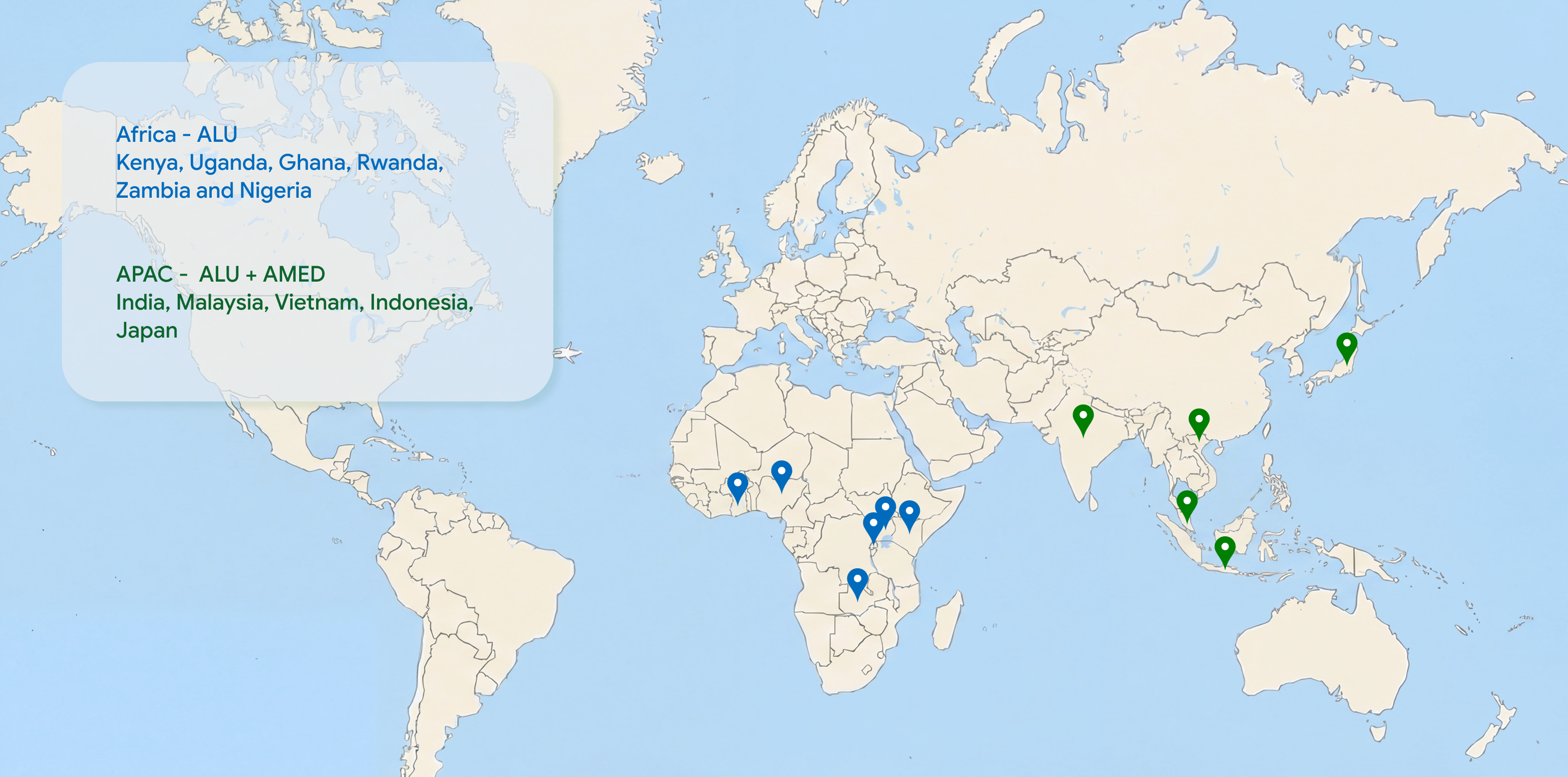
The foundation’s announcement says its Agricultural Land Use data already covers India, Malaysia, Vietnam and Indonesia, with deployments underway in Kenya, Uganda, Ghana, Rwanda, Zambia and Nigeria. Google’s platform documentation explains the underlying premise: field boundaries are the unit that lets a system turn regional imagery into farm-level observations. It also says its monitoring service organizes predicted data by field and crop season. Those are valuable capabilities, but they are not the same thing as a validated instruction to plant, spray or borrow money.
That boundary is especially important for GearPulse readers who follow AI as infrastructure rather than spectacle. A model can be technically impressive and still fail the person at the end of the network through a mistimed forecast, poor connectivity, unclear explanation or an advisory that assumes inputs are available. The data path has to be as trustworthy as the model.
Scale is not proof of impact
The partners frame the program around increasingly unpredictable weather and small farms that are difficult to see in conventional imagery. AP’s reporting on the Gates Foundation’s broader AI commitment adds an essential counterweight: researchers warn that weak infrastructure and underrepresentation can leave the most marginalized people out—or amplify existing gaps—despite a well-intentioned AI rollout.
There is evidence of operational momentum rather than a blank slate. The University of Notre Dame Mumbai reported this month that the AIM for Scale initiative is funding weather and crop-disease forecasting work intended to reach millions of farmers, with Digital Green integrating forecasts into its FarmerChat advisory service. It is a useful example of what a serious deployment looks like: a forecast service, a distribution partner and a feedback loop—not simply a model release.
The new initiative should therefore be evaluated in layers:
- Reach: how many people can actually receive the service in a language and channel they use?
- Reliability: what happens when satellite observations, local weather data or a recommendation are wrong?
- Agency: can farmers understand, challenge and opt out of a recommendation, rather than treating it as an opaque verdict?
- Outcomes: are decisions, yields, resilience or access to insurance and credit improving after costs and bad seasons are counted?
The last point is tougher than a launch metric, but it is the only one that turns “AI for agriculture” into a meaningful claim.
A good reason to be exact about the language
There is a familiar temptation to describe initiatives like this as AI arriving in agriculture. It has been arriving in pieces for years: better forecasts, remote sensing, crop models, extension services and mobile tools. What this commitment can change is the connective tissue—funding, technical support, local partners and language resources—if those pieces are built around the people making decisions rather than around a demo.
That is why the more modest part of the news may prove the most consequential. A service that helps a farmer distinguish an actionable weather window from generic climate information can be more valuable than a dazzling general-purpose assistant. It is the same principle behind Google’s effort to put flood forecasts closer to the people who need them: prediction earns trust only when its delivery, uncertainty and local context are treated as product features.
The bottom line
Google and the Gates Foundation have outlined a serious expansion, with a stated $100 million-plus commitment and a clear target of 200 million smallholder farmers. The credible elements are the unglamorous ones: field-level mapping, local climate information, languages and delivery partners.
But a target population is not a result, and an AI recommendation should never be confused with a guarantee. This is worth watching because it puts a real-world, high-stakes question to AI infrastructure: can it become specific, accountable and useful enough to help people whose next decision cannot be retried with a software update?