
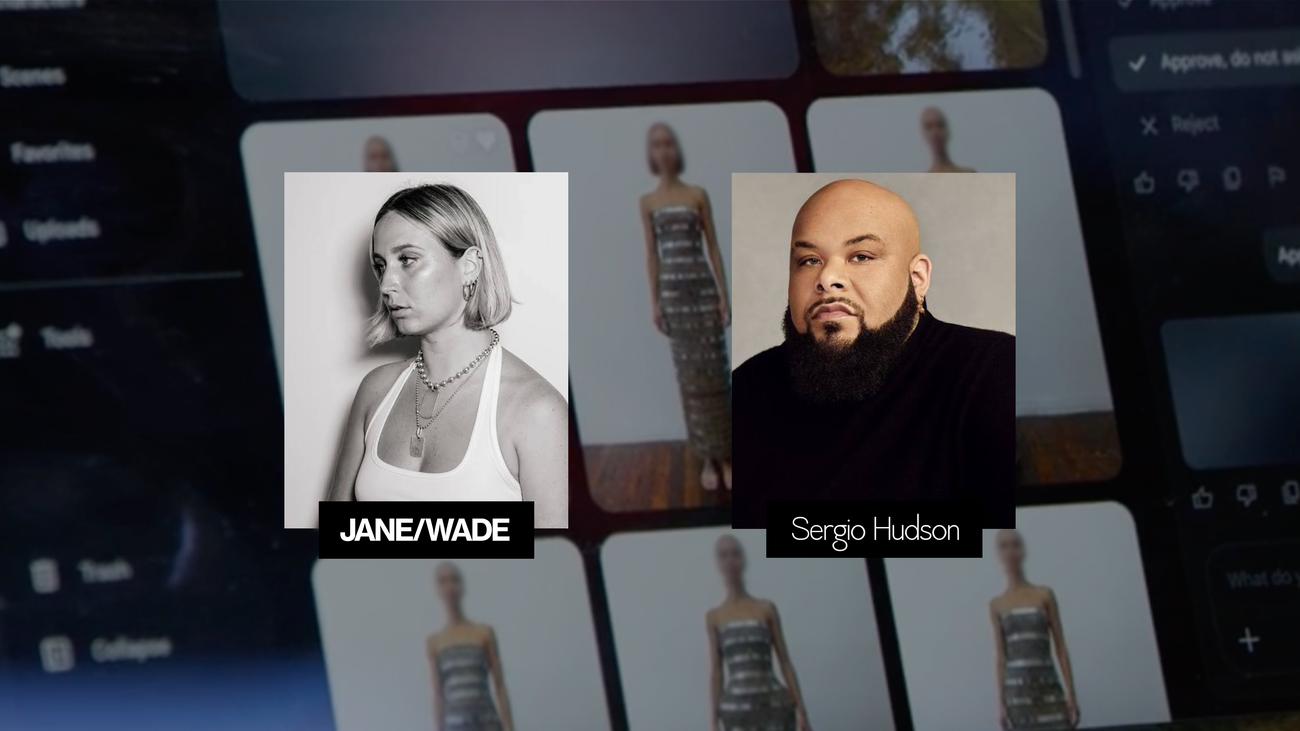
The most interesting thing about Google’s Fashion Week experiment is what it did not try to do. It did not present a chatbot as a designer, claim that a model could replace a fitting, or turn an AI image into the finished campaign. Instead, Google’s Envisioning Studio worked with Jane Wade and Sergio Hudson on two custom, beta workflows inside Flow: one to reason through a look before physical sampling, the other to reason through a runway before a set is built.
That is a considerably more useful target for generative AI. The expensive, repetitive part of creative production often happens before the public sees anything: comparing alternatives, giving several people the same visual reference, and finding a bad idea while it is still cheap to change. Google’s post and Vogue’s reporting agree on that boundary. The experiments were planning aids around two real Spring 2027 shows, not a new consumer fashion feature.
The context matters, too. The CFDA announced in 2025 that Wade and Hudson were among five designers receiving Google-backed support for their September 2026 collections. This is therefore a close collaboration with unusually motivated participants, not evidence that a generic prompt box will transform every small studio on Monday morning.
Two narrow jobs, not one magic creative tool
Google describes Wade’s Styling Suite as a way to place garments, accessories, hair and makeup on digital models before producing physical samples. Hudson’s separate Runway Visualization tool was used to explore a venue, lighting, props and model paths while keeping a studio budget in view.
| Workflow | The decision it moves earlier | What it cannot settle |
|---|---|---|
| Styling Suite | Which combinations are worth bringing into a fitting or sample round | Fit, fabric behaviour, construction, comfort and the judgement of a stylist in the room |
| Runway Visualization | Whether a set, lighting scheme and circulation concept are worth costing or revising | Sight lines in a live room, physical build quality, audience response and production delivery |
That division is the whole point. A generated image can make a team’s intention legible sooner. It cannot tell a designer whether a sleeve pulls when a person moves, whether a fabric photographs as intended under a particular light, or whether a crew can build a concept safely and on schedule. Wade told Vogue that real fittings remained part of the process; that makes the test more believable, not less ambitious.
The promise is fewer expensive detours
For a small label, a sample, another fitting or a revised rendering is not just an item on a task list. It can be a new factory charge, another day of coordination and a decision that has to be explained again to a stylist, producer or lighting team. A shared previsualisation may narrow the field before those costs start accruing.
This is where Google’s approach has more practical weight than a headline about “AI fashion.” The software is being asked to make options cheap, not to certify an answer. A useful output may be the one that reveals a bad pairing, an overbuilt set or an absent accessory early enough to avoid spending money on it.
That is also the useful lens for other creative tools. When Google moved Lyria 3.5 into Gemini, the gain was access to a rapid first draft of music, not a replacement for a multitrack studio. Flow’s Fashion Week work follows the same pattern: a faster first decision is valuable, but it is not the final craft.
Why this is not yet a product announcement
Readers should resist turning this into a buying recommendation for Flow. Google calls the two workflows custom tools built with the designers; it does not announce their public release, pricing, supported inputs, accuracy rates or measured savings. Vogue’s account is valuable corroboration of how the collaboration was used, but it is still a report on two carefully supported cases rather than an independent benchmark.
There are real operational questions before a fashion or creative team should put work into a similar system: who has rights to reference images and sketches, how are generated files shared, what happens to sensitive collection details, and how easy is it to trace a decision back to the source material? Those questions matter more when a tool moves from a fellowship project to a commercial workflow.
Bottom line
Google’s Fashion Week test is persuasive precisely because it keeps AI in its lane. The goal is not synthetic fashion; it is less wasteful pre-production. If Flow eventually exposes these kinds of structured, project-specific workflows more broadly, the measure of success will not be how spectacular the images look. It will be whether a designer can make one better decision before committing materials, money and people to the real one.