
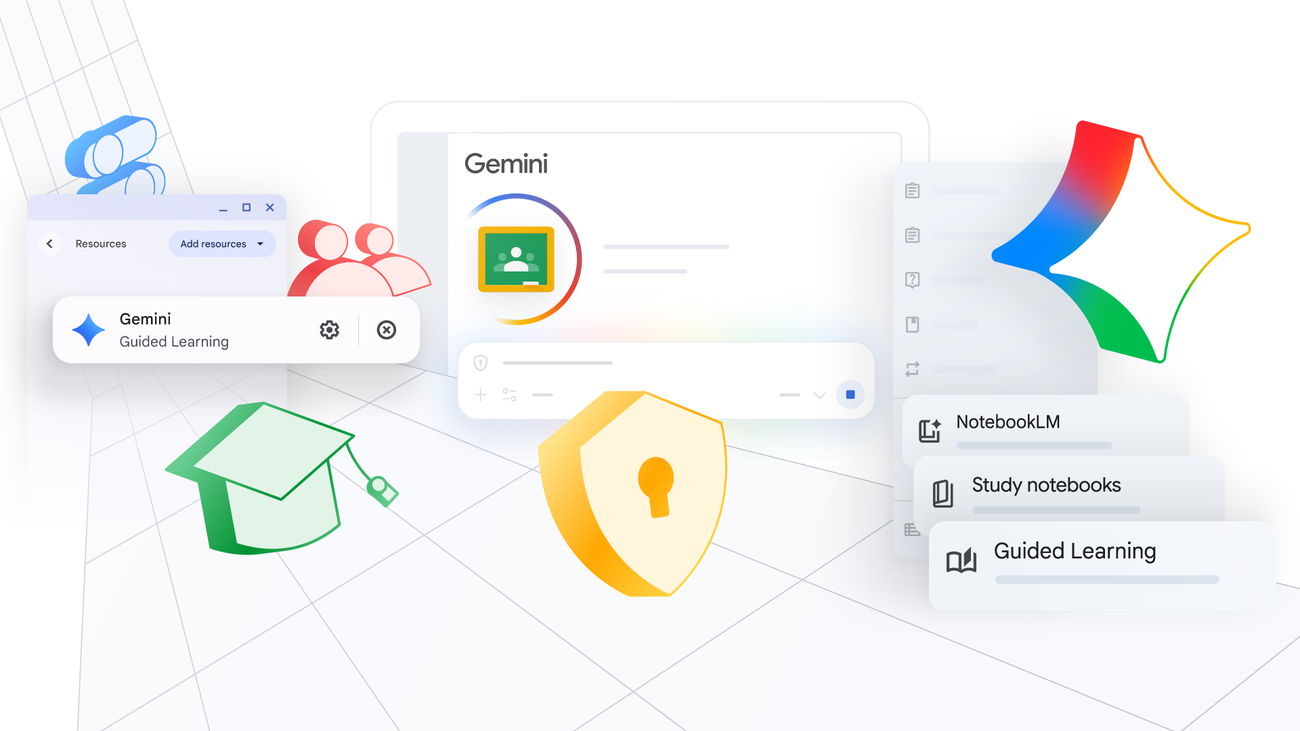
Google’s newest education AI announcements are easy to read as a feature dump: Gemini, Classroom, NotebookLM, Chromebooks, learning management systems, and training programs all stitched together.
The better way to read them is as a control story. Google is trying to convince schools that AI in the classroom does not have to mean students wandering through a chatbot unsupervised.
That promise is the whole product.
What Google announced at ISTE
Google says it is bringing teacher-led AI activities to Google Classroom for Guided Learning in Gemini, study notebooks in Gemini, and NotebookLM over the coming months. The idea is that educators choose the class materials, define the activity, and then receive insight into how students are engaging with the work.
Google is also expanding teacher-led AI experiences into select learning management systems through Gemini LTI. NotebookLM support is first, with class-material selection available now for PowerSchool Schoology and coming soon for Canvas by Instructure. Moodle is supported, but Google says class sources must be uploaded manually.
There is a Chromebook classroom-management angle too. Google says Class tools can lock students into approved experiences such as NotebookLM or Guided Learning, with a coming Guided Learning toggle meant to reduce distractions during class activities.
| Feature | What it is meant to do |
|---|---|
| Teacher-led Guided Learning | Give students Gemini help inside a curriculum-informed space. |
| Teacher-led study notebooks | Turn class material into bite-sized lessons and quizzes. |
| Teacher-led NotebookLM | Convert class sources into flash cards, podcasts, and study aids. |
| Classroom app in Gemini | Let Gemini reference assignments, grades, and materials for teacher workflows. |
| Class tools on Chromebooks | Keep students focused on approved classroom activities. |
The important claim is data boundaries
For schools, the key claim is not “AI can make a quiz.” Teachers have had quiz generators for a while.
The key claim is that Google can keep the experience rooted in curriculum and under educator direction. Google says educators can select the class materials that inform activities, get insight into student progress, and use Workspace for Education with data that is not used to train AI models.
Those details matter because classroom AI fails quickly when it becomes generic. A student does not need a random answer about chemistry. They need help with the lesson their teacher assigned, at the level the class is working through, with guardrails that match the school’s policies.
The other story is teacher workload
Google is also pushing Gemini deeper into teacher workflows. A June Workspace Updates post says Google is updating the Gemini tab in Classroom to help teachers create and refine lesson plans, generate visual aids from any device, and work with classroom material more easily.
That is a more realistic use case than pretending AI will replace instruction. Teachers spend a huge amount of time turning curriculum goals into assignments, announcements, rubrics, differentiated materials, and parent-facing explanations. If Gemini can reduce the drafting burden while leaving final judgment with the teacher, the tool has a practical reason to exist.
The catch is that time saved in drafting can become time spent checking. Schools should judge these tools by the net result: fewer admin hours, clearer student support, and fewer mistakes.
Training may matter as much as features
Google’s broader education push includes an AI Educator Series built with ISTE+ASCD. ISTE+ASCD announced a three-year partnership with Google in February to make AI literacy training available to six million K-12 teachers and higher education faculty in the U.S.
That training layer matters because classroom AI is not just a software rollout. Teachers need to know when to use it, when to reject it, how to explain it to students, and how to spot shallow answers that look polished.
| School question | Why it matters |
|---|---|
| Can teachers inspect the source material used by AI? | Grounding only helps if it is visible. |
| Are student insights understandable and limited? | Analytics can help instruction or become surveillance. |
| Can admins set age, privacy, and access policies clearly? | AI tools in schools need predictable governance. |
| Does training reach substitutes, support staff, and new teachers? | Classroom practice depends on everyone using the tools consistently. |
Bottom line
Google’s ISTE 2026 education updates are not just about adding Gemini to more places. They are about making AI feel administrable enough for schools to adopt.
That is the right problem to solve. The useful version keeps teachers in charge, keeps student work grounded in assigned materials, and makes AI a controlled classroom tool instead of a parallel internet. The rollout still has to prove itself in real schools, but the direction is more serious than another chatbot shortcut.