
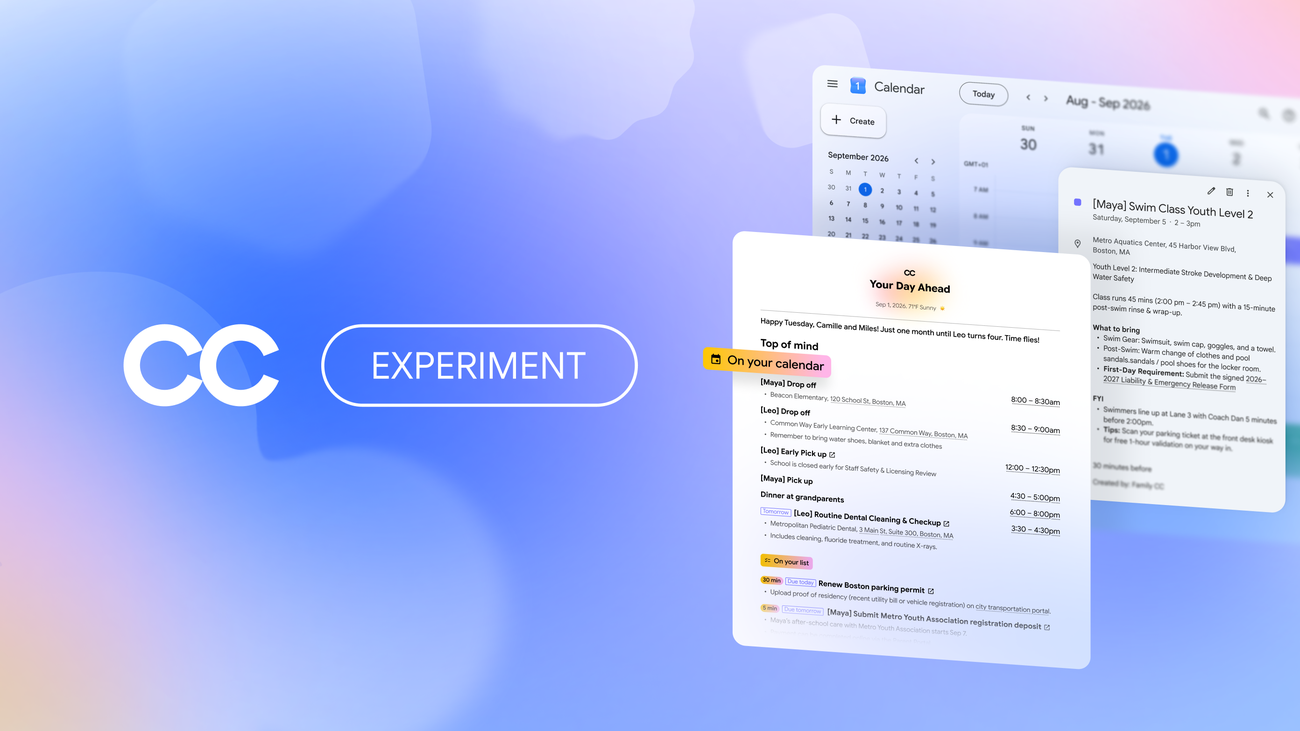
The family calendar has always been a small exercise in systems design: information arrives through scattered inboxes, someone converts it into a plan, and everyone else hopes the plan is current. Google Labs’ newly expanded CC aims to become the shared layer in that system. It is an intriguing use of an AI agent precisely because it tackles a real annoyance rather than inventing one.
Google says the experiment now lets up to six household members collaborate with a dedicated CC Google Account. They can choose emails, Drive files, calendars, Chat messages and recurring senders to share; CC turns that input into a common morning brief, calendar items and tasks. It can also help prepare registration or permission-slip PDFs, make a shopping list and assemble meal ideas.
That is a much more consequential job than summarising one person’s inbox. A household agent touches the data that produces real-world commitments. The winning version will not be the one that knows the most about a family. It will be the one that makes it easiest to see what it knows, correct it and stop it from acting at the wrong moment.
This is a shared workspace, not a magic family assistant
CC began as an individual productivity experiment in late 2025, then informed Gemini’s Daily Brief experience. The new version takes a different approach from simply giving everyone another shared calendar: Google says CC has its own verified account and each member decides what to contribute. A school’s messages can be approved for ongoing sharing, while an unrelated inbox remains private. One-off material can be forwarded by email or Google Chat, and a shared Drive folder or calendar can be connected directly.
That design has a practical virtue. A dedicated identity gives a household a visible place to direct information instead of making one parent’s account the accidental control centre. Ars Technica and SiliconANGLE both report that CC can maintain shared calendar and task data while separating household memory from person-specific information.
| What CC is meant to do | The useful reading | The limit worth remembering |
|---|---|---|
| Deliver a shared “Your Day Ahead” brief | Bring appointments, deadlines and unresolved tasks into one morning view | A concise brief can still omit the qualifier that changes a plan |
| Read specifically shared material | Reduce manual forwarding from school, sports, travel and household sources | The approval choices are the product’s real security boundary |
| Create or update family tasks and calendar entries | Turn notices into work people can see | A mistaken date is worse when it propagates to six people |
| Pre-fill forms and make lists | Remove repetitive administrative work | A human should check every field and approve anything submitted |
| Keep shared and private memory | Avoid treating every preference as a household default | Families need a clear way to inspect, edit and delete what has been retained |
The distinction matters because an AI agent is not just reading information; it is sorting, interpreting and potentially preparing actions from it. An invitation image with a handwritten time, a school PDF with an exception, and a flight confirmation with an itinerary change are all messy inputs. AI can make them easier to process, but it does not make ambiguity disappear.
The clever feature is selective sharing
The most promising part of Google’s pitch is not the form filling. It is the attempt to make sharing granular. Google says people can nominate senders for automatic sharing, review new senders privately each week, and forward isolated items when appropriate. CC is also supposed to respond only to group members and seek permission before acting outside that group.
Those choices are a better starting point than blanket access, but a useful permission model has to survive ordinary family life. Someone will approve a sender in a rush. A school email may include data about a child, a payment link or a document intended for one guardian. A shared calendar can reveal more than an appointment title. And a helpful memory can become awkward when a household changes, a child grows older, or an adult leaves a shared plan.
The sensible setup is therefore deliberately narrow at first:
- Start with a single shared calendar and one low-risk sender such as a club or school newsletter.
- Keep banking, medical, legal, employment and account-recovery messages out of automatic sharing.
- Treat form completion as drafting; review the output before signing, paying or submitting it.
- Give one adult a recurring job to inspect connected senders, calendars and stored household information.
- Keep an ordinary non-AI route for urgent changes. A text message or a direct calendar edit should not have to wait for an agent’s interpretation.
This is the same discipline GearPulse recommended when Gemini entered Google Meet note-taking: useful AI output is a convenience layer, not the unquestioned record of what happened. In a household, the cost of misplaced confidence is often mundane but painful—a missed pickup, a duplicated booking or a form filed with the wrong detail.
Its biggest limitation is also an honest signal
For now, Google describes CC as an early Google Labs experiment, available on web and mobile to U.S. adults with personal Google accounts. Existing users are due to receive an upgrade email; other eligible users can join a waitlist. It is not a general family account where children can independently participate. That narrows the immediate use case to adults coordinating a household rather than a fully shared family assistant.
It also avoids pretending the experiment has solved the hard policy questions around children’s data and agent autonomy. A tool that can see school schedules and pre-fill permission slips needs conservative defaults, clear logs and a graceful off switch long before it needs a warmer personality.
Google says each CC runs on an isolated cloud computer powered by its Antigravity agent harness and current Gemini models. That makes the product a useful sequel to our look at Google’s agent-review approach. The technical infrastructure may be sophisticated, but the household test is more basic: can the system explain why it made a calendar change, expose the source material and hand control back immediately?
Bottom line
CC has a credible target because family logistics are already fragmented, repetitive and full of low-value copying. A shared agent could turn that chaos into a calmer daily brief and a better-maintained calendar.
But this is not the moment to hand an AI the keys to a household. Give it a small, inspectable workflow first. If Google’s selective-sharing controls remain legible under real use—and if users can easily correct, revoke and erase what CC has learned—the experiment could become one of the more practical agent ideas in consumer tech. Until then, its value is less “AI runs the family” and more “AI helps a family keep its own system straight.”