
Medical AI has spent too much time sounding like a chatbot with a stethoscope sticker.
Google’s latest AMIE work is different enough to deserve attention, and cautious enough to deserve restraint. Google Research and Google DeepMind say AMIE, short for Articulate Medical Intelligence Explorer, can now conduct real-time clinical video consultations in a research setting. It is built on Gemini and Project Astra, and it uses a multi-agent setup to listen, speak, watch for clinically relevant cues and reason through a simulated patient visit.
The important word is simulated. This is not a product you should use instead of a doctor. It is not proof that AI can safely handle live patients at scale. But it does move the medical-AI debate into the place telehealth actually lives: voices, faces, movement, visible discomfort, awkward camera angles, and the small observations that do not fit neatly into a text prompt.
My read: this is relevant because the future of medical AI will not be decided by benchmark scores alone. It will be decided by whether these systems can behave usefully in the room, even when the room is a video call.
What Google tested
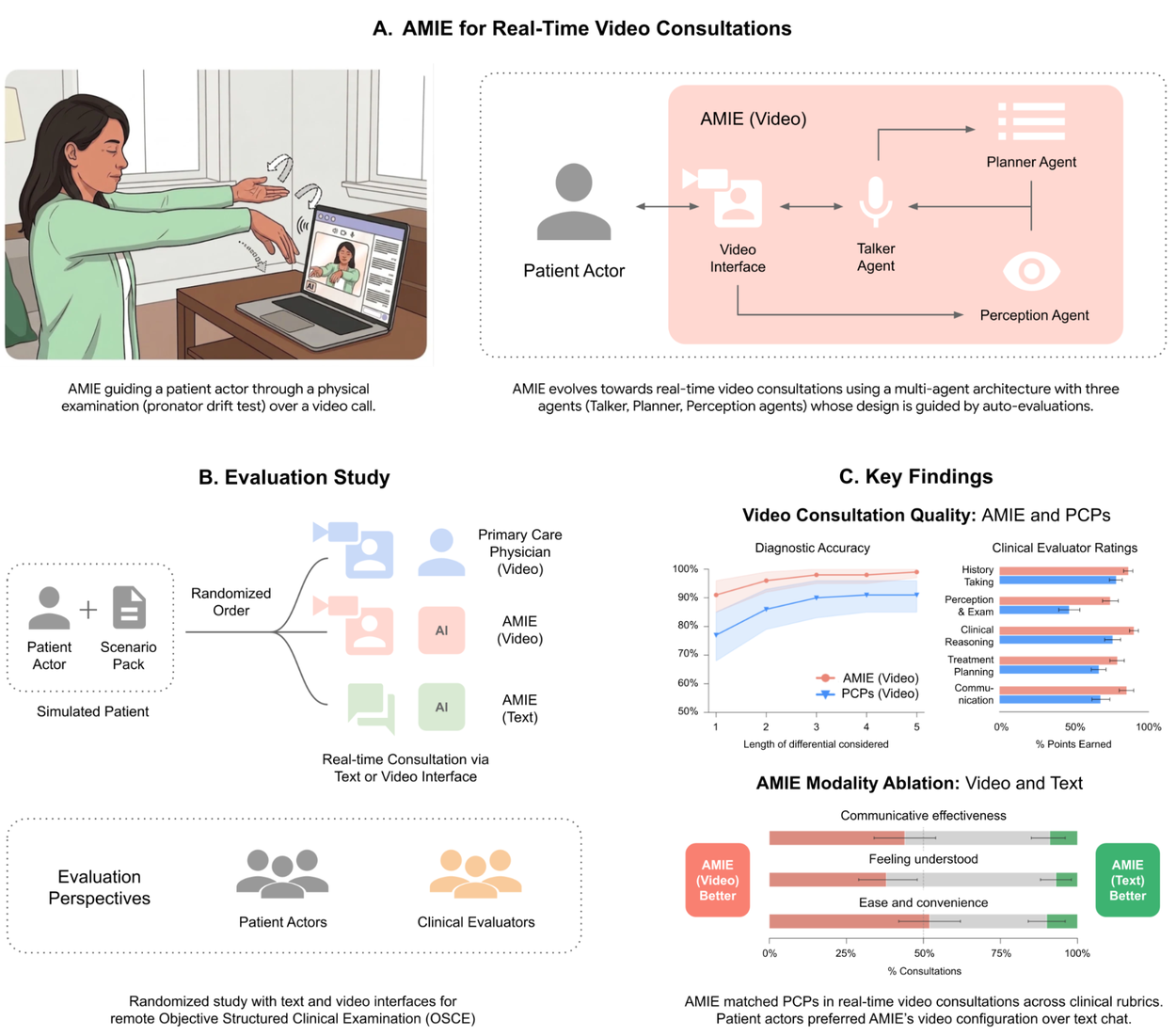
Google’s research post describes AMIE Video as an asynchronous multi-agent architecture with three roles: a Talker agent for low-latency patient conversation, a Planner agent for background clinical reasoning and a Perception agent for continuous audio-visual review.
The study used a randomized Objective Structured Clinical Examination setup. Patient actors performed 100 clinical scenarios across 300 live consultations. Google says the comparison involved AMIE Video, AMIE Text and board-certified primary care physicians using the same video interface, with independent clinical evaluators scoring the encounters.
| Study element | What Google and the paper report |
|---|---|
| System | AMIE Video, built on Gemini and Project Astra |
| Architecture | Talker, Planner and Perception agents working in parallel |
| Consultation format | Real-time video OSCE simulations |
| Scenarios | 100 clinical scenarios |
| Consultations | 300 live consultations |
| Human comparison | Board-certified primary care physicians in video visits |
| Evaluation | Independent clinical evaluators using standard OSCE and case-specific rubrics |
| Main caveat | Professional patient actors, not real patients with live clinical risk |
Google says clinical evaluators rated AMIE Video on par with, or better than, primary care physicians across several core competencies, including history-taking, diagnostic accuracy, management appropriateness and communication quality. The paper also says AMIE Video improved on AMIE Text in areas where audio-visual perception matters.
That is impressive. It is also exactly where readers should slow down.
Why video changes the problem
Text chat makes patients translate their bodies into words. That sounds trivial until you have tried to explain a tremor, a rash, breathlessness, pain while moving, or the difference between “dizzy” and “about to faint.”
Video gives a clinician more texture. A physician may notice gait, breathing, facial discomfort, asymmetry, a patient’s ability to follow an instruction, or whether someone looks more unwell than their words suggest. Telehealth still has limits, but it is a richer channel than typing.
AMIE Video is interesting because it tries to use that channel instead of pretending text is enough.
| Telehealth cue | Why AI video matters | Why humans still matter |
|---|---|---|
| Breathing, cough and speech | Audio can carry clinical hints that text loses | Context, urgency and bedside judgment are hard to automate safely. |
| Movement and gait | Video may reveal functional problems | Camera angle and patient instruction can distort what is seen. |
| Visible discomfort | A system can flag distress cues | Empathy is not just detecting a face; it is responding responsibly. |
| Guided self-exam | AI can prompt a patient through simple maneuvers | Some exams cannot be performed remotely at all. |
| Health literacy barriers | Spoken video may be easier than written prompts | Vulnerable patients need safeguards, not just convenience. |
This is where AMIE starts to feel less like a clever demo and more like a serious research direction. Not because it replaces a doctor, but because it attacks a real bottleneck in remote care.
The caveats are the main story for adults
Google is clear that AMIE remains a research system and needs more work before responsible real-world clinical deployment. The paper is even more specific. The study used professional patient actors rather than real patients. It excluded many clinical presentations that cannot be authentically acted through video. It also notes limitations around subtle perception, affective nuance, fine anatomical precision and technical disruptions.
Those caveats are not footnotes. They are the difference between a promising research system and a tool that can be trusted with someone’s health.
In real care, patients are messy. They forget details. They understate symptoms. They have poor cameras, bad connections, language barriers, anxiety, comorbidities and medication lists that do not fit neatly into a scenario pack. Some need reassurance. Some need an ambulance. Some need a clinician to notice that the stated complaint is not the dangerous part.
That is why I would treat AMIE Video as a serious step forward, not a near-term doctor replacement. The useful future is likely supervision, triage support, documentation, preparation, follow-up and clinician assistance before it is autonomous care.
The personal angle
Most people do not want medical AI because they love AI. They want it because healthcare is slow, expensive, uneven and often exhausting to navigate.
If a responsible system can help a patient explain symptoms more clearly, prepare a clinician better, reduce unnecessary waiting, or catch a missed cue in a video visit, that is meaningful. The danger is skipping the boring validation work because the demo looks emotionally convincing.
GearPulse has covered plenty of AI systems where the interface arrived before the operating model. AMIE should be judged the other way around. The interface is finally catching up to how people actually seek care, but the operating model has to be conservative: oversight, auditability, escalation, privacy, liability and clinical evidence before consumer confidence.
Bottom line
Google AMIE Video matters because it moves medical AI out of the text box and toward the visual, spoken, imperfect reality of telehealth.
The study is promising, especially because it compares video AI with video physicians in a structured setting. But it is still simulated research, not deployment proof. The right reaction is not panic or blind excitement. It is pressure: prove it with real patients, real safeguards and real clinical workflows.
That is the version of medical AI worth taking seriously.
Support independent GearPulse articles at buymeacoffee.com/gearpulse.site.