
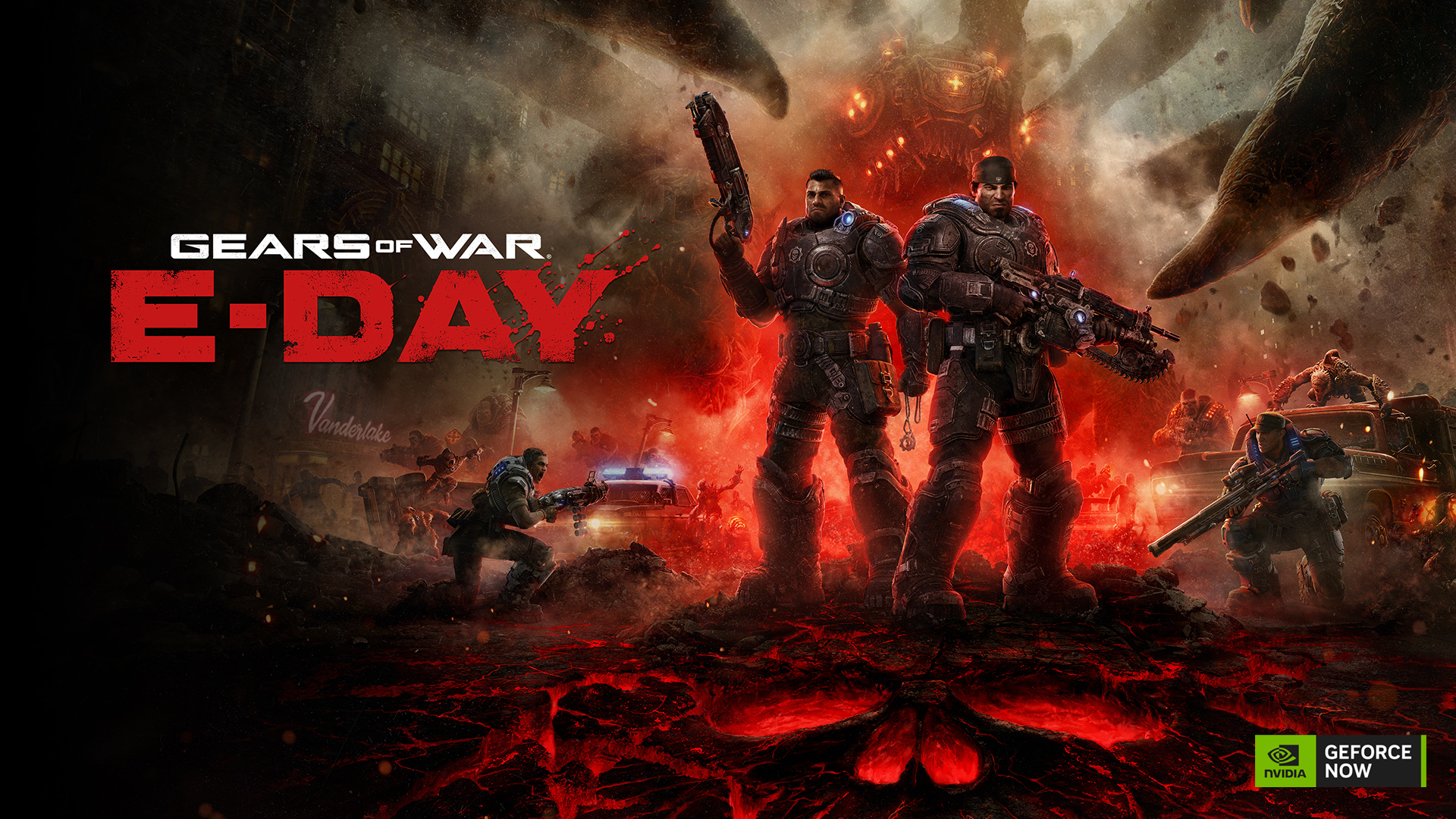
Gears of War: E-Day has joined GeForce NOW following its October 6 worldwide release, NVIDIA says. That is more useful than a routine cloud-library addition because the official PC specification calls for a 115GB SSD. For a laptop with a crowded drive, a handheld, or a living-room screen without a gaming PC attached, streaming removes the download and local-storage problem outright.
It does not remove every other condition. Players still need a compatible game entitlement or qualifying subscription, and NVIDIA notes that onboarding and availability can differ by store and region. The cloud also trades a local install for a connection whose latency, stability and data-centre distance now matter as much as the graphics card used to.
That is the honest appeal of this release: it makes a very large, technically ambitious PC game more reachable without pretending that streaming is the same thing as owning a fast local machine.
Why this particular cloud release matters
Xbox lists E-Day for Xbox Series X|S, Xbox on PC and Steam, with Game Pass Ultimate and PC Game Pass access at launch. Its final PC requirements specify 115GB of SSD space across the listed target tiers. That is not unusual for a modern Unreal Engine 5 blockbuster, but it is still a significant portion of a 512GB device after the operating system and a handful of other large games are accounted for.
NVIDIA’s current GFN Thursday update says the game is now streaming and available on Game Pass. Its earlier technical announcement tied the PC version to DLSS 4.5, hardware-accelerated ray tracing and RTX Mega Geometry. Tom’s Hardware’s independent 43-GPU analysis also identifies it as one of the first shipped games to use RTX Mega Geometry. In other words, this is not simply a convenient way to run an old favourite on a thin client; it is a current showcase title whose visual options can ask quite a lot of local hardware.
| If your constraint is… | GeForce NOW changes… | It does not change… |
|---|---|---|
| Limited SSD space | No 115GB local game install is required for the stream. | You still need room for the client, updates and any other games you install locally. |
| A modest laptop or handheld | Rendering happens on NVIDIA’s remote hardware rather than its integrated GPU. | Your display, Wi-Fi and network quality still shape the experience. |
| Interest in RTX features | NVIDIA positions its Ultimate tier around RTX 5080-class cloud performance, DLSS and Reflex. | Tier eligibility and feature support are not a promise of identical visual settings in every region. |
| Existing PC/Xbox library access | A supported entitlement can make the game streamable without buying a gaming PC. | Store compatibility must be checked; GeForce NOW is not an all-you-can-play catalogue. |
For readers who saw October’s GeForce NOW slate, this is the useful distinction between an announced game and a playable one. E-Day was on that forward-looking list; now NVIDIA says it is actually in the service.
Cloud convenience is not a performance verdict
There is a temptation to read a cloud launch as proof that local hardware no longer matters. It is better understood as a redistribution of the hardware problem.
The data centre carries the GPU load and the game installation. Your end of the bargain is a stable, sufficiently responsive network. A poor connection can show compression, input delay or sudden quality changes at precisely the moments when a fast local PC would be most predictable. NVIDIA’s advertised RTX 5080-class Ultimate hardware is a server-side capability, not a guarantee that every household gets the same result.
The same restraint applies to the RTX feature list. DLSS 4.5, ray tracing and RTX Mega Geometry are meaningful technical components of the PC version, but they are not a reason to assume that every E-Day session needs to be viewed as a graphics demonstration. A player choosing cloud gaming for a 115GB storage reprieve may value a clean, responsive 1080p session over maximum lighting effects. That is a sensible choice, not a compromised one.
The audience that benefits most
The strongest case is specific: you already have access to the game, want to play it on a screen that lacks a capable gaming GPU, and have a good enough connection to make streaming feel dependable. Think a work laptop after hours, a Mac, a handheld with limited storage, or a TV setup where a console is not the preferred route.
The weaker case is someone treating this as a universal rental service. GeForce NOW streams games that its service supports; it does not generally include the game purchase by itself. The precise store version, Game Pass status, tier and local availability deserve a check before anyone signs up around one release.
Bottom line
Gears of War: E-Day arriving on GeForce NOW is a genuinely practical win because it sidesteps the 115GB SSD requirement and makes a demanding new PC release viable on more kinds of hardware.
But the value is not “cloud gaming has solved PC gaming.” It is narrower and more convincing: if storage or a graphics card is the obstacle, streaming can remove it. If the obstacle is unreliable internet, feature entitlement or a distant data centre, it cannot. Choose the cloud route for the device problem it actually solves, and this is one of the month’s more useful additions.