
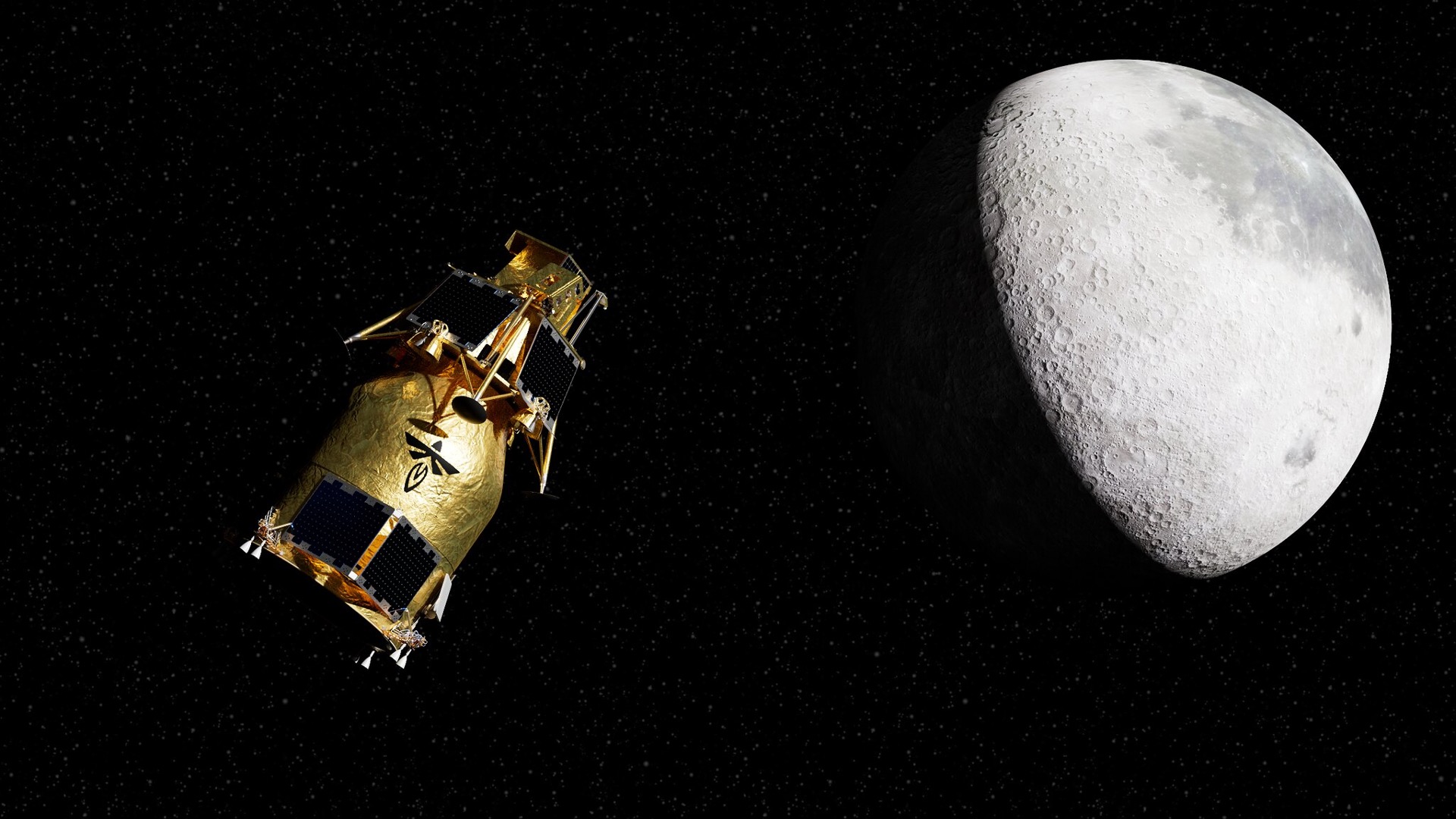
Firefly Aerospace putting NVIDIA Jetson hardware to work in lunar orbit is easy to oversell and easy to underread.
It is not proof that a small AI module can replace a mission-control team. It is also not just a neat space anecdote. The useful story is that Firefly and NVIDIA are pushing more image-processing work closer to the spacecraft sensor, where bandwidth, timing, and autonomy matter more than they do on Earth.
NVIDIA says Firefly Aerospace has operated Jetson in lunar orbit for the first time, supporting on-orbit processing for a Moon imaging service. Firefly’s public release, distributed through Yahoo Finance, frames the same idea around processing imagery before it comes back to Earth.
That may sound minor until you remember the basic problem: space missions can collect more data than they can conveniently transmit.
Why process images in lunar orbit?
On Earth, the usual answer to too much image data is boring but effective: upload it, store it, process it in a data center, and worry about the bill later.
Space does not work that way. Communications windows are limited. Downlink capacity is precious. Power is constrained. Operators may want to know quickly whether an image is useful, whether a target was captured, or whether a spacecraft should prioritize one data product over another.
That is where edge computing becomes valuable.
| Mission problem | Old default | Edge-processing advantage |
|---|---|---|
| Large image files | Send everything back | Filter, compress, or prioritize data before downlink |
| Time-sensitive decisions | Wait for Earth processing | Support faster mission decisions |
| Limited bandwidth | Spend downlink on raw data | Send more useful processed products |
| Autonomy | Ground teams review more manually | Spacecraft can do more first-pass work onboard |
| Cost pressure | More ground and network load | Use compute near the instrument when it makes sense |
This is the same logic behind edge AI in factories, cars, drones, and cameras. The difference is that lunar orbit is a much harsher proving ground.
What NVIDIA Jetson brings
NVIDIA’s Jetson platform is designed for embedded AI and robotics-style workloads. The official NVIDIA embedded-systems page positions Jetson around autonomous machines, sensor processing, and AI at the edge rather than conventional cloud training.
That makes it a reasonable fit for image-processing tasks, but the space context changes the question. A developer board on a lab bench is one thing. A compute module operating as part of a lunar mission has to live with radiation exposure, launch vibration, thermal constraints, power limits, and mission software discipline.
NVIDIA’s announcement is careful enough to read as an operational milestone, not a general claim that every Jetson module is suddenly a space-grade computer. Firefly’s use case is specific: support on-orbit image processing for a Moon imaging service.
That specificity is important. It turns the story from “AI goes to space” into something more practical: can commercial off-the-shelf style AI hardware help a space company handle data closer to where it is created?
The Firefly angle
Firefly has become one of the more visible commercial lunar companies because it sits in the messy middle between launch, lander, orbital services, and payload delivery. NASA’s Commercial Lunar Payload Services program has also helped create a market where private companies carry instruments and services toward the Moon rather than NASA building every delivery system itself.
In that environment, an imaging service is not just a camera. It is a product. Customers care about what can be captured, how quickly the data can be reviewed, and how useful the returned product is.
On-orbit processing helps because it can make imagery more service-like. Instead of treating the spacecraft as a remote hard drive, operators can treat it as a sensor platform with some local intelligence.
That does not mean every decision should happen onboard. Space missions still need conservative operations, redundancy, and careful validation. But it does suggest where the market is heading. More spacecraft will need to make first-pass decisions because there will be more spacecraft, more sensors, and more data than ground teams can manually babysit in real time.
The caveats are real
This is not a consumer-gadget story, so the usual spec-sheet instinct can mislead.
The first caveat is reliability. Space hardware is judged by mission performance, not by peak AI throughput. If an onboard processor saves bandwidth but creates mission risk, it is not worth it. Public announcements rarely give enough detail to evaluate the full radiation, redundancy, and fault-tolerance plan.
The second caveat is scope. Image processing is a sensible workload for edge compute. That does not automatically extend to high-risk autonomous navigation or mission-critical control. There is a wide gap between improving data handling and handing the spacecraft more authority.
The third caveat is economics. Edge processing has to justify itself against simpler options: better compression, more ground processing, different mission planning, or more downlink capacity. The case gets stronger when bandwidth is scarce, imagery volume is high, or fast triage has operational value.
Why this matters beyond one mission
The bigger story is that space is starting to look more like an edge-computing market.
Satellites, lunar orbiters, landers, and deep-space probes all face versions of the same problem: sensors are getting better faster than communications become free. Cameras, spectrometers, radar instruments, and other payloads can create enormous data flows. Sending all of it home is not always the best answer.
If companies can prove that small, efficient AI computers can work reliably in these environments, spacecraft could become more selective and more useful. They could flag interesting terrain, reduce redundant imagery, prioritize urgent observations, or prepare data products before Earth ever sees the raw files.
That is not science fiction. It is a practical response to a bottleneck.
Bottom line
Firefly operating NVIDIA Jetson in lunar orbit matters because it treats AI hardware as mission infrastructure, not a demo prop.
The achievement does not prove that commercial AI modules are ready for every space workload. It does show why on-orbit processing is becoming attractive: the Moon is far away, bandwidth is limited, and useful imagery is more valuable than raw data volume. If this kind of edge compute keeps proving itself, future space services may be judged as much by what they process onboard as by what they manage to send back.