
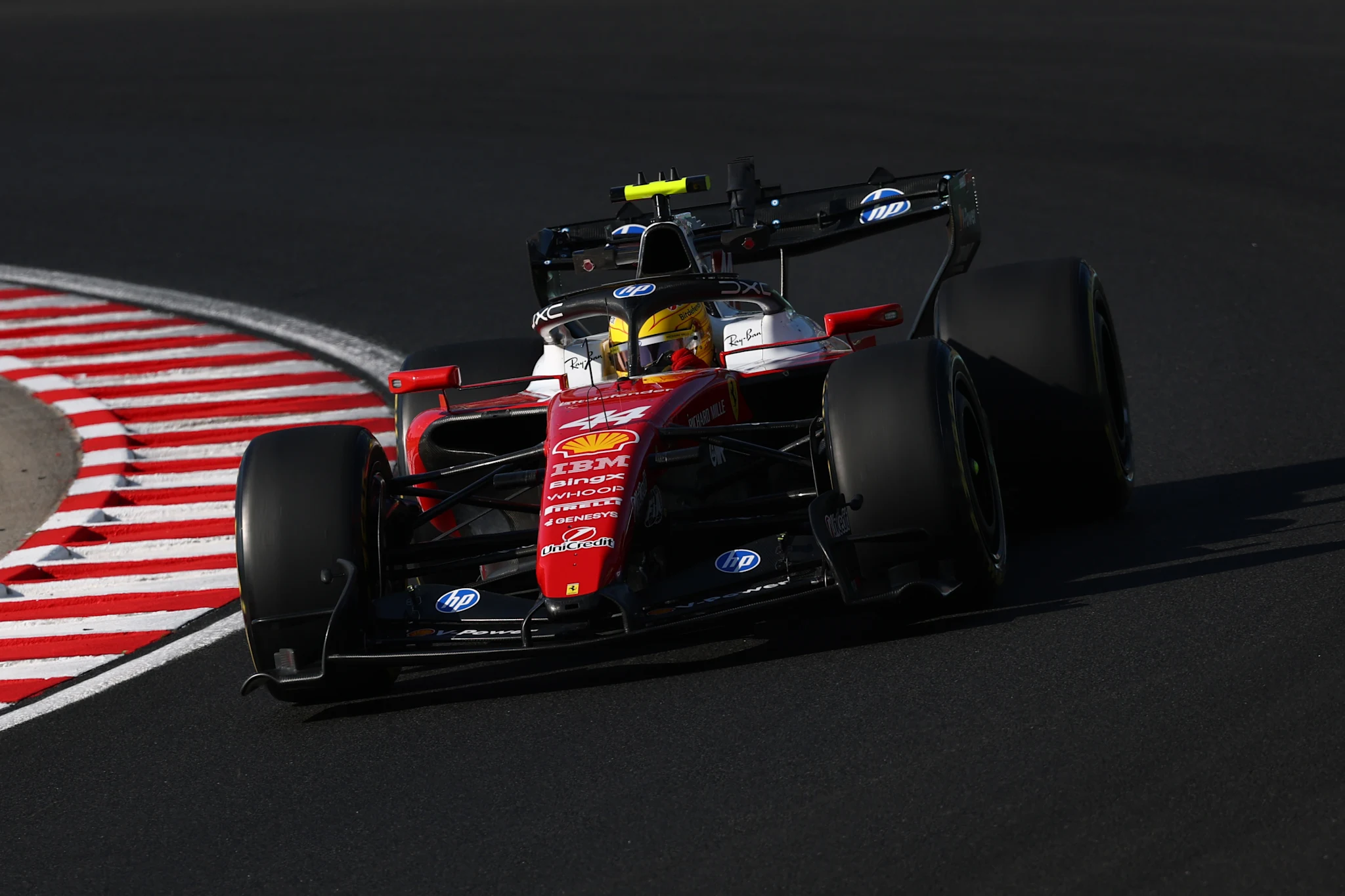
Ferrari’s Friday in Hungary is the kind of result that usually needs a warning label.
Yes, Lewis Hamilton topped second practice at the Hungaroring. Yes, Charles Leclerc was second in FP2 after leading FP1 by almost half a second. And yes, the timing sheet made the gap look uncomfortable for Mercedes, McLaren and Red Bull before Saturday’s qualifying.
But Friday practice is not a trophy, and Ferrari knows that better than most. The interesting part is not the headline order. The interesting part is where it happened.
GearPulse’s view: Hungary is Ferrari’s most useful proof test since its recent run of form began. Silverstone and Spa both carried race-shaping caveats around safety cars, energy deployment and high-speed efficiency. Budapest is slower, tighter and more dependent on braking confidence, traction, rotation and tyre control. If Ferrari is quick here too, Mercedes has a more serious problem than one awkward Friday.
Why this story rose today
The source stack is clean. Formula 1’s FP1 report had Leclerc fastest on a 1:19.075 before a late Ferrari issue stopped him near pit entry. Formula 1 and the FIA then both recorded Hamilton’s FP2 benchmark at 1:18.729, 0.148s clear of Leclerc and 0.499s ahead of Lando Norris. The Race repeated the red-flagged FP2 order and noted that Max Verstappen was almost seven tenths away, while George Russell was 0.933s off in fifth.
Sky Sports F1 supplied the trend signal because its Friday analysis moved the story beyond a timing sheet. Russell said Mercedes’ fears about Ferrari’s pace at the Hungaroring had been realised, and Sky framed Ferrari’s form around the tight, twisty nature of the track. Ferrari’s own report added the expected caution: Hamilton called it a solid day with progress between sessions, while Leclerc warned that teams usually find performance from Friday to Saturday.
That makes this the strongest Daily Dose lead of the day. It has official timing, primary-team context, reliable media pickup, and a clear question for the championship: has Ferrari finally found repeatable performance, or did Friday flatter the SF-26?
Ferrari needed this circuit to answer a different question
Ferrari has already had good days this season. Leclerc won at Silverstone, fought for the Spa win, and Ferrari arrived in Hungary with more credibility than it had a month ago. GearPulse has covered that arc, which is why another generic “Ferrari momentum” piece would be too thin.
Hungary changes the evidence.
The Hungaroring is only 4.381 km, with 70 race laps and very little full-throttle recovery time compared with Spa or Silverstone. Drivers spend most of the lap asking the car to turn, brake, rotate and launch cleanly from one corner into the next. That makes it a better test of mechanical compliance and low-to-medium-speed balance than of pure straight-line efficiency.
That is why Friday mattered. Ferrari did not just pop one soft-tyre lap in a messy session. Leclerc led FP1, Hamilton led FP2, and the car looked responsive enough for both drivers to take turns setting the reference. The caveat is real because practice programmes differ, fuel loads are hidden and the red flag interrupted some rivals’ qualifying simulations. Still, when both Ferrari drivers are comfortable on the same day and the closest non-Ferrari car is half a second back in FP2, the paddock has to pay attention.
Mercedes had the wrong kind of quiet day
This was supposed to be Mercedes’ first practical check after George Russell’s software-calibration issue moved from mystery to supposed fix. It was never going to be a perfect Spa comparison because Hungary is less power-sensitive, but it was still a valuable baseline before the summer break.
Instead, the story moved sideways. Russell was fifth in FP2, nearly a second from Hamilton, and Kimi Antonelli was 13th after a compromised session. Formula 1’s FP2 account noted Russell calling the car badly out of balance, while Sky carried Russell’s broader point that Ferrari looked very strong and Mercedes had work to do.
That does not mean Mercedes has lost its championship footing. Antonelli missed FP1 because Mercedes ran Fred Vesti for rookie-driver obligations, and his FP2 was disrupted by Franco Colapinto’s red flag and his own lock-ups. Russell also suggested the long-run picture looked more competitive than the single-lap gap.
But the optics matter. Mercedes came into Hungary trying to prove that Russell’s technical frustration had been contained. Ferrari used Friday to ask a bigger question: what if Mercedes’ recent advantage is narrowing at exactly the point where Antonelli’s title lead needs clean weekends, not merely recovery weekends?
Hamilton’s lap matters because Leclerc was already quick
The strongest Ferrari signal is not Hamilton being fastest by itself. It is that Hamilton’s FP2 lap came after Leclerc had already topped FP1 and then briefly reclaimed P1 in FP2.
That gives Ferrari a two-car reference, which is the thing it has lacked too often. Leclerc has usually looked like the sharper Ferrari benchmark over one lap, especially when the car is edgy. Hamilton’s best Ferrari weekends have tended to arrive when he can build into the balance rather than fight it from the first run. Hungary’s Friday suggested both sides of the garage found a usable window.
The intra-team comparison is useful:
| Question | Friday evidence | GearPulse read |
|---|---|---|
| Is Leclerc’s recent form still alive? | Fastest in FP1, second in FP2. | Yes, even with a late FP1 issue and some FP2 lock-ups. |
| Is Hamilton fully in the same window? | Fastest in FP2 after improving between sessions. | Encouraging, especially at a circuit where rhythm matters. |
| Is Ferrari clearly ahead for qualifying? | Half-second to Norris in FP2, but disrupted programmes. | Possible, not proven. |
| Is Mercedes in trouble? | Russell fifth, Antonelli 13th, balance complaints. | More warning than verdict. |
The Hamilton-Leclerc pairing is exactly why Ferrari’s Friday is more than a one-driver spike. If qualifying stays close, Ferrari can pressure Mercedes with two cars rather than hoping one driver makes something happen.
The caveats are not small
The session was not clean enough to turn into a prediction sheet.
Colapinto’s crash at the final corner red-flagged FP2 and interrupted some qualifying simulations. Antonelli never got the representative soft-tyre picture he wanted. Oscar Piastri was eighth after missing FP1 for Leonardo Fornaroli’s McLaren rookie run, and McLaren was still working through its Hungary upgrade programme. Aston Martin lost Lance Stroll for FP2 after his FP1 suspension failure, which kept one of the day’s big technical packages from producing a full comparison.
There was also track evolution, wind and new asphalt to account for. Formula 1 and FIA reports both described grip and balance as difficult, and Russell told Sky the resurfaced sections were bumpy and breaking up in places. Those are conditions in which a team that hits its starting setup can look better than it will once everyone else corrects overnight.
Ferrari’s own caution is therefore sensible. Friday gives the team a chance. It does not give it pole, race pace or tyre life.
Probability board
This is editorial analysis, not betting advice:
| Question | GearPulse read |
|---|---|
| Ferrari remains in the pole fight on Saturday | 70-80%, because both cars were immediately quick in the relevant corners. |
| Ferrari keeps a half-second advantage over the field | 15-25%, because Friday gaps usually compress and several rivals had disrupted runs. |
| Mercedes looks cleaner in qualifying than it did in FP2 | 55-65%, because Antonelli’s session was messy and Russell said long-run pace was better. |
| Hamilton beats Leclerc in qualifying | 45-55%, because Hamilton led FP2, but Leclerc’s FP1 margin and qualifying record keep it close. |
| Ferrari becomes Mercedes’ main title threat after Hungary | 40-50%, dependent on race pace and tyre degradation, not just practice speed. |
The most likely version is not Ferrari domination. It is a three-team fight in which Ferrari starts from a better place than usual and Mercedes no longer has the comfortable assumption that Hungary will reset the order in its favour.
Fun fact
Hungary is often called Monaco without the walls, but that undersells how physical it is. The lap is short, the corners keep arriving, and the race rarely gives tyres or brakes a long rest. That is why surprise winners and odd strategic races have appeared here before: Fernando Alonso in 2003, Jenson Button in 2006, Esteban Ocon in 2021 and Oscar Piastri in 2024 all turned Hungary into a career marker.
Ferrari does not need a fairy tale this weekend. It needs a controlled, repeatable one.
Skipped candidates
Aston Martin’s B-spec upgrade was tempting because Stroll’s suspension failure and Alonso’s solo FP2 programme gave it real drama. GearPulse already covered Aston Martin’s Hungary upgrade credibility test on July 14, though, and today’s story was more about execution trouble than a fresh strategic angle.
McLaren’s upgraded-car follow-up had useful data, especially with Norris third in FP2 and Piastri rebuilding after missing FP1. But GearPulse published the McLaren/Fornaroli upgrade tradeoff on July 22, so another McLaren lead needed a clearer step change than Friday provided.
The Mercedes software-fix follow-up remained important, but GearPulse covered Russell’s fix yesterday. Friday’s new information is best used as context inside the Ferrari story rather than as another Russell article.
Colapinto’s FP2 crash was visible and official, but it was too narrow for a Daily Dose lead unless Alpine later confirms a major sporting or chassis consequence.
Bottom line
Ferrari’s Hungary Friday is not proof that the championship has turned. It is proof that Ferrari has earned a more serious Saturday.
The important point is that the SF-26 looked quick on a circuit that asks a different question from Spa and Silverstone. Hamilton had the headline lap, Leclerc confirmed the baseline, and Mercedes spent Friday talking about balance rather than control.
GearPulse’s bottom line: if Ferrari converts this into qualifying pace and race stint discipline, Hungary stops being a one-off practice story and becomes the weekend Mercedes has to explain.