
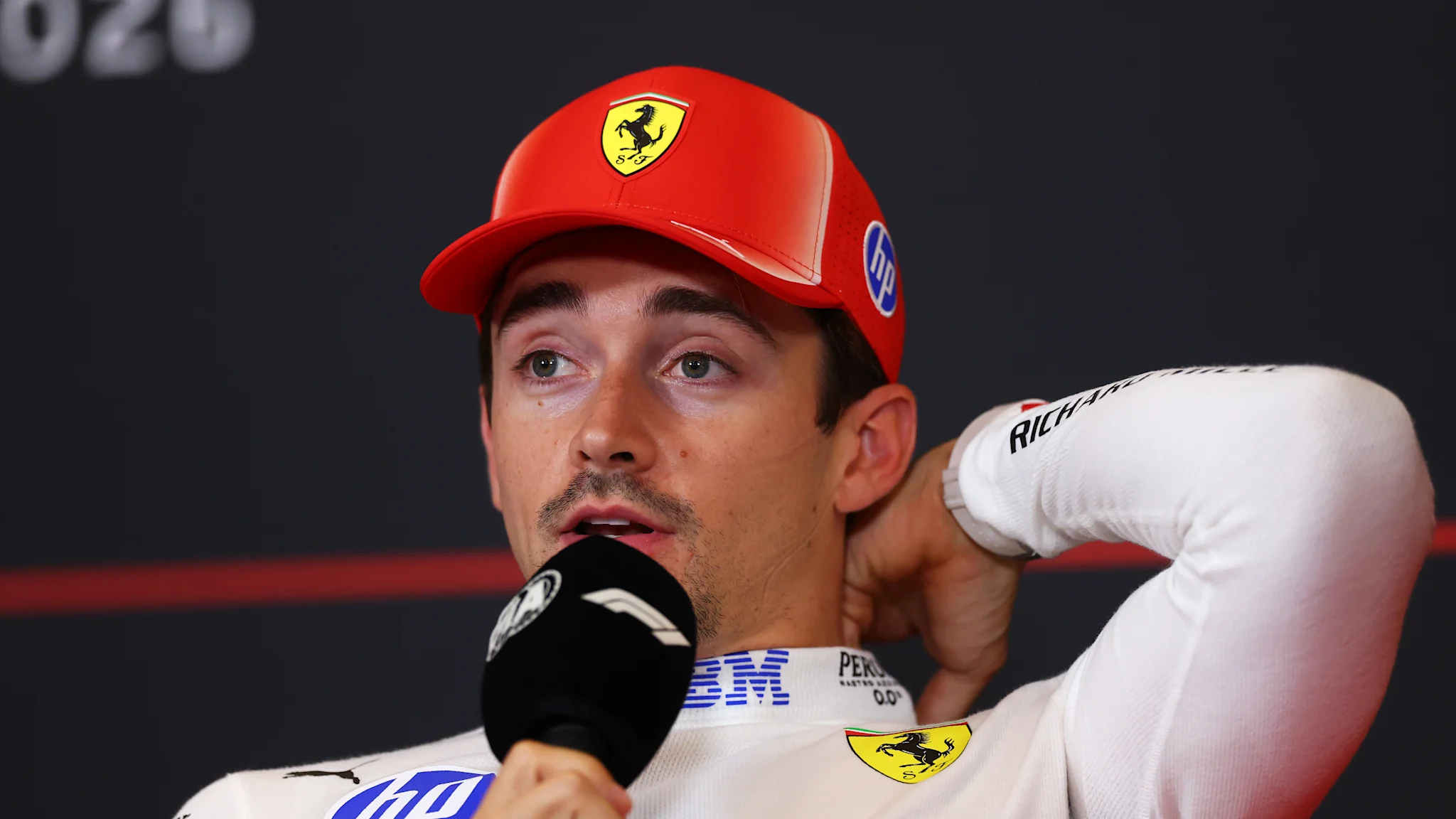
Ferrari’s Austrian Grand Prix weekend has moved from “is Barcelona repeatable?” to something more useful: “can Ferrari pressure Mercedes with both cars, not just one highlight lap?”
That is today’s Daily Dose of F1 story because the answer now matters immediately.
Formula 1’s official qualifying coverage put Charles Leclerc second and Lewis Hamilton third at the Red Bull Ring, split from pole by George Russell’s Mercedes and ahead of championship leader Kimi Antonelli. The FIA report recorded Russell’s 1:06.113 pole, Leclerc 0.236s back, and Hamilton close enough to make Ferrari’s final runs more than a consolation prize. F1’s Vasseur follow-up added the team-principal context: Ferrari had two cars in the fight at the end, even if the late yellow-flag sequence left the final order feeling more complicated than a normal front-row story.
GearPulse covered that yellow-flag debate yesterday. The better fresh angle now is Ferrari itself. After Hamilton’s Barcelona win reopened the season’s emotional range, Austria has given the Scuderia a second straight weekend where Mercedes cannot treat it as background noise.
Why this was the day’s strongest story
The Red Bull Ring has already produced three obvious narratives: Mercedes’ Friday rebound, the qualifying yellow-flag argument, and Red Bull’s upgraded-car crash problem. Ferrari’s two-car response is different enough to stand on its own because it points forward to the race rather than backward to the ruling.
It also meets the source test. Formula 1 published Leclerc’s post-qualifying confidence angle, Vasseur’s reaction and the team-by-team qualifying notes. The FIA confirmed the session order and timing. Motorsport.com covered the same qualifying result as a specialist outlet, while The Guardian had already picked up Ferrari’s Austria optimism after the team’s Friday direction. That gives this story official timing, official paddock context, reliable media corroboration and a clear reason readers should care before the race.
The trend signal is not just “Ferrari qualified well.” It is the combination: Hamilton’s recent Barcelona win, Leclerc needing a confidence reset, Mercedes still looking quick, and Ferrari getting both drivers close enough to make the front group uncomfortable.
The useful Ferrari signal is two cars
Ferrari has had plenty of weekends where one driver drags the story into view. Austria is more interesting because both cars arrived in the fight at the end of qualifying.
Leclerc taking second matters because he has often been Ferrari’s cleanest one-lap reference. Hamilton taking third matters for a different reason: his Barcelona victory proved the Ferrari project could deliver a peak, but Austria tests whether that peak was a single-day surge or the start of a repeatable front-running pattern.
That distinction is important. A team with one quick car can win opportunistically. A team with two quick cars can shape strategy, split pressure, cover undercuts and make Mercedes defend rather than dictate.
| Ferrari question | Austria evidence | GearPulse read |
|---|---|---|
| Is Barcelona form fading? | Leclerc and Hamilton qualified second and third at Spielberg. | The pace has carried into a very different circuit type. |
| Is this only a Leclerc lap? | Hamilton was directly behind Leclerc and ahead of Antonelli. | Ferrari has a genuine two-car platform this weekend. |
| Is Mercedes still the benchmark? | Russell took pole and Antonelli starts close. | Yes, but the margin is small enough to pressure. |
| Does the yellow-flag debate define Ferrari’s weekend? | It shaped the final pole story, but Ferrari’s pace existed before it. | No. The car-speed signal is cleaner than the controversy. |
The probability framing is therefore balanced: Ferrari is not the race favorite by default, because track position still belongs to Russell and Mercedes has looked strong across the weekend. But Ferrari now looks like a live win threat rather than a team waiting for Mercedes to trip over itself.
Austria rewards exactly what Ferrari must prove
The Red Bull Ring is a short circuit, but it is not a simple one for race execution. The lap is only 4.326 km, with heavy braking uphill, traction-sensitive exits, three DRS zones and very little room to hide tyre degradation. If a car overheats its rear tyres or slides too much through the middle sector, the damage repeats quickly because the lap cycles so fast.
That is why Ferrari’s race pace matters more than its qualifying headline.
Leclerc’s confidence point is not cosmetic. A Ferrari that lets him lean on the rear through fast loaded corners changes the race. Hamilton’s part is just as revealing: if he can keep the car in the same operating window across a stint, Ferrari can ask Mercedes strategic questions rather than simply chase in a straight line.
The likely race shape is tight rather than settled:
| Team | Starting strength | Race risk |
|---|---|---|
| Mercedes | Pole, clean air, and Antonelli close enough to support strategy. | Tyre life under Ferrari pressure and avoiding DRS vulnerability. |
| Ferrari | Two cars directly in the lead fight after a strong Q3 finish. | Converting qualifying balance into stable stint pace. |
| Red Bull | Verstappen remains dangerous even from behind at a home race. | Rear-aero confidence after the late crash and traffic recovery. |
| McLaren | Underlying pace has been present through the weekend. | Starting position and execution need to unlock it. |
GearPulse’s view: Ferrari’s best path is not a miracle launch. It is sustained pressure. If Leclerc or Hamilton can sit inside DRS early without cooking tyres, Russell’s pole becomes an advantage to defend, not a guarantee.
Hamilton changes Ferrari’s leverage
Hamilton’s presence makes this story bigger than a normal Ferrari qualifying rebound.
Since Barcelona, every Ferrari performance carries a second question: is Hamilton now fully inside the team rhythm? Austria gives that question a cleaner test because the weekend did not simply fall into his lap. Mercedes looked strong, Red Bull had home-event urgency, and Leclerc was sharp enough to keep Hamilton honest.
That is healthy for Ferrari. If Leclerc is the qualifying spearhead and Hamilton is close enough to force strategy respect, the team has a structure it can use. The downside is that two-car pressure only works if Ferrari executes cleanly. A slow stop, awkward tyre split or early overheating phase would turn the front-row threat into another “what might have been” weekend.
The optimistic case is easy to see: Ferrari has momentum from Barcelona, two cars near the front in Austria, and a circuit where DRS and tyre temperature can keep the leader under stress.
The caveat is just as clear: Mercedes has pole, Antonelli nearby, and enough speed that Ferrari probably needs either a better launch, better tyre life or sharper timing to take control.
Fun fact: short laps magnify small Ferrari gains
Spielberg’s modern F1 layout has only 10 official corners. That means a two-tenth swing is not spread across a long sequence like Spa or Silverstone; it is compressed into a few braking zones, traction exits and high-speed commitments.
That makes Ferrari’s Austria result more meaningful than the raw gap suggests. On a short lap, getting both cars into the top three usually means the balance is not just flattering one driver or one sector. It means the car is operating well enough across the lap’s main stress points.
It also means the race can punish tiny mistakes. One lock-up into Turn 3, one compromised exit onto a DRS straight, or one stint where the rear tyres fall away can undo the advantage of a strong Saturday.
Bottom line
Ferrari did not own Austria qualifying, but it did something almost as important: it put both Leclerc and Hamilton in the fight while Mercedes still looked strong.
That is the part that should worry rivals. Barcelona proved Ferrari could win on a high-emotion weekend. Austria is starting to test whether the Scuderia can keep presenting two credible threats when the margins are smaller and the strategic pressure is higher.
GearPulse’s read: Mercedes remains the cleaner favorite from pole, but Ferrari’s Austria rebound is real enough that Russell cannot treat the opening stint as a controlled cruise. If Leclerc and Hamilton keep the tyres alive, this race becomes a Mercedes defense against two red cars, not just another pole-sitter’s afternoon.