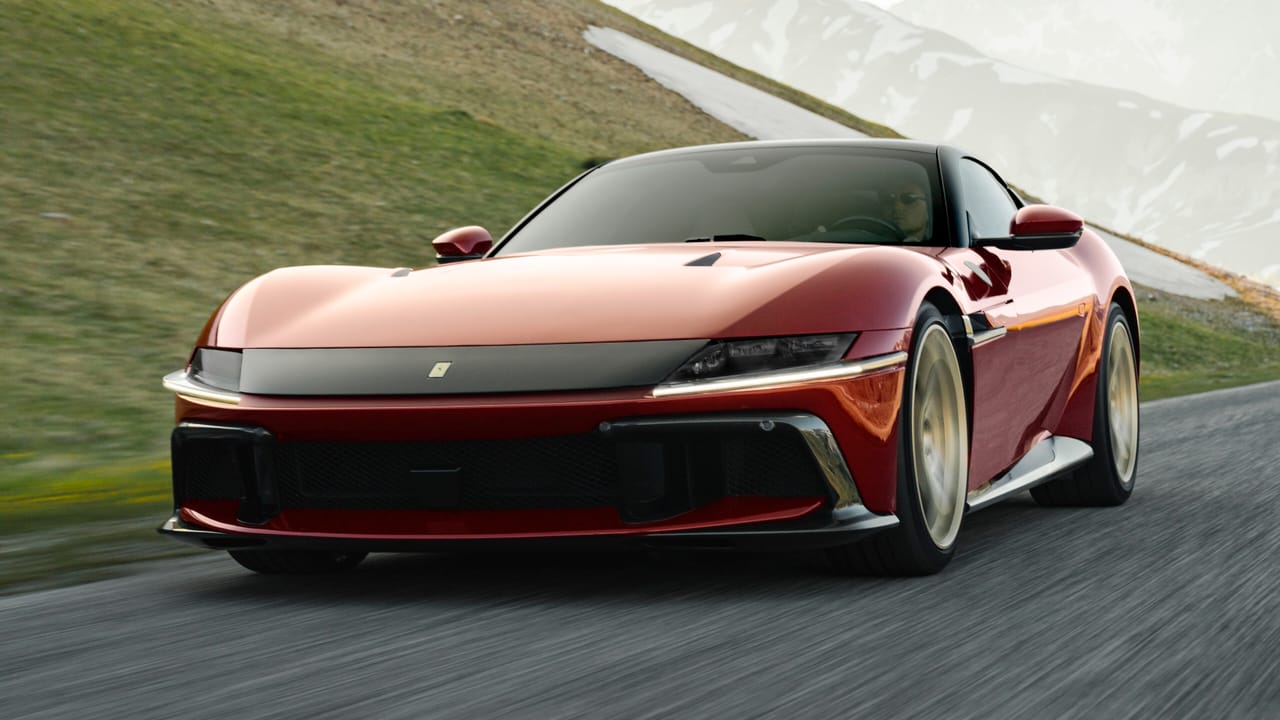
Ferrari has given the manual-transmission debate exactly what it needed: a car that will annoy everyone in a productive way.
The new Ferrari 12Cilindri Manuale brings back the look and ritual of an open-gate manual shifter, a clutch pedal and a naturally aspirated front-mounted V12. But it does not bring back a conventional mechanical manual gearbox. The car still uses an eight-speed dual-clutch transmission, with the driver interface handled by Ferrari’s Manuale By-Wire system.
GearPulse’s view: the 12Cilindri Manuale is relevant because it admits the uncomfortable truth of modern supercars. Buyers want emotion and control, but the car still has to satisfy performance, emissions, packaging and usability demands. Ferrari’s answer is a simulation with serious hardware behind it.
What Ferrari has made
The base ingredients are familiar from the 12Cilindri. The Manuale keeps the 6.5-liter naturally aspirated V12, rear-wheel drive and grand-touring shape. The new part is the cockpit interface.
Top Gear, Car and Driver, Autocar India and MotorTrend all describe the same central twist: the driver gets an H-pattern-style shifter and clutch pedal, but the inputs are interpreted electronically and routed through the existing DCT architecture.
| 12Cilindri Manuale detail | Reported direction |
|---|---|
| Engine | 6.5-liter naturally aspirated V12 |
| Output | About 830 hp / 819 bhp depending on market convention |
| Redline | 9,500 rpm |
| Core transmission | Eight-speed dual-clutch automatic |
| Manual interface | By-wire gated shifter and clutch pedal |
| Manual behavior | Uses a six-speed manual-style pattern |
| Production | 1,499 units |
| Price reference | Around 590,000 euros before market-specific taxes/options, according to early reports |
The phrase “fake manual” is tempting. It is also a bit lazy. This is not a plastic novelty lever glued onto a normal automatic. Ferrari is trying to engineer the feel, resistance, feedback and consequences of manual driving into a modern transmission stack.
That difference is why the car deserves a serious argument.
The purist complaint is obvious
A real manual gearbox has a mechanical relationship between the driver’s hand, foot, clutch, gears and drivetrain. The driver can get it wrong. The car can punish sloppy timing. The act of shifting is not only an input; it is part of the machine’s physical language.
The 12Cilindri Manuale breaks that chain. The clutch pedal and shifter are sensors. The DCT still does the actual gear work. The car can simulate stalls, takeoffs and manual behavior, but it is still mediation.
Purists are right to say that this is not the same thing.
But the useful question is not whether it is identical to a 599 GTB Fiorano with a real manual. It is whether Ferrari has found a way to keep the human ritual alive in a world where the mechanical solution no longer fits the product strategy.
Why Ferrari did not simply build a real manual
The romantic answer is that Ferrari should just give customers a traditional manual because they asked for one. The engineering and business answer is less simple.
Modern supercars operate inside a dense web of emissions calibration, durability targets, global homologation, customer usability expectations, warranty risk, performance marketing and electronic chassis systems. A conventional manual sounds pure, but it creates tradeoffs Ferrari may not want in a limited ultra-GT.
The by-wire approach lets Ferrari preserve the V12, the eight-speed DCT’s automatic capability and the manual ritual in one car.
| Conventional manual strength | By-wire Manuale strength |
|---|---|
| Mechanical authenticity | Compatibility with modern DCT architecture |
| Full driver responsibility | More control over drivetrain protection |
| Simpler emotional story | Auto mode available when the owner wants ease |
| Historic Ferrari romance | Tunable feel, resistance and feedback |
That last row is the crux. Ferrari is not claiming the old gearbox is back untouched. It is selling a new kind of driver interface for a buyer who wants analog theater but still lives in a modern Ferrari ecosystem.
The Koenigsegg comparison is useful
Several reports compare the Ferrari idea with Koenigsegg’s CC850-style approach. The comparison is fair at the concept level: both cars use electronics to give a manual-like interface while keeping modern transmission capability.
But Ferrari’s version lands differently because Ferrari carries more historical baggage around gated shifters. A Ferrari open gate is not just a control. It is an icon. Put a shiny grid and a round knob in a V12 Ferrari and the brand is inviting every old-school owner, collector and forum regular to judge whether the sensation is worthy.
That is brave and risky. The car cannot merely be clever. It has to feel right.
Why this matters beyond Ferrari collectors
Almost nobody reading this will buy a 12Cilindri Manuale. That does not make the idea irrelevant.
Cars are becoming increasingly by-wire, software-mediated and electrified. Steering feel, brake feel, engine sound, shift behavior and even drivetrain character are becoming design decisions as much as mechanical facts. Enthusiasts can reject that reality, but the industry is already there.
The interesting question is whether simulation can be honest.
Bad simulation insults the driver. Fake engine noise that sounds like a game menu, numb steering with artificial weight, and drive modes that only make throttle mapping twitchier all make cars feel cheaper than their hardware.
Good simulation can preserve a human connection when the old mechanism no longer makes sense. If Ferrari’s clutch pedal, gate resistance, shift timing and feedback create a satisfying ritual, then the Manuale is not a lie. It is a new interface wearing an old grammar.
What would make it fail?
The failure modes are clear.
First, if the lever feels like a toy, the whole car becomes cynical. Ferrari cannot afford a six-figure nostalgia prop that feels like a simulator accessory.
Second, if the car is too protective, the experience will feel fake. Manual driving includes consequence. If the system smooths every mistake, it becomes theater without stakes.
Third, if automatic mode is better in every meaningful situation, owners may treat the manual interface as a photo feature rather than a driving feature. That would turn the Manuale into decoration.
The counterargument is also strong. If the system can be stalled, launched, heel-and-toed and driven with enough tactile resistance to satisfy demanding owners, then Ferrari may have made a bridge between two eras.
Bottom line
Ferrari’s 12Cilindri Manuale is relevant because it makes the manual gearbox debate more honest. It is not a pure manual. It is not pretending the old world can return unchanged. It is Ferrari using electronics to preserve the ritual of a gated shifter and clutch pedal inside a modern V12 grand tourer.
That will irritate purists, and it should. A Ferrari manual used to be a mechanical contract between driver and car. This is a software-mediated contract. The question is whether it still feels binding.
GearPulse’s take: if the experience has weight, consequence and musicality, the 12Cilindri Manuale will be more than a nostalgia play. It will be proof that the future of driver engagement may be partly artificial, but it does not have to be soulless.
Support independent GearPulse articles at buymeacoffee.com/gearpulse.site.