
There are no 2026 British Grand Prix results yet. Formula 1’s own Silverstone page still lists “No results available for this session,” which is expected because the race weekend runs from 3–5 July 2026.
That makes the useful question slightly different: not “who won Silverstone?”, but “what should we expect when F1 gets there?”
The short version: Silverstone looks like a Mercedes-favoured weekend on paper, but not a comfortable one. Ferrari arrives with momentum after Lewis Hamilton’s first win in red, McLaren has the kind of aero platform that should make sense through Silverstone’s fast corners, and the Sprint format makes the whole weekend less forgiving. Adding an entirely new variable to the mix are the sweeping 2026 technical regulations, which force drivers to manage active aerodynamics and a 50/50 electrical power split around one of the fastest tracks on the calendar.
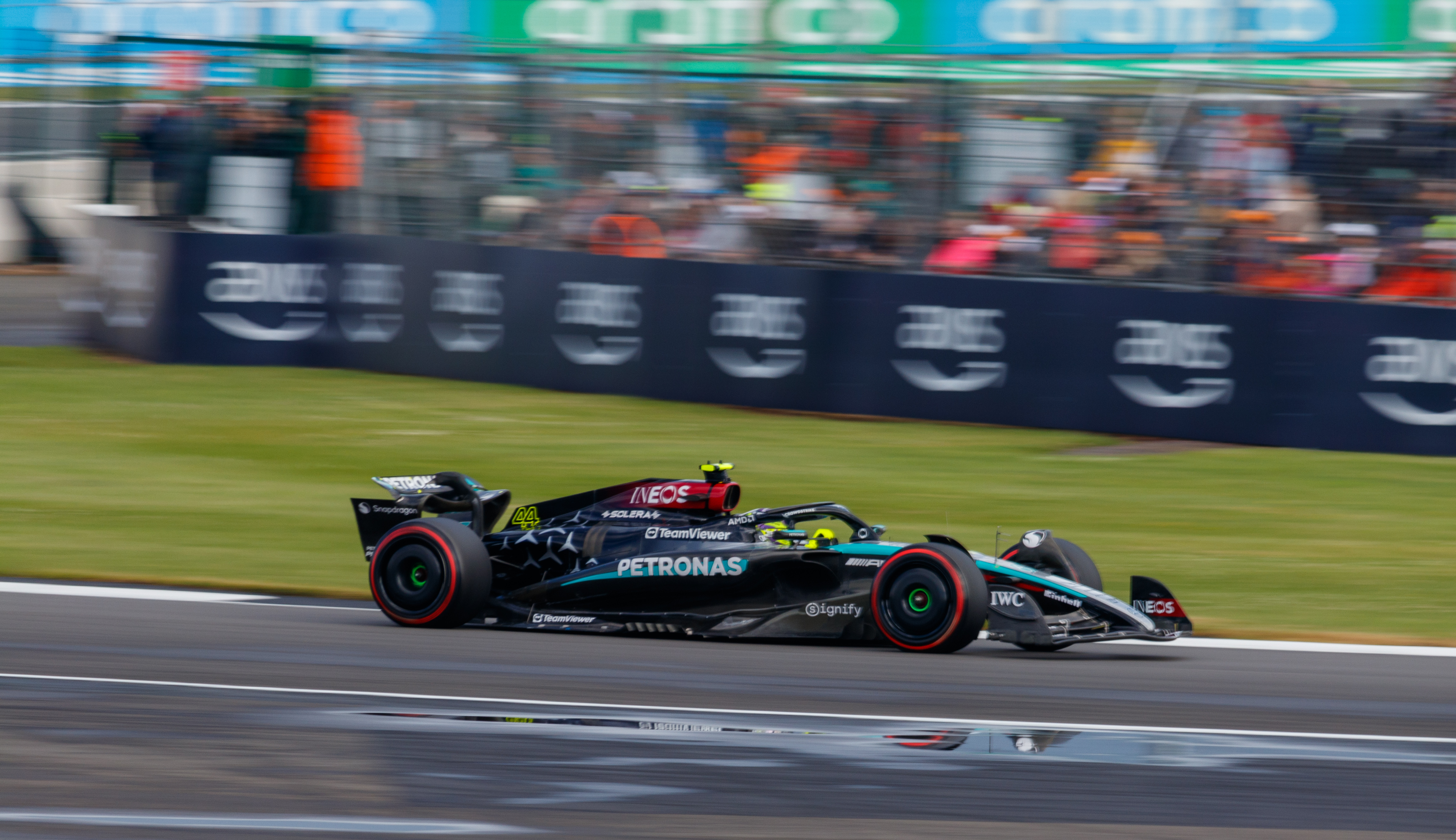
The 2026 regulations vs. Silverstone’s layout
Before looking at the championship battle, it’s impossible to preview Silverstone without addressing how the massive 2026 regulation changes will alter how cars tackle the circuit.
Silverstone is defined by its long straights and brutal high-speed corners. The 2026 cars feature a 50-50 power split between the internal combustion engine and the electrical system, replacing the complex MGU-H with a massive increase in battery reliance. This means drivers will be forced to actively manage energy deployment—via “super clipping” or the new manual Override button—down the Hangar and Wellington straights to avoid derating before the braking zones.
More crucially, 2026 introduces Active Aerodynamics with two distinct modes: X-Mode (low drag for straights) and Z-Mode / Corner Mode (high downforce for corners). Drivers can manually trigger these dynamic wing elements. Nailing the transition from low-drag X-Mode back to high-downforce Corner Mode exactly as they enter the daunting 300 km/h Maggotts-Becketts-Chapel complex will be the defining technical challenge of the weekend. Any hesitation in the system’s re-engagement, or driver error in triggering it, could be catastrophic.
The weekend format matters more than usual
The 2026 British Grand Prix is not a normal format weekend. It is a Sprint weekend.
Formula 1 lists the key Silverstone sessions as:
| Session | Date | Local time |
|---|---|---|
| Practice 1 | 3 July | 11:30 |
| Sprint Qualifying | 3 July | 15:30 |
| Sprint | 4 July | 11:00 |
| Grand Prix Qualifying | 4 July | 15:00 |
| Race | 5 July | 14:00 |
That changes the expectation game. Teams get only one practice session before competitive running starts. On a circuit like Silverstone, where aero balance, tyre temperature, wind sensitivity, and confidence through high-speed corners matter, a wrong Friday setup can poison the rest of the weekend.
This is not the place where a team wants to arrive with a narrow operating window.
Why Silverstone is a real car test
Silverstone is not just a historic venue with a large crowd. It is one of the clearest chassis tests on the calendar.
The circuit is 5.891 km long, with 52 laps and a race distance of 306.198 km. It is famous for high-speed sections such as Copse, where cars spend a long time loaded laterally and drivers need absolute trust that the aerodynamic platform will stay stable.
McLaren’s own Silverstone preview describes the track as a test of aerodynamic quality, noting that it is tough on tyres because of the lateral loads, while being comparatively gentle on brakes.
That combination usually favours cars with:
- strong high-speed aero efficiency;
- stable balance through fast direction changes;
- good tyre temperature control;
- low wind sensitivity;
- enough straight-line efficiency to avoid being exposed on the Hangar Straight.
Current championship form before Silverstone
As of 17 June 2026, the British GP is still two race weekends away, because Austria comes first on 26–28 June. The picture can change before Silverstone, but the current form guide is clear enough.
Formula 1’s official drivers’ standings currently show:
| Position | Driver | Team | Points |
|---|---|---|---|
| 1 | Kimi Antonelli | Mercedes | 156 |
| 2 | Lewis Hamilton | Ferrari | 115 |
| 3 | George Russell | Mercedes | 106 |
| 4 | Charles Leclerc | Ferrari | 75 |
| 5 | Lando Norris | McLaren | 73 |
| 6 | Oscar Piastri | McLaren | 68 |
| 7 | Max Verstappen | Red Bull Racing | 55 |
The constructors’ standings are even more telling:
| Position | Team | Points |
|---|---|---|
| 1 | Mercedes | 262 |
| 2 | Ferrari | 190 |
| 3 | McLaren | 141 |
| 4 | Red Bull Racing | 89 |
Mercedes is the reference point. Ferrari is close enough to make the title fight uncomfortable. McLaren is not leading the standings, but Silverstone is exactly the type of circuit where McLaren’s aerodynamic strengths should matter.
The Barcelona result changes the mood
The last completed race before this article was written was Barcelona-Catalunya, where Lewis Hamilton took his first Formula 1 win for Ferrari. Reuters reported that Hamilton ended a 41-race winless run, while Kimi Antonelli retired with an electrical issue. George Russell finished second and Lando Norris finished third, creating the first all-British podium since 1968.
That result matters for Silverstone expectations for three reasons.
First, Hamilton is no longer just a “potential Ferrari threat.” He has now converted Ferrari pace into a win. That changes how rivals treat him strategically.
Second, Antonelli’s lead is still strong, but no longer feels untouchable. He remains the championship leader, but a retirement in Barcelona reduced the psychological gap.
Third, Russell and Norris both arrive in the Silverstone conversation with recent podium-level evidence. For a British GP with Hamilton, Russell, Norris, Bearman, and Lindblad on the grid, that matters commercially and emotionally as much as competitively.
The likely competitive order
1. Mercedes should start as the baseline favourite
Mercedes leads both championships and has the strongest driver points profile. Antonelli has been the dominant early-season driver, and Russell remains close enough to make Mercedes a two-car threat. The risk: Barcelona exposed reliability pressure for Antonelli. A Sprint weekend reduces recovery time.
2. Ferrari may be the biggest race-day threat
Ferrari arrives with the strongest recent emotional momentum because Hamilton has just won. Hamilton at Silverstone is never a neutral variable. He has nine British Grand Prix victories, including the emotional 2024 win. Add Ferrari momentum, home support, and a title gap that has narrowed, and he becomes one of the most obvious candidates for a podium or win. The risk is Ferrari’s second-car volatility; Leclerc cannot afford another poor weekend.
3. McLaren is the technical dark horse
Silverstone’s high-speed demands should suit a strong McLaren platform. The team itself frames Silverstone as an aerodynamic test. Norris also has the home-race factor. The issue is championship position: the car has not been the most complete package across all circuits, so the team still needs qualifying execution and tyre management to turn “good circuit fit” into a result.
4. Red Bull looks more like a spoiler than a favourite
Red Bull is fourth in the constructors’ standings. Max Verstappen remains too good to dismiss at any circuit, but the public form guide does not currently make Red Bull the obvious Silverstone favourite. Silverstone can reward bravery and high-speed confidence, which keeps Verstappen relevant if the top teams trip over strategy or Sprint chaos.
Bottom line
Silverstone 2026 is shaping up as more than a normal British GP.
It is a Sprint weekend, a massive fan event, and a high-speed aero test arriving just after Hamilton’s first Ferrari win. The safest expectation is a Mercedes podium. The more interesting expectation is a Hamilton win attempt in front of a record-scale Silverstone crowd.
If the current form guide holds, the British GP should not be about whether one car disappears up the road. It should be about who handles the pressure best when there is almost no practice time, high-speed aerodynamic commitment is mandatory, and the crowd is pushing every British driver into the story.
Sources
- Formula 1 — 2026 British Grand Prix schedule and circuit data
- Reuters — Hamilton ends Antonelli’s run with first win for Ferrari
- The Guardian — Silverstone expected to host record F1 attendance
- McLaren — British Grand Prix 2026 circuit preview
- Mercedes-AMG F1 — British Grand Prix 2026 team preview