
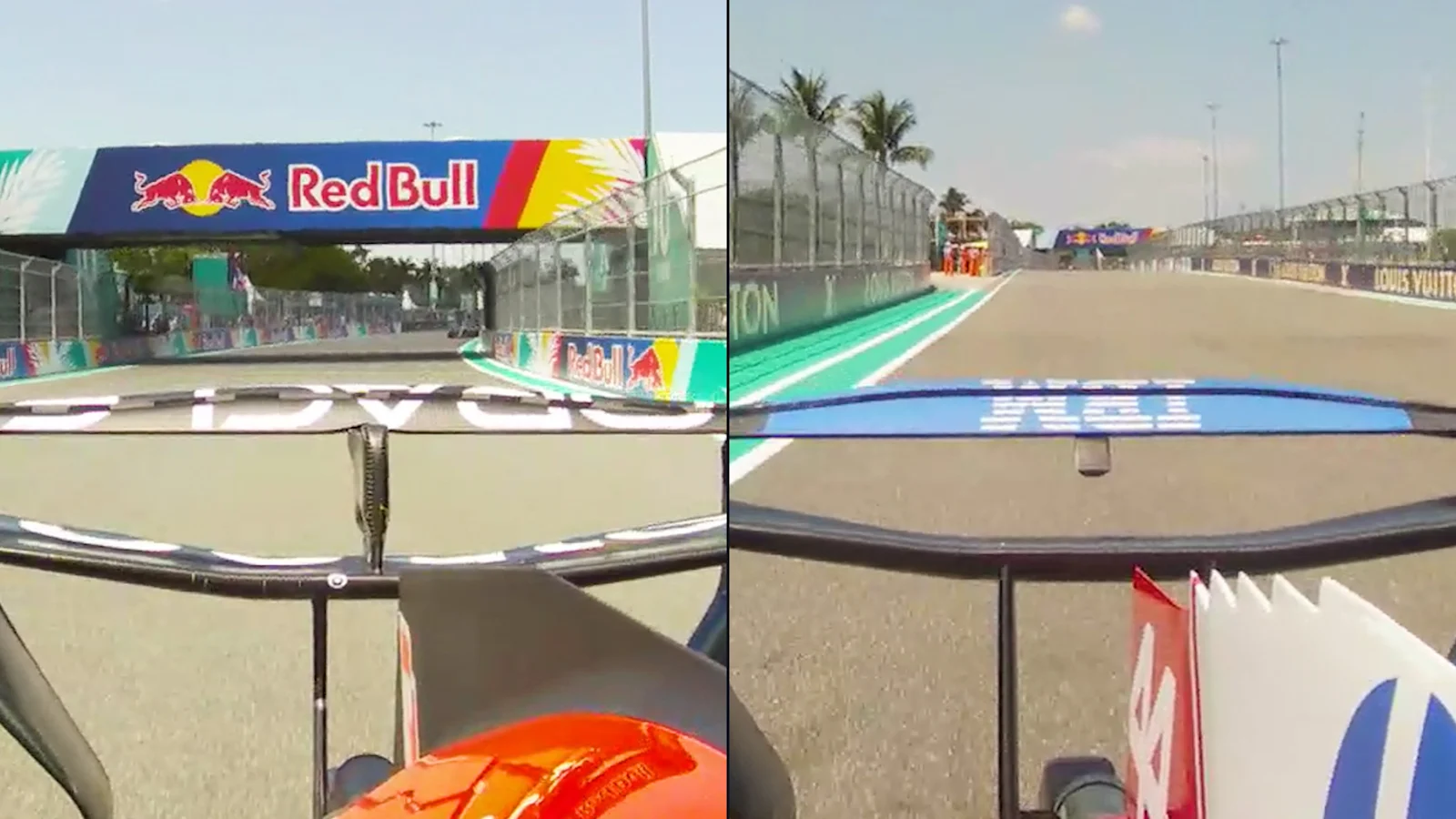
Formula 1’s most dramatic 2026 aero idea has crossed from clever to uncomfortable.
The Race reports that the FIA is in safety talks with Red Bull and Ferrari over their rotating rear-wing concepts after Max Verstappen’s British Grand Prix crash. Motorsport.com and Autosport add the next practical layer: Red Bull is investigating the Silverstone failure with “all options” open before Spa, including whether it should step back from the concept for one of the calendar’s fastest tracks.
That is why this is today’s Daily Dose of F1 story. GearPulse covered Charles Leclerc’s Silverstone win on July 5 and the FIA’s Safety Car software-error explanation on July 6. This is a different story: the post-Silverstone technical consequence. Red Bull’s wing did not just cost Verstappen a result. It put one of the new-regulation era’s boldest design paths under public safety pressure.
GearPulse’s view: the rotating wing is not automatically reckless. It is exactly the kind of engineering stretch F1 is supposed to reward. But after two high-speed Red Bull failures in two race weekends, the burden of proof has moved. Red Bull now has to prove the system fails safely, not merely that it works when everything behaves.
Why this became the story
Red Bull’s own British GP report says Verstappen was on course for a strong finish when an issue with the rear wing sent him into the Stowe gravel with just over four laps left. Formula 1’s post-race article quotes Verstappen explaining the problem in simple terms: if the rear wing does not fully return to its high-downforce state, the car loses rear load and can spin.
That is not a small failure mode. Stowe is fast, exposed and not the place where a driver wants the rear of the car to become a question mark.
Sky Sports F1 reported Verstappen’s harsher public reaction, including his view that two similar outcomes in high-speed corners made the situation dangerous. Red Bull team boss Laurent Mekies did not try to dress it up as bad luck. The Race and Sky both reported him acknowledging that drivers being let down by the car in high-speed corners twice in a row is unacceptable, even if the Austria and Silverstone causes were not identical.
The important word is “outcome.” Whether the mechanical details differ matters to Red Bull’s engineers. To the FIA, the driver and the next race weekend, the common result matters more: an active rear-wing system did not give the driver the downforce state he expected at a high-speed corner.
Active aero changed the failure math
The 2026 rules replaced the old DRS world with a more ambitious active-aero system. Formula1.com’s regulation explainer describes the basic architecture: cars switch between a low-drag Straight Mode on designated sections and a higher-downforce Corner Mode for corners. The front and rear wings are both part of the new aerodynamic toolkit.
That makes this different from the DRS era. Old DRS was important, but it was a rear-flap overtaking aid with a narrower use case. The 2026 system is baked into how the car balances drag, battery deployment and cornering load across the lap.
The FIA technical regulations are written with that risk in mind. The public technical document includes a core fail-safe principle for the rear wing adjuster system: failure should return the rear-wing flap to Corner Mode. That makes intuitive sense. If something goes wrong, the driver should get more downforce, not less.
The Red Bull and Ferrari rotating concepts are legal interpretations of that new world, not random stunts. Formula1.com’s technical comparison from Miami explained why they drew so much attention. Ferrari’s version flips the rear-wing element through a more dramatic rotation. Red Bull’s version appears to create an even larger open slot gap, with a different mechanism and geometry.
That is the creative bit. The safety question is whether the creative bit can be made as boringly reliable as a conventional flap.
Red Bull has the immediate problem
For Red Bull, this is not an abstract regulatory debate. Spa is next, on July 17-19, and Spa is exactly the kind of venue where a low-drag rear wing can look irresistible.
The Kemmel Straight rewards efficiency. Eau Rouge, Raidillon, Pouhon and Blanchimont punish instability. If the rotating wing gives Red Bull a straight-line and energy-deployment advantage, parking it costs performance. If it fails to return cleanly, the price can be much higher than lap time.
That is why Motorsport.com’s “all options open” detail matters. A team does not want to bin a concept it has raced since Miami, especially one tied to its recovery push. But Red Bull also cannot arrive at Spa with a system Verstappen does not trust. Confidence is not a soft metric at these speeds. It decides how early a driver commits, how much margin he carries, and whether he believes the car will be there when the aero maps say it should be.
The intra-team comparison adds another layer. Isack Hadjar finished fifth at Silverstone, giving Red Bull useful points on a day Verstappen retired. But the story still belongs to Verstappen because the failure hit the lead driver while he was fighting in the podium group. When the fastest and most experienced driver in the car says the rear-wing behavior is dangerous, the team cannot reduce the issue to unlucky execution.
Ferrari is in the frame, but not in the same hole
Ferrari is part of the reported FIA discussion because its rotating rear wing is the other major version of the same broad idea. That does not mean Ferrari has Red Bull’s problem.
The distinction is important. Ferrari brought the concept into public view early in the 2026 cycle and has used a different movement philosophy. Red Bull’s interpretation, as Formula1.com’s technical analysis noted in Miami, appears more extreme in the open slot gap it creates. The two designs chase the same performance outcome, but they do not have to carry the same reliability risk.
That is why the FIA angle is bigger than a Red Bull repair job. The regulator has to decide whether this is a team-specific failure, a category of design that needs tighter scrutiny, or simply a warning sign that the new active-aero era has entered its first hard safety test.
Ferrari’s competitive interest is obvious. If Red Bull has to retreat from its version while Ferrari keeps using its own, the balance shifts. If the FIA asks both teams for extra assurances, Ferrari loses some development freedom but gains a clearer safety envelope. If the FIA tightens interpretation across the grid, McLaren and any other team considering a similar path get a useful signal before committing race parts.
The practical choice before Spa
Red Bull’s decision tree is uncomfortable because every option has a cost.
| Option | Upside | Risk |
|---|---|---|
| Keep the rotating wing | Preserves the aero concept and potential Spa straight-line efficiency | Verstappen has to trust a system that just failed twice in public |
| Modify the mechanism | Keeps the development path alive while addressing the failure mode | Limited time before Spa, and validation under race loads is hard |
| Revert to a conventional rear wing | Simplest way to reduce repeat-failure risk | Gives up a performance route Red Bull has invested in since Miami |
| Run a track-specific compromise | Balances confidence and speed for Spa | Could be neither fast enough nor proven enough |
GearPulse’s read is that Red Bull is more likely to modify or shelve the concept for Spa than pretend nothing happened. Call it a 55-65% chance that the car does not run the same specification in Belgium, either through a revised mechanism, tighter operating limits, or a more conventional fallback. That is editorial analysis, not betting advice and not based on private garage information.
The harder call is the FIA’s. A full ban or sweeping clampdown feels less likely unless the FIA sees a common design weakness. A more probable near-term outcome is extra documentation, inspection, software checks or operating assurances for any rotating rear-wing concept. That sits in the 45-55% range because it lets the FIA act without killing innovation prematurely.
The fun fact with consequences
The nickname around these wings is playful, but the rule change behind it is not. F1 spent years trying to move beyond simple drag reduction and into cars that actively manage the trade between speed and downforce. In 2026, that theory finally became visible.
The fun part is that the most eye-catching solution looks almost cartoonish when it flips open. The serious part is that a Formula 1 rear wing is not just a drag device. It is a stability contract. When it returns to its cornering state, the driver expects a specific rear load at a specific moment. If that contract breaks, the driver is already committed.
That is why these two Red Bull failures landed harder than a normal reliability problem. A power-unit failure ruins a result. A stuck or partially returned rear-wing state can change the car’s behavior at the worst possible point of the lap.
Bottom line
The rotating rear wing should not be treated as a scandal just because it looks radical. F1 needs teams to explore the edges of the rules, and the 2026 active-aero regulations practically invited creative interpretations.
But Red Bull’s Silverstone crash changed the standard of proof.
Before Austria, the question was whether the concept was fast. After Austria and Silverstone, the question is whether it is fail-safe enough for Spa, Monza, Baku and every other high-speed test still coming. Ferrari is watching because its own version is now part of the FIA conversation. McLaren is watching because it has been more cautious. The FIA is watching because active aero is now part of the sport’s safety architecture, not just its performance show.
Red Bull can still rescue the concept. The smart version of that rescue starts with humility: prove the wing returns safely every time, or leave the clever part in the truck until it does.