
Formula 1’s customer-engine question was supposed to be mostly settled.
The modern rulebook guarantees customer teams the same power-unit specification as the factory team. That principle mattered in the V6 hybrid era, when Mercedes, Ferrari, Renault and Honda customers needed confidence that they were not buying second-class hardware. But the 2026 rules have reopened the argument in a more awkward way: the parts may be equal, while the understanding is not.
That is why today’s Daily Dose of F1 is not another Silverstone result recap. Motorsport.com reported on July 8 that the new hybrid systems have put factory-team know-how back at the centre of the performance picture, using McLaren and Mercedes as the live example. Reuters, carried by The Straits Times, separately reported FIA president Mohammed Ben Sulayem’s idea of an independent engine supplier for 2031, alongside possible refuelling if F1 moves to lighter V8s. RaceFans also flagged the same “FIA engine” and refuelling discussion in its roundup.
Those two threads belong together.
McLaren is not slow because Mercedes has handed it a worse power unit. The more interesting problem is that the 2026 cars ask teams to extract performance from energy deployment, recharge logic, active aero states, gearbox choices and calibration detail at the same time. In that world, equal hardware can still produce unequal lap time.
GearPulse’s view: F1’s customer-engine problem is back, but not in the old conspiracy-shaped form. It is now an expertise problem. And if McLaren, the reigning champion team, can look exposed by it, the FIA has a real governance issue to solve before the next engine cycle.
Why McLaren made this trend
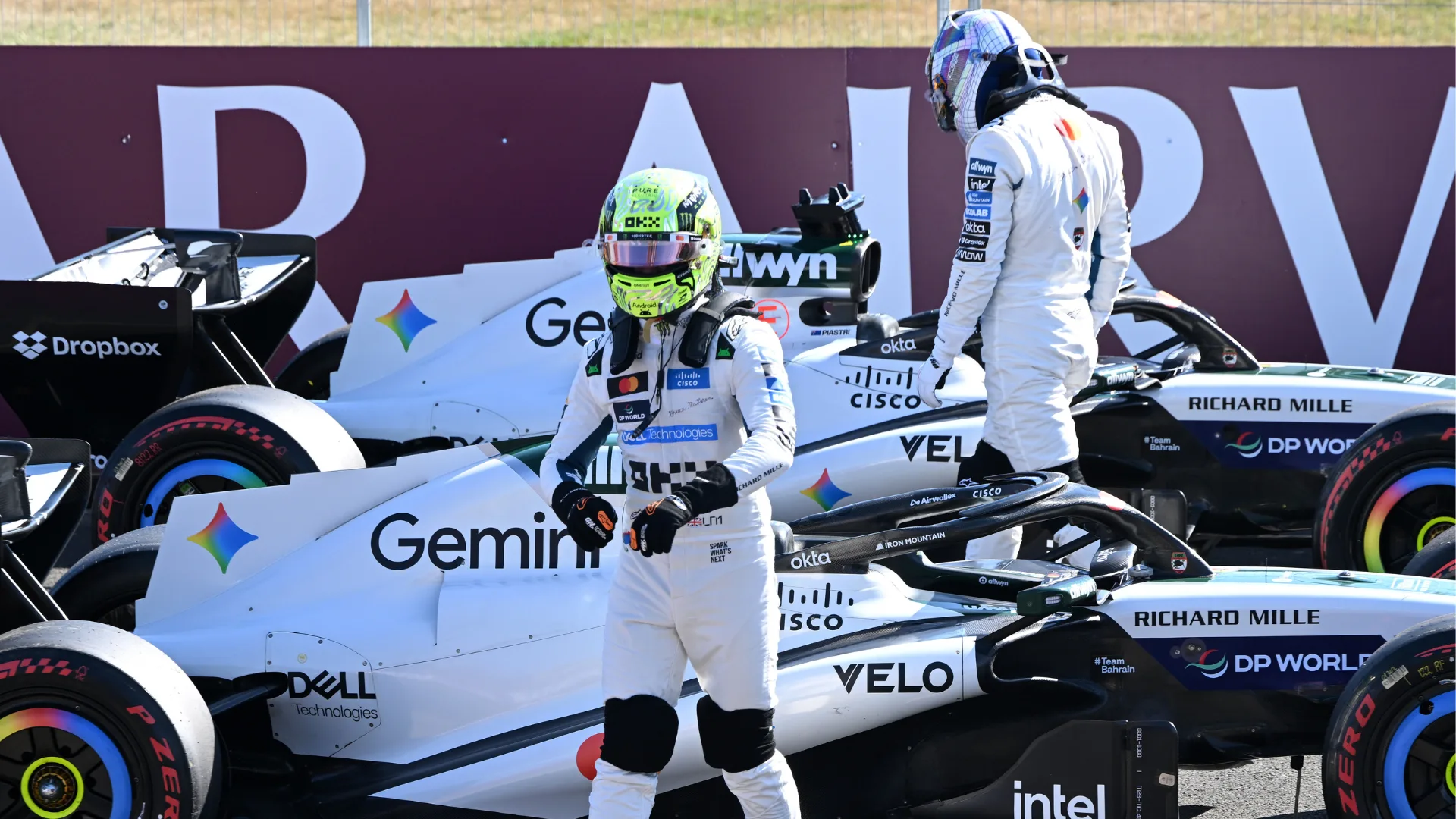
McLaren’s British Grand Prix looked respectable on paper. Lando Norris finished fourth and had already taken a Sprint podium, while Oscar Piastri’s Sunday was compromised by first-lap contact and repairs. But McLaren’s own race report was blunt about the bigger picture: the team saw a consistent gap to the front-runners across the weekend and listed closing that gap as its highest priority.
Formula 1’s official follow-up went further. Andrea Stella said the MCL40 was still roughly half a second away from Ferrari and Mercedes at Silverstone, and that Norris’ P4 came partly because other cars hit trouble. Sky Sports F1 reported the same theme, with Norris calling the pace “pretty shocking” despite the result.
That is the competitive surface. The deeper part is where Motorsport.com’s reporting becomes important. Stella has not framed the deficit only as a chassis problem. At Silverstone, he pointed to power-unit exploitation and energy-starved circuits, saying McLaren still appears to be leaving something on the table with the Mercedes HPP package.
That is a loaded admission. McLaren uses Mercedes power, but Mercedes also uses Mercedes power. If the works team has operating tricks, calibration knowledge or integration detail that a customer cannot instantly replicate, the same hardware does not create the same performance envelope.
The 2026 rules made the engine political again
Formula 1’s own 2026 regulation explainer makes clear why this is not a simple horsepower story. The current power units lean much more heavily on electrical energy. Drivers and teams manage Boost, Recharge, Overtake Mode and active aero, with energy harvesting possible through braking, part-throttle running, lift-off and super clipping.
That creates a richer race product when it works. It also creates more places to be slightly wrong.
In the old customer-engine debate, fans tended to ask whether a supplier was giving a team identical hardware. In 2026, the better questions are more subtle:
| Question | Why it matters in 2026 |
|---|---|
| Does the customer understand every deployment option? | Electrical energy is now a lap-time tool, not just a background system. |
| Can the gearbox ratios support the real power curve? | Choices made before the season can shape straight-line and recharge behaviour for months. |
| Does the works team find calibration tricks first? | The factory team lives inside the power-unit development process. |
| Can the customer copy the behaviour quickly? | A legal feature is not useful if the customer cannot deploy it in the same operating window. |
The Mercedes qualifying behaviour that surprised McLaren, as reported by Motorsport.com, is exactly the kind of detail that makes this story bigger than one team having a bad Silverstone. If a works team can use its own power unit more cleverly because it has deeper system knowledge, the sporting question is not whether Mercedes is cheating. It is whether the customer framework is strong enough for a software-heavy era.
McLaren is the awkward test case
This would be easier to dismiss if the example were a backmarker. It is not.
McLaren won both championships in 2025. Norris is the reigning world champion. Piastri has already shown race-winning quality. The team has the staff, money, drivers and competitive culture to make a customer model work. If McLaren is struggling to extract the same Mercedes package as Mercedes, the issue is not laziness or lack of ambition.
There are still caveats. McLaren’s gap is not purely power-unit related. Stella also pointed to aero development direction, and Formula 1’s report says the first visible gains from McLaren’s redirected upgrade approach should arrive at the Hungarian Grand Prix. McLaren’s own race report says a significant upgrade is scheduled for Hungary. Silverstone also amplified low-grip, wind and high-speed energy demands.
So the cleanest read is this: McLaren has a car-development gap and a power-unit exploitation gap, and the two are interacting. That is exactly why the story matters. The 2026 regulations made the car, engine, software and aero states more tightly connected. A customer can be only slightly late in several areas and suddenly look half a second away.
Why the FIA is already looking toward 2031
Ben Sulayem’s independent-engine idea sounds like a future-regulation story, but it landed now because the present rules are exposing the problem.
Reuters reported that the FIA president is studying whether Formula 1 could bring back refuelling and create an affordable independent V8 supplier from 2031. Motorsport.com added the governance layer: such a move could reduce manufacturer leverage over customer teams, especially in a grid where Mercedes and Ferrari currently supply multiple cars and Red Bull has a sister-team structure.
There is a nostalgic version of this story that is just “bring back loud V8s.” That is too shallow. The more interesting version is about independence.
If F1 can make the next engines cheaper and simpler, more teams could theoretically control their own destiny. If not, an FIA-selected supplier could become a neutral fallback for teams that do not want to be tied to a rival manufacturer. The idea has echoes of the Cosworth era, but the politics are different now because F1 has spent years courting major manufacturers with complex hybrid technology.
That is the tension. Simpler engines could reduce dependency. They could also anger the manufacturers F1 worked hard to attract.
The refuelling caveat
Refuelling is the messy part of the proposal.
F1 banned race refuelling after 2009 for cost, safety and logistical reasons. Bringing it back would need more than nostalgia and lighter fuel tanks. It would mean transporting specialist equipment again, adding pit-lane risk, changing strategy incentives and explaining why a championship built around sustainable fuels and efficiency wants mid-race fuel stops back on the menu.
The FIA’s logic is understandable if the future V8 is naturally aspirated and needs more fuel. A smaller tank plus refuelling could keep car weight down. But that does not automatically make it a good sporting answer.
GearPulse’s probability read: an independent or standardised supplier concept for 2031 feels more plausible than refuelling returning in full. Put the neutral-engine idea in the 45-55% range as a serious proposal that could survive into formal talks. Put refuelling closer to 25-35% unless the FIA can prove the safety, cost and racing-product case. That is editorial analysis, not betting advice.
The team comparison that matters
Mercedes has turned the 2026 reset into a championship lead. Ferrari has become the sharpest challenger after Leclerc’s Silverstone win and Hamilton’s podium. Red Bull has speed but also active-aero and energy-management headaches. McLaren is stuck in the uncomfortable middle: good enough to score, not good enough to dictate.
That comparison explains why the customer debate is back.
| Team | Current 2026 lesson |
|---|---|
| Mercedes | Works integration is a weapon when the power unit is complex. |
| Ferrari | Factory control plus a strong car gives Leclerc and Hamilton a real title platform. |
| Red Bull | Building your own power unit gives freedom, but also exposes every reliability and deployment weakness. |
| McLaren | A championship-grade customer team can still lose time in integration and exploitation. |
The fun fact with a serious edge: McLaren has already proved the customer model can win. Its 2025 title did not require a works engine. Brawn did the same with Mercedes power in 2009, and Red Bull won championships with Renault power before building its current Red Bull-Ford operation. Customer success is not impossible. It just gets harder when the performance is hidden in software behaviours and energy maps instead of a visible engine specification.
Bottom line
McLaren’s Silverstone problem is not just McLaren’s problem.
It is the first clear warning that F1’s 2026 equality promise may be too hardware-focused for the way the cars now make lap time. The rules can require Mercedes to supply the same power-unit specification. They cannot easily force Mercedes to hand over years of embedded know-how, calibration instinct and system integration advantage in a form McLaren can instantly use.
That does not make the championship unfair by default. Factory teams should gain something from building engines. But F1 also needs credible customer teams, because half the grid cannot become full engine manufacturers overnight.
So the FIA’s 2031 independent-engine talk is not just future noise. It is a reaction to a live problem. If equal engines no longer feel equal in practice, F1 has to decide whether it wants to simplify the next formula, standardise part of the supply chain, or accept that customer teams are buying the same parts with fewer instructions.
McLaren’s Hungary upgrade will tell us whether this is a short-term recovery story. The 2031 engine talks will tell us whether F1 thinks the customer model itself needs repairing.