There are no 2026 Austrian Grand Prix results yet. The race weekend takes place from 26–28 June 2026 at the Red Bull Ring in Spielberg, so this is not a results piece. It is a form-guide preview: what should we expect when Formula 1 reaches Austria?
The short version: Austria looks like one of the most compressed weekends of the season so far. Mercedes arrives as the championship leader, Ferrari arrives with fresh momentum after Lewis Hamilton’s first win in red, McLaren should like the Red Bull Ring’s fast and efficient layout, and Red Bull will be under unusual pressure at its own circuit.
The basic schedule
The 2026 Austrian Grand Prix is Round 8 of the season and runs from Friday 26 June to Sunday 28 June. McLaren’s official race hub lists the weekend as follows, in local Austrian time, which is CEST:
| Session | Date | Local time |
|---|---|---|
| Practice 1 | Friday, 26 June | 13:30–14:30 |
| Practice 2 | Friday, 26 June | 17:00–18:00 |
| Practice 3 | Saturday, 27 June | 12:30–13:30 |
| Qualifying | Saturday, 27 June | 16:00–17:00 |
| Race | Sunday, 28 June | 15:00–17:00 |
This is a normal Grand Prix format, not a Sprint weekend. That matters. Teams will have three practice sessions to understand tyre temperatures, kerb behaviour, brake cooling, ride height and setup balance before qualifying. Compared with a Sprint weekend, Austria gives teams more time to solve problems before parc fermé really bites.
Why the Red Bull Ring always looks simple — until it isn’t
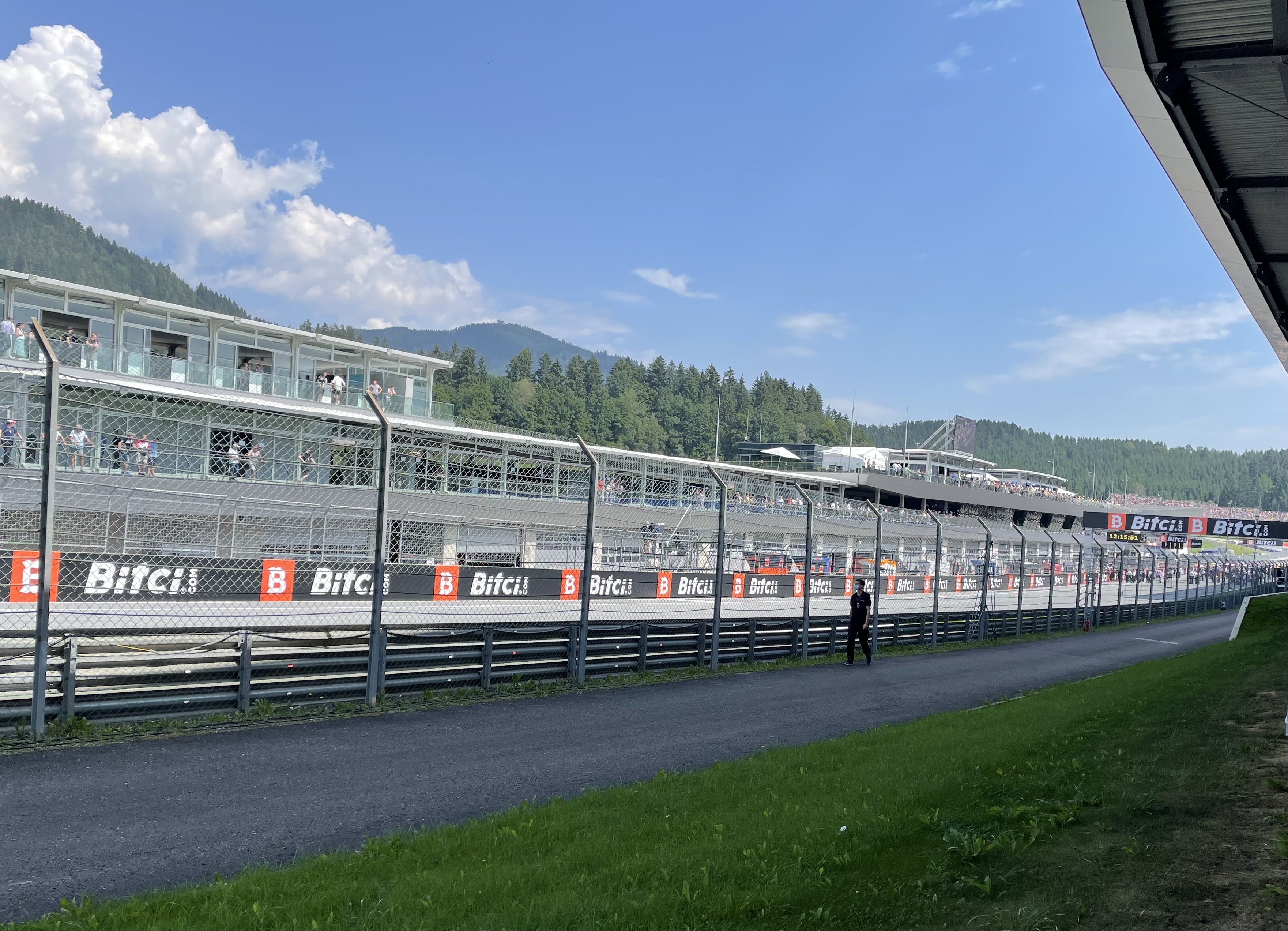
On paper, the Red Bull Ring is one of the least complicated circuits on the calendar. The 2026 layout is listed at 4.326 km, with 71 laps and a total race distance of 307.018 km. It has few corners, a very short lap time, big elevation changes, hard braking zones and a middle sector that can punish cars that are not stable over kerbs or through fast downhill direction changes.
That is why Austria often creates a strange kind of pressure. A long circuit allows gaps to spread naturally. At the Red Bull Ring, the short lap compresses the field. In qualifying, one small lock-up, a poor exit, dirty air from traffic, or one missed apex can turn a front-row lap into a second- or third-row lap. The margins are usually tiny.
Formula 1 describes the first half of the circuit as power-heavy, with cars blasting along three straights separated by uphill right-handers. The second half is more flowing and downhill, with quick corners including the Rindt right-hander. That means Austria is not just a straight-line speed test. It is a car-balance test split into two personalities: power and braking early in the lap, then rhythm and confidence on the way back down.
The gravel trap solution: fixing the track limits chaos
One of the biggest historic talking points at the Red Bull Ring has finally been resolved. For years, the final two corners (Turn 9 and Turn 10) were a track-limits nightmare. Drivers constantly ran wide over the asphalt run-off, resulting in thousands of deleted lap times and post-race penalties that scrambled the final results hours after the chequered flag.
To fix this, the FIA and circuit officials introduced a brilliant, low-tech solution in recent years: a 2.5-meter-wide strip of gravel placed exactly behind the exit kerbs. This “natural deterrent” immediately punishes drivers who push too wide by killing their momentum. It forces the grid to respect the white lines on pure fear of the gravel trap. As the grid heads into the 2026 weekend, expect those final two corners to be the ultimate test of risk versus reward in qualifying, without the mess of post-session penalties.
The championship picture before Austria
The Austrian GP arrives one race after a major momentum swing in Barcelona.
Lewis Hamilton won the 2026 Barcelona-Catalunya Grand Prix for Ferrari, his first Grand Prix victory since joining the team. That ended Kimi Antonelli’s run of dominance and turned the championship narrative from “Mercedes control” into something more fragile and interesting.
After Barcelona, the main drivers’ standings looked like this:
| Position | Driver | Team | Points |
|---|---|---|---|
| 1 | Andrea Kimi Antonelli | Mercedes | 156 |
| 2 | Lewis Hamilton | Ferrari | 115 |
| 3 | George Russell | Mercedes | 106 |
| 4 | Charles Leclerc | Ferrari | 75 |
| 5 | Lando Norris | McLaren | 73 |
| 6 | Oscar Piastri | McLaren | 58–68* |
| 7 | Max Verstappen | Red Bull Racing | 55 |
The constructors’ picture is clearer:
| Position | Team | Points |
|---|---|---|
| 1 | Mercedes | 262 |
| 2 | Ferrari | 190 |
| 3 | McLaren | 141 |
| 4 | Red Bull Racing | 89 |
| 5 | Alpine | 57 |
| 6 | Racing Bulls | 41 |
This matters because Austria is not a place where the championship leader can hide. If Mercedes is still the best car, the Red Bull Ring should let that show. If Ferrari’s Barcelona pace was real and not just a perfect combination of strategy, tyre management and timing, Austria is the kind of compact circuit where Hamilton and Leclerc can keep the pressure on. If McLaren’s race pace is stronger than its qualifying execution, Spielberg gives Norris and Piastri multiple overtaking zones to stay in the fight.
What Barcelona changed
Before Barcelona, the season looked increasingly like a Mercedes year. Antonelli had won five races and was building a large points gap. Then Spain changed the tone.
Hamilton’s Ferrari win was not just a sentimental headline. It proved Ferrari could execute a winning race from the sharp end, and it proved Hamilton was still able to turn a strategic opportunity into a controlled victory.
For Austria, that creates three major storylines:
-
Can Antonelli respond immediately?
A title leader’s first major setback is always revealing. Austria will show whether Barcelona was just an isolated failure or the start of a more nervous phase for Mercedes. -
Was Ferrari’s win track-specific or a real step?
Hamilton’s win came with strong race management and strategy. The Red Bull Ring will ask different questions: straight-line efficiency, traction, braking, kerb control and qualifying sharpness. -
Can McLaren move from podium threat to win threat?
Lando Norris finished third in Barcelona, and McLaren remains close enough to be dangerous. Austria’s short lap could help them if their car is efficient and gentle enough on tyres.
Mercedes: still favourites, but not untouchable
Mercedes should arrive in Austria as the safest pick on pure 2026 form. The team has the championship lead, the deepest points total, and two drivers capable of winning. Antonelli has been the breakthrough story of the season, while Russell has been consistently close enough to punish any weakness.
Austria should suit a complete car. The Red Bull Ring rewards power, traction and braking stability, but it also exposes cars that struggle to rotate cleanly through medium- and high-speed corners. If Mercedes has the most balanced package, Austria can quickly become a front-row lockout opportunity.
But there is one warning sign: reliability. Antonelli’s Barcelona retirement was a reminder that no title campaign is safe if the car does not reach the finish. Austria is short, intense and hard on repeated acceleration and braking phases. A small technical weakness can become expensive very quickly.
Expectation: Mercedes starts as the benchmark, especially with Antonelli and Russell both inside the top three of the championship. But Barcelona removed the aura of inevitability.
Ferrari: the emotional momentum team
Ferrari arrives in Austria with the kind of momentum that changes a garage. Hamilton’s Barcelona victory was more than another number in his record book. It was proof that the Ferrari project can win.
For Hamilton, Austria is also an interesting challenge. The Red Bull Ring is a place where rhythm, braking confidence and racecraft matter. If he qualifies near the front, he can make the race come to him. If Ferrari has good tyre behaviour, he becomes a genuine win threat again.
Leclerc is the other side of the story. He has 75 points in the standings after Barcelona, but he needs a clean weekend. Austria can suit his qualifying style, because short laps reward drivers who can extract everything instantly. A Leclerc front-row start would not be a shock if Ferrari has a strong Saturday car.
Expectation: Ferrari is the main emotional and competitive storyline. Barcelona made the team dangerous again. Austria will show whether that danger is repeatable.
McLaren: the team that could quietly steal it
McLaren may not lead either championship, but Austria is exactly the type of weekend where they should be watched carefully.
The Red Bull Ring has enough overtaking opportunities to make race pace useful. It is not Monaco. A McLaren starting third, fourth or fifth can still be a real problem if it has strong tyre degradation and clean straight-line efficiency. Norris and Piastri also know this place can produce wheel-to-wheel racing over multiple corners rather than just one simple DRS pass.
Expectation: McLaren is the spoiler. If Mercedes and Ferrari focus too much on each other, Norris or Piastri could turn Austria into a papaya opportunity.
Red Bull: the home race pressure problem
The Red Bull Ring carries Red Bull branding, Red Bull history and Red Bull expectation. That does not mean Red Bull Racing automatically arrives as favourite.
After Barcelona, Red Bull sits fourth in the constructors’ standings with 89 points, behind Mercedes, Ferrari and McLaren. Max Verstappen remains the obvious spearhead, but the 2026 picture is not built around Red Bull dominance. Austria therefore becomes less of a celebration and more of a test: can Red Bull produce a home-race response?
The circuit should give Verstappen chances if the car is quick enough in a straight line and stable under braking. Turn 1, Turn 3 and Turn 4 are all natural attacking zones, and Verstappen is one of the best drivers in Formula 1 at turning half-chances into full moves.
But the bigger question is whether Red Bull has the overall package. A car that is nervous through the downhill half of the lap, weak over kerbs, or slow to generate tyre temperature could struggle even with Verstappen driving it.
Expectation: Verstappen can still fight for a podium, but Red Bull needs more than home-race energy. It needs a car that can qualify well and protect tyres in traffic.
Prediction: who should be favourite?
A sensible pre-weekend expectation looks like this:
| Rank | Team/Driver group | Why |
|---|---|---|
| 1 | Mercedes | Best 2026 form, strongest points base, Antonelli and Russell both in title contention. |
| 2 | Ferrari | Barcelona win gives them real momentum; Hamilton is now a genuine threat again. |
| 3 | McLaren | Track should suit an efficient car; Norris and Piastri can attack if qualifying is clean. |
| 4 | Red Bull | Home race and Verstappen factor, but 2026 form makes them outsiders rather than favourites. |
| 5 | Alpine/Racing Bulls | Possible points threats if the top teams hit trouble. |
My early pick: Mercedes should be favourite for pole, but Ferrari and McLaren look close enough to make the race uncomfortable. If Hamilton qualifies on the first two rows, he has a realistic chance to fight for another win. If Norris or Piastri start near the front with good tyre life, McLaren could become the race-day threat. Verstappen remains the wild card, especially if Red Bull finds a setup window at home.
Most likely podium mix before practice: Mercedes, Ferrari, McLaren. Most interesting upside pick: Lando Norris. Most emotional win scenario: Hamilton makes it two in a row for Ferrari. Most pressure-heavy storyline: Antonelli’s response after Barcelona.
Why this race matters
Austria is not just the next round. It is the first answer after the season’s first major plot twist.
If Antonelli wins, Mercedes can frame Barcelona as a glitch. If Hamilton wins again, Ferrari’s title hopes become serious. If Russell wins, Mercedes suddenly has two internal title contenders. If McLaren wins, the season opens even wider. If Verstappen wins at the Red Bull Ring, it becomes the kind of home-race rescue story that can restart a campaign.
That is why the 2026 Austrian Grand Prix already feels important before a single practice lap has been completed.