
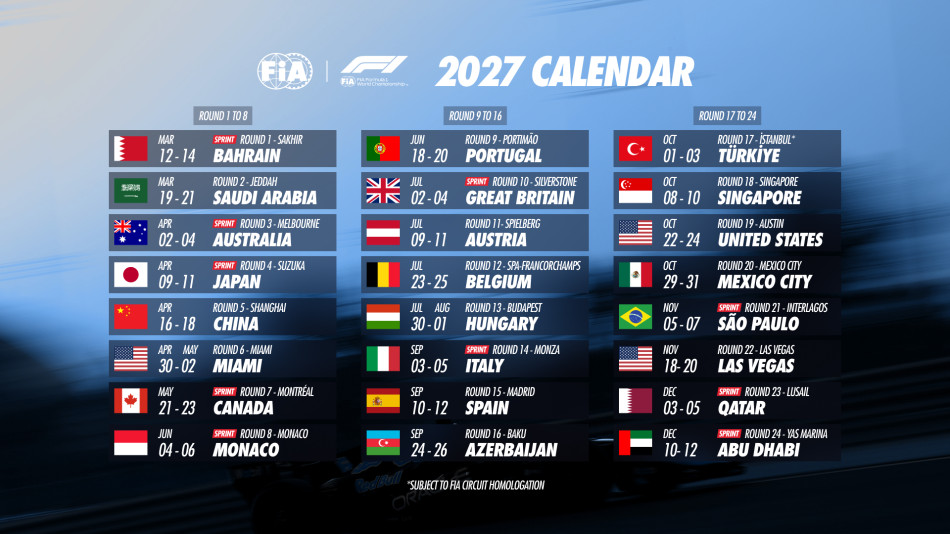
Formula 1’s 2027 calendar is a better piece of scheduling than its headline makes it sound. Portugal returns at Portimão, Türkiye returns at Istanbul Park, and the 24-race season is arranged in regional blocks that reduce some needless backtracking. Those are welcome changes, particularly after a 2026 season that has made the physical cost of the calendar hard to ignore.
But the consequential change is not a pin on the map. It is the decision to take Sprint weekends from six to 10. F1 is effectively betting that more competitive sessions will make more tickets and broadcasts feel essential — without weakening the very anticipation that makes a conventional Grand Prix weekend work.
The calendar, approved by the FIA World Motor Sport Council, starts in Bahrain on March 14 and ends in Abu Dhabi on December 12. Pre-season testing is a single four-day Bahrain test, from February 24 to 27. The shorter test is reasonable with the 2026 regulations carrying into a second year, but it also gives teams less public running to diagnose a bad winter before the points begin.
The useful changes, separated from the noise
| 2027 change | What is confirmed | Why it matters to fans |
|---|---|---|
| 24 Grands Prix | Bahrain opens; Abu Dhabi closes | The season keeps its familiar scale rather than expanding again. |
| Portugal returns | Portimão is June 18–20 | A properly fast, undulating circuit returns for the first time since 2021. |
| Türkiye returns | Istanbul is October 1–3, subject to FIA circuit homologation | Turn 8 is back, in a logical Azerbaijan–Türkiye–Singapore run. |
| 10 Sprint weekends | Up from six in 2026 | There are more meaningful Friday and Saturday sessions, but fewer quiet build-ups. |
| Barcelona rotates out | Spa appears in 2027; Barcelona is scheduled to return in 2028 | A historic venue is not gone forever, but continuity is no longer guaranteed annually. |
That final distinction matters. AS reports that Barcelona-Catalunya’s renewed arrangement has it alternating with Spa, with Barcelona slated for 2028, 2030 and 2032. This is not a tidy replacement story: the two tracks offer different kinds of racing and different relationships with their crowds. It is an illustration of the ceiling F1 now faces. There are more viable hosts than 24 available dates, so even places with genuine history have to prove their place in a rotating portfolio.
A calendar can be efficient without becoming interchangeable
The geography is doing sensible work. After the Bahrain–Saudi opening double header, Australia, Japan and China form an Asia-Pacific run. Monaco opens the European leg, followed by Portugal, then Silverstone and Austria, then Spa and Hungary. Later, Türkiye sits between Azerbaijan and Singapore; Austin, Mexico City and São Paulo follow each other before Las Vegas, Qatar and Abu Dhabi.
That order will not remove every freight movement or every exhausting flight. It does show that F1 understands a calendar is part of the product. A championship that asks mechanics, engineers, broadcasters and fans to cross the world needs more than a collection of desirable cities; it needs a shape people can live with.
Portimão is the most immediately appealing addition on sporting grounds. Its elevation changes and blind crests ask more from a driver than a calendar render can capture. Istanbul Park supplies a different argument: a modern circuit with a genuine signature corner, rather than another venue whose identity is mainly its skyline. Neither guarantee a great race — no circuit does — but both add texture to a schedule that must resist turning every stop into the same hospitality-led spectacle.
Ten Sprints need a higher standard than ten extra races
The FIA says the expanded format follows strong demand and that Sprint weekends have drawn larger audiences. Those are useful commercial signals. They are not, by themselves, a sporting case for putting a Sprint at almost half the calendar.
For 2027, Bahrain, Australia, Japan, Monaco and Abu Dhabi host Sprints for the first time; Canada, Great Britain, Italy, Brazil and Qatar return to the list. The selection has some imagination. Monaco, especially, puts a premium on qualifying precision, while Suzuka and Silverstone should make a short race feel like more than a support act.
Yet abundance changes how an attraction feels. The best Sprint weekends work because the format breaks the usual rhythm: Friday is immediately tense, Saturday offers a compact contest, and Sunday still has room to be the larger strategic story. Make that rhythm too common and a Sprint risks becoming a routine points prelude, while teams lose more of the practice time that lets a race weekend evolve.
There is a parallel with the rule changes already planned for 2027. As GearPulse argued in its analysis of F1’s shorter Grand Prix distance, a technical adjustment earns its place only if it makes the racing more workable rather than merely different. The same test belongs here: more sessions must produce more meaningful competition, not simply more occasions to sell a schedule.
The bottom line
F1’s 2027 map is attractive because it restores two circuits with character and gives the travel sequence more logic. It also confirms a harder truth about the modern championship: a 24-race limit does not preserve every beloved stop every year.
The bigger wager is the 10-Sprint programme. It could make selected weekends richer, especially at circuits where qualifying is an event in itself. But if every other round is designed to feel extra-special, the word “special” stops carrying much weight. The calendar has the venues to make that experiment worthwhile. F1 now has to choose its Sprint weekends with enough discipline that Sunday remains the destination.