
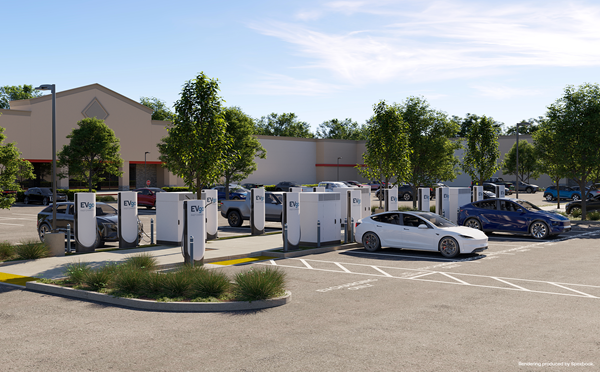
EV charging in America is slowly becoming less tribal, and EVgo’s new Supercharger plan is one of the clearer signs.
EVgo says it will deploy licensed Tesla V4 Superchargers across its U.S. metropolitan network. The company describes the units as capable of up to 500 kW and 1,000 volts, with Tesla navigation visibility, Tesla Trip Planner routing, Magic Dock support for CCS and NACS vehicles, and longer cables to make different charge-port locations less annoying. Deployments are scheduled to start this fall, with the first sites expected to be operational in the second half of 2026.
My read: this is relevant because EV drivers do not care who wins the branding argument while they are low on battery. They care whether the charger shows up in the route planner, works with their inlet, starts without a ritual and adds range quickly enough to keep the day moving.
That is where EVgo borrowing Tesla’s hardware language becomes more than a corporate partnership detail.
The charger map is becoming a shared surface
Tesla’s Supercharger network earned its reputation by feeling predictable. EVgo’s reputation has been built more around public fast charging in urban and retail-heavy locations. Putting Tesla-style Superchargers inside EVgo’s network does not make those networks identical, but it does blur an important line for drivers.
EVgo says the sites will appear in Tesla in-car navigation and be routable through Tesla Trip Planner. That visibility matters almost as much as the hardware. A charger hidden from the car’s route planner can be technically available and still feel invisible.
| What EVgo announced | Why drivers should care |
|---|---|
| Licensed Tesla V4 Superchargers | More familiar hardware at non-Tesla network sites |
| Up to 500 kW / 1,000 V capability | Better headroom for modern high-voltage EVs, where the car can use it |
| Magic Dock | Native CCS or NACS charging without a separate adapter |
| Tesla navigation integration | Less app-hopping for Tesla drivers |
| Longer cables | Fewer awkward parking gymnastics for non-Tesla charge-port layouts |
| First sites expected in H2 2026 | Useful, but still a future deployment until locations are live |
The caveat is important: “up to” charging power is not a promise that your car will pull 500 kW. Real charging speed depends on vehicle architecture, battery temperature, state of charge, site power, stall sharing and software. Still, higher-voltage hardware gives the network room to serve the next wave of EVs instead of only catching up to the last one.
This is what NACS standardization was supposed to unlock
EVgo had already been moving toward NACS. In January, the company said it had nearly 100 NACS stalls live after a 2025 pilot and planned more than 500 NACS connectors by the end of 2026. The new Supercharger deployment takes that logic further: not just connector compatibility, but a more recognizable and route-planner-friendly charging experience.
That distinction matters. Standardization is not just a plug shape. It is the whole path from “I need to charge” to “the car is actually charging.”
Tesla opening its connector and hardware ecosystem has created a strange but useful moment. Rivals can either fight the gravity of the Supercharger experience or use parts of it to make their own networks feel less fragmented. EVgo is choosing the second route.
This connects with recent GearPulse coverage of the U.S. charging network passing scale milestones and Walmart turning retail parking lots into practical range extenders. The next phase of EV infrastructure is not a press-release contest over plug counts. It is about reducing the number of surprises between a map pin and a working session.
The business angle is just as interesting
For EVgo, this is a way to court Tesla drivers without pretending Tesla drivers are the only future. The company’s August 5 release points to more than 3 million Tesla vehicles sold in the U.S. and more than 35 NACS-equipped models expected by the end of 2026. That is a large addressable pool for a public fast-charging operator.
For Tesla, Supercharger for Business turns its charging hardware into infrastructure that can spread beyond Tesla-owned sites. That is powerful in a quieter way than selling cars. Tesla’s charging design becomes part of the public charging grammar.
For everyone else, the pressure rises. If an EVgo site can show up in Tesla navigation, support both connectors through Magic Dock and offer a credible high-power experience, then other networks have fewer excuses for making drivers juggle apps, adapters and mystery stalls.
What still needs proof
The announcement is promising, but it is still a deployment promise. The useful questions start once sites open.
| Question | Why it matters |
|---|---|
| Where are the first locations? | Metro coverage is useful only if the sites fit real driving patterns |
| How many stalls per site? | A great charger is less helpful if queues become normal |
| How reliable is Magic Dock in practice? | Adapter-free charging is a trust feature, not a bullet point |
| How transparent is pricing? | Public fast charging still needs clearer cost expectations |
| How well does Tesla navigation handle site status? | Routing only helps if availability data is accurate |
The best version of this is not a Tesla-only win or an EVgo-only win. It is a driver win: fewer closed gardens, fewer connector headaches and less anxiety about whether the charger on the map is the charger you can actually use.
That is especially important as more mainstream EVs arrive with NACS ports. The charging experience has to feel normal before buyers treat EVs as normal.
Bottom line
EVgo’s Supercharger deployment is a practical signal that the charging market is finally learning from its own friction. Hardware, connectors, navigation and site design have to work together.
My take: this is the kind of EV infrastructure news that matters more than it sounds. It does not make the U.S. charging network fixed overnight, and it will need real-world proof after the first sites go live. But if EVgo can make Tesla-style charging feel available beyond Tesla’s own map, the whole EV market gets a little easier to recommend.
Support independent GearPulse articles at buymeacoffee.com/gearpulse.site.