
Hydrogen freight has had no shortage of handsome trucks, tidy renderings and long-range promises. Its recurring problem is everything that happens around the truck: dependable fuel, a station at the right place, enough throughput to keep a fleet moving, and a bill that does not make diesel look sensible.
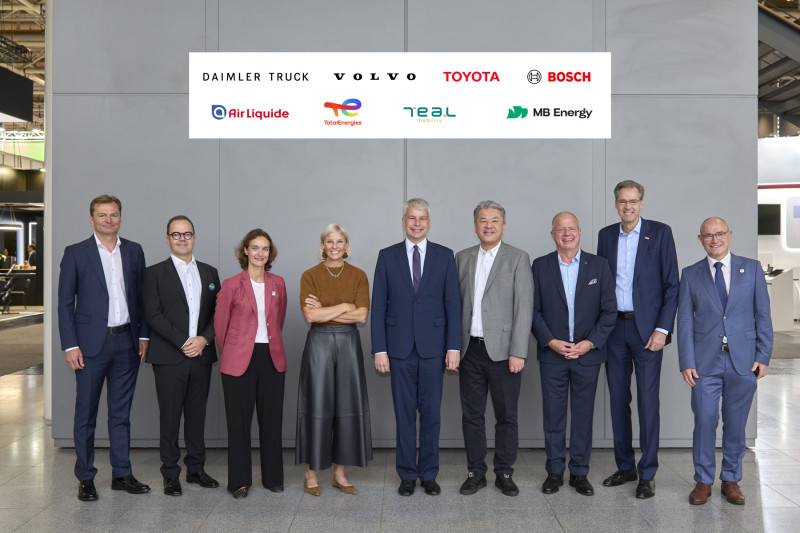
That is why the coalition announced at IAA Transportation by Daimler Truck, Volvo Group, Toyota, Bosch, Air Liquide, TotalEnergies, TEAL Mobility and MB Energy deserves attention. It is not a new vehicle launch. It is a plan to make the vehicle, hydrogen supply and refuelling network arrive together in Germany, then turn that model into a European one by 2030.
The useful shift is one of accountability. The group says it is working toward high-capacity sites able to refuel as many as 100 trucks a day, while Daimler plans a small series of 100 next-generation fuel-cell trucks for customer operation from the end of 2026. Those are intentions, not delivered infrastructure. But they are concrete enough to expose the real question: can hydrogen become a routine fleet tool rather than a specialist demonstration?
What has actually been announced
The companies are splitting the job along the parts that normally fail to line up. Truck makers bring fuel-cell and hydrogen-combustion vehicles; Toyota brings fuel-cell-system experience; Bosch is supplying gaseous-hydrogen components; and the energy and retail partners are meant to build supply and refuelling capacity. TEAL Mobility is the TotalEnergies/Air Liquide joint venture operating under the TotalEnergies brand.
| Announced element | What it is meant to solve | What is still unproven |
|---|---|---|
| Daimler’s 100-truck fuel-cell customer series from late 2026 | Actual operating data beyond prototypes | Route coverage, uptime and fleet economics |
| Stations targeting up to 100 trucks per day | The queue and throughput problem at commercial depots and corridors | Where they will be, how many open, and utilisation |
| Coordinated supply from energy companies | The gap between a truck order and available fuel | Hydrogen availability and delivered price |
| German model with a 2030 European ambition | A repeatable way to join vehicles, pumps and policy | Whether other countries match the incentives and rollout pace |
Volvo and Daimler say recent applications to Germany’s NOW programme were oversubscribed, covering more than 70 high-capacity stations and 800 heavy-duty trucks. That is a signal of commercial interest, not an installed base. It should not be read as 70 operating stations or 800 trucks already on the road.
The pump is the product
For a fleet operator, a fuel-cell truck is only as useful as its refuelling plan. A station that can technically dispense hydrogen but cannot handle a shift change, cope with peak demand or offer a predictable price is not a transport solution. The coalition’s focus on high-throughput stations and diesel-competitive pump pricing is therefore more important than the familiar promise of fast refuelling.
The companies identify three conditions: lower truck cost through incentives and series production, cheaper hydrogen through a competitive supply chain and quota mechanisms, and operating support such as zero-emission toll exemptions. Each one is an external dependency. The announcement does not name a retail hydrogen price, a universal truck price, a corridor map or a binding station-opening schedule.
That caveat keeps the story honest. Hydrogen does not need to win every freight job. Battery-electric trucks already make considerable sense for operations with dependable charging windows and repeatable routes. Hydrogen’s credible territory is more demanding work—long distances, heavy payloads, high utilisation and little spare time—where charging and battery mass may be harder to accommodate. Its case rises or falls on delivered energy, not on the elegance of the powertrain.
Why this matters beyond the trade-show floor
The freight system is easy to overlook because its technology sits upstream of a household purchase. Yet it affects the availability, price and emissions of the things that arrive at warehouses, shops and front doors. A reliable zero-tailpipe-emission option for the awkward routes would matter, even if a battery remains the better answer for many other ones.
Toyota’s own near-term work shows the distinction. Its separate programme with Scania is putting 40 fuel-cell heavy trucks into selected logistics operations from early 2027; as our coverage of that pilot explains, that is a measured operating test rather than a retail-product verdict. This new coalition is the complementary challenge: it tries to make the fuel and station side substantial enough for those fleet tests to become scalable.
H2 MOBILITY’s IAA event also highlighted early logistics users, including an H2 tractor unit from Volvo Trucks making its German IAA debut. That is helpful evidence that the discussion is moving past a boardroom slide, but it is not evidence of mass adoption. The difference between a well-run showcase and a network fleet can be measured in station downtime, queueing, fuel delivery and maintenance contracts.
The bottom line
Europe’s hydrogen-truck effort is becoming more credible because it is finally discussing the unglamorous components in the same sentence as the truck: pump capacity, fuel price and operating incentives. The coalition has not solved them; it has made them its test.
Watch for the first customer trucks, named stations, actual corridor coverage and published fuel economics. Until those appear, this is a serious deployment plan with an appropriately difficult burden of proof—not a reason to declare hydrogen freight inevitable.