
DeepSeek’s newest open-source move is not another clean “new model” launch. That is exactly why it matters.
The company has posted DSpark variants of DeepSeek-V4-Pro and DeepSeek-V4-Flash on Hugging Face, alongside the DeepSpec codebase for training and evaluating speculative-decoding draft models. The model cards are careful about the framing: the DSpark releases are the same V4 checkpoints with an extra speculative-decoding module attached.
That caveat is important. DSpark is not meant to make DeepSeek-V4 smarter. It is meant to make generation cheaper and faster when the serving stack can use speculative decoding well.
What changed
Speculative decoding is a serving trick with a simple idea: use a smaller draft model to propose tokens, then let the larger target model verify them. When the draft guesses well, the target model can accept several tokens at once instead of grinding through every output token in the usual sequence.
DeepSeek’s DeepSpec repository gives developers the full workflow: prepare data, train a draft model against cached target outputs, then evaluate acceptance on benchmarks such as GSM8K, MATH500, AIME25, HumanEval, MBPP, LiveCodeBench, MT-Bench, Alpaca, and Arena-Hard-V2.
| Piece | What DeepSeek published | Why it matters |
|---|---|---|
| DeepSpec | Training and evaluation code for draft models | Lets researchers inspect and reproduce the pipeline instead of only reading a claim. |
| V4-Pro-DSpark | V4-Pro checkpoint with speculative module | Targets the high-capacity 1.6T-parameter V4-Pro model. |
| V4-Flash-DSpark | V4-Flash checkpoint with speculative module | Targets the smaller 284B-parameter V4-Flash model. |
| DSpark paper | Technical description packaged in the official repo | Explains the speculative-decoding approach behind the release. |
The practical promise is lower latency and better throughput. The practical risk is that speculative decoding is workload-sensitive. If the draft model does not match the target model’s next-token behavior closely enough, acceptance drops and the speedup shrinks.
This builds on V4’s bigger efficiency story
DeepSeek-V4 was already an efficiency pitch before DSpark arrived.
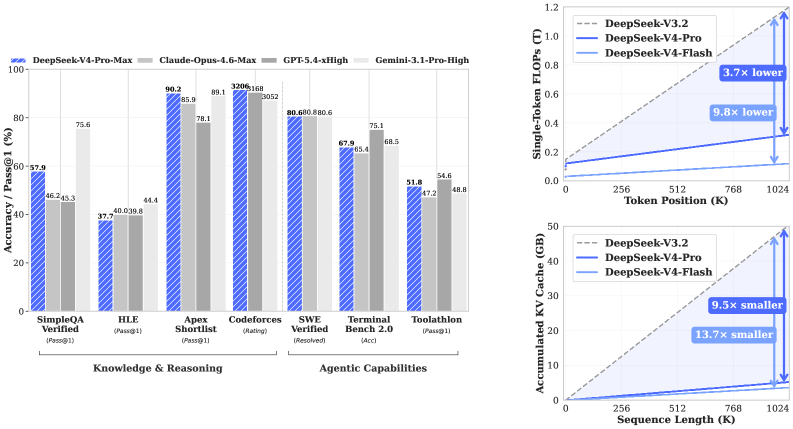
The official V4 technical report describes two Mixture-of-Experts models: V4-Pro with 1.6 trillion total parameters and 49 billion activated parameters, and V4-Flash with 284 billion total parameters and 13 billion activated parameters. Both support a one-million-token context window, according to the report and model cards.
DeepSeek’s headline technical claim is about long-context cost. In a one-million-token context setting, the report says V4-Pro uses 27% of the single-token inference FLOPs and 10% of the KV cache of DeepSeek-V3.2. V4-Flash pushes that lower, with the report listing 10% of FLOPs and 7% of KV cache versus V3.2.
That matters because long context is expensive in two ways: compute and memory. A model can look impressive in benchmark tables and still be awkward to serve if the KV cache becomes too large or the output stream is too slow.
DSpark attacks the second half of that problem.
Why developers should care
For most teams, “open-source model” is not the end of the evaluation. The harder question is whether the model can be served at a price, latency, and reliability level that fits the product.
DeepSeek is trying to answer that at several layers at once:
| Question | V4 answer | DSpark answer |
|---|---|---|
| Can the model handle very long context? | V4 targets one-million-token context. | No direct change; DSpark is about generation. |
| Can memory pressure be reduced? | Hybrid attention cuts KV-cache requirements versus V3.2. | No direct replacement for KV-cache efficiency. |
| Can output generation get faster? | V4 architecture helps, but decoding is still sequential. | Speculative decoding can accept multiple drafted tokens when it works well. |
| Is this a new base model? | Yes, V4-Pro and V4-Flash are the underlying V4 models. | No, the DSpark cards say the checkpoints add a speculative module. |
That distinction keeps the story grounded. DSpark is most interesting for people already considering V4, not for someone looking for a totally separate model family.
The caveats are real
There are several reasons to avoid treating this as a universal speed button.
First, the V4 model cards and report are official DeepSeek materials. They are useful, but they are not a substitute for independent serving tests on real workloads.
Second, speculative decoding depends on deployment details. Batch size, prompt length, hardware, sampling settings, draft-model quality, and target-model behavior can all change the result. A speedup in one benchmark mix does not automatically carry over to a customer-support bot, coding assistant, or long-document agent.
Third, V4 itself is still described as a preview release. SiliconANGLE and Gizchina both framed the original V4 launch around open weights, long context, aggressive efficiency, and pricing pressure. Those are meaningful signals, but production buyers still need to test stability, tool behavior, refusal behavior, multilingual quality, and support maturity.
Bottom line
DeepSeek’s DSpark release is interesting because it moves the V4 conversation away from raw benchmark scorekeeping and toward serving economics.
V4-Pro and V4-Flash already make a big claim: long context with dramatically lower FLOPs and KV-cache pressure than DeepSeek’s prior generation. DSpark adds the next layer by trying to make token generation itself less expensive through speculative decoding.
That does not make it a drop-in win for every AI product. It does make DeepSeek’s open release more useful to teams that care about the full cost of running a model, not just how it scores in a table.